Post-Neutering Care for Male Cats: A 0-14 Day Timeline for Swelling, Urination Monitoring, and Preventing Licking

Male cat neutering incisions typically don't require stitches and heal faster than females. However, scrotal swelling, monitoring urination, and preventing licking are the real priorities. This article provides a day-by-day 0-14 day timeline for care, along with warning signs that require immediate veterinary attention.
CatGarden Editorial TeamPublished 2026/08/20Updated 2026/10/05
Male cat neutering aftercareCat sterilizationPost-operative careCat health
Post-Neutering Care for Male Cats: A 0-14 Day Timeline for Swelling, Urination Monitoring, and Preventing Licking

The core of post-neutering care for male cats boils down to three things: protecting the scrotal incision from licking, ensuring normal urination within 8-12 hours post-op, and restricting jumping activities for 7-10 days. Most male cats' scrotal swelling will significantly subside within 3-7 days. Since the incisions on both sides are usually left unsutched (or with a single stitch), they will appear mostly healed in about 7-10 days, making the overall recovery considerably faster than an abdominal spay for female cats.

We annually board many cats whose owners are traveling right after neutering, and we often have owners bring in cats for grooming after their e-collars have been removed. The following timeline is a compilation of veterinary post-operative instructions and our practical observations from caring for post-surgical cats, designed for you to follow at home.

Key Takeaways

  • Male cat neutering involves closed or open scrotal incisions, most of which are left unsutched. The wound heals through self-contraction, making "no water contact, no licking" even more critical than for female cats.
  • Scrotal swelling peaks 24-72 hours post-surgery, then gradually subsides. It should visibly reduce within 3-7 days. If it continues to enlarge, feel hot, or ooze blood after day 5, it's abnormal and requires a vet visit.
  • Post-surgery, the first urination should occur within 8-12 hours. A complete lack of urination for over 24 hours, or repeated attempts to urinate with only a few drops produced and signs of pain, is an emergency room-level warning sign.
  • E-collars or surgical suits are recommended for continuous wear for 7-10 days. Removing them prematurely because the cat "looks fine" is the most common cause of complications.
  • It takes approximately 4-6 weeks for male cats to have no viable sperm in their ejaculate. Isolation from unneutered female cats is still necessary during this period.

How Does Male Neutering Aftercare Differ from Female Spaying?

Many owners who have both a male and female cat neutered at the same time tend to care for them identically, which is incorrect. The surgical procedures are fundamentally different:

ItemMale Cat (Testicle Removal)Female Cat (Ovariohysterectomy)
Incision LocationSides of the scrotum, one small incision eachMid-abdomen or flank
SuturesOften unsutched or single stitch, usually absorbableRequires suturing, with subcutaneous and skin layers
Incision SizeApprox. 0.5-1 cmApprox. 1.5-4 cm
Primary RisksScrotal swelling, hematoma, licking/infectionInternal bleeding, wound dehiscence, hernia
Recovery PeriodApprox. 7-10 daysApprox. 10-14 days
Activity RestrictionNo strenuous jumping for 7-10 daysStrict restriction for at least 14 days
E-collar Duration7-10 days10-14 days (depending on suture status)

If your female cat also recently had surgery, consider reading our companion article: How to Care for a Female Cat After Spaying? A Complete 0-14 Day Timeline for Incisions, E-collars, Diet, and Activity Restrictions. Simply put: Male cats win in faster recovery, but lose in having unsutched wounds in an area cats are prone to licking.

(As a side note, if you're still trying to determine the sex of your kitten and which surgery is appropriate, you can refer to How to Tell Kitten Gender: 3 Home Observation Points and Common Misidentification Reasons. We've encountered many cases where owners thought they had a female kitten, only to discover it was male at the vet's office.)

Complete Timeline for Male Cat Neutering Aftercare (Days 0-14)

Day 0: The First 12 Hours Home Require the Most Attention

Anesthesia hasn't fully worn off yet. The focus today isn't "wound care" but preventing injury and ensuring physiological functions are recovering.

  • Environment: Confine your cat to a quiet room or large cage with no elevated surfaces. Block off all cat trees, window perches, and cabinets – cats under anesthesia can fall and injure themselves.
  • Thermoregulation: Cats may have low body temperature after anesthesia. Maintain room temperature at 25-27°C (77-81°F) and provide a dry blanket for them to choose whether to use. Cold paws and shivering are normal metabolic processes, but if they persist for over 4 hours, contact your vet.
  • Water: Offer a small amount of water 2-3 hours after returning home, once the cat can stand steadily.
  • Feeding: It's generally recommended to offer 1/3 to 1/2 of their usual portion 4-6 hours after returning home, once you're sure they won't vomit. Don't overfeed them. A reduced appetite on the first night is normal for some cats.
  • First Urination: This is the most crucial thing to record for male cats post-surgery. The goal is to see urine within 8-12 hours of returning home. Lightly line the litter box with litter (about 3 cm or 1.2 inches deep) to easily observe urine volume and color.

> Pro Tip: For the first few days post-surgery, we switch to low-sided, open litter boxes to make it easier for the cat to step in without lifting their legs. If you normally use a covered box, temporarily remove the lid. Ventilation and ease of observation are more important than odor control during this period. You can refer to Covered vs. Open Litter Box: Odor, Heat, and Acceptance for a comparison.

Days 1-3: Peak Swelling Period - Don't Be Alarmed by Enlargement

This is the stage where most owners call, asking, "Did it fail? Why is it bigger than before surgery?"

  • Scrotal swelling peaks within 24-72 hours due to inflammatory fluid and a small amount of blood accumulating in the empty scrotal sac. It's considered normal if it feels slightly warm to the touch and the cat doesn't strongly resist being touched.
  • Slight oozing is normal: pale pink or yellow, minimal amount, drying into a thin crust.
  • Complete the pain medication course: Many owners stop pain medication once the cat appears active. Insufficient pain control can lead the cat to lick the wound. Administer oral pain relievers (commonly NSAIDs or opioids) as prescribed. Never give human painkillers (like acetaminophen or ibuprofen) as they are toxic to cats.
  • Do not apply ointments or rinse with iodine unless specifically instructed by your vet. Unsutched incisions heal best when kept dry; applying substances can delay healing.
  • No water contact: Do not bathe or use wet wipes near the wound. If the cat's hindquarters get dirty during this period, use a dry towel or a Quick-Dry Pet Towel for local dry cleaning, avoiding the scrotal area.

Days 4-7: Swelling Reduction Observation Period

  • The normal progression is for the swelling to be slightly smaller each day. By day 7, it should be close to its normal size (some cats may have loose scrotal skin that gradually tightens).
  • Appetite, energy levels, and playfulness usually return fully by days 3-4 – this is the most dangerous time as the cat starts wanting to jump and run, potentially removing the e-collar.
  • Activity must still be restricted: No jumping on high surfaces, no running up and down stairs, no vertical leaps for wand toys. Opt for slow-paced floor play or scent games.

Days 8-14: Returning to Normalcy, But Don't Rush

  • Most male cats can have their e-collar removed around days 7-10 (or as advised by your vet if sutures were used).
  • Bathing is recommended only after 14 days post-surgery and once the wound is completely dry and closed. If long-haired cats require cleaning, opt for localized dry shampooing or washing only the front half. When booking grooming appointments, we always ask for the surgery date; if it's less than two weeks prior, we'll suggest postponing or performing only partial care. You can Book a Grooming Appointment to discuss scheduling.
  • Fertility: Surgery does not mean immediate sterilization. Viable sperm may still be present for 4-6 weeks post-surgery, so continue to isolate from unneutered female cats.
  • Behavioral changes are not immediate: Reduced spraying, yowling, or fighting typically takes 1-3 months. Older cats with deeply ingrained behaviors may take longer.

Urination Monitoring: The Non-Negotiable Post-Neutering Task for Male Cats

Male cats already have narrower urinary tracts than females. Any post-operative stress, pain, or insufficient water intake can lead to urination problems. During boarding, we meticulously record urination for all post-surgical cats.

What Normal Urination Looks Like

  • 2-4 urinations within 24 hours; urine clumps are similar in size to normal (approx. 4-6 cm or 1.5-2.5 inches diameter for adult cats).
  • Color ranges from pale yellow to yellow, without blood.
  • The cat squats in the litter box, finishes within 10-20 seconds, and does not repeatedly return to squat after leaving.

Warning Signs to Watch For

  • No urination for over 24 hours post-surgery.
  • Repeatedly entering and exiting the litter box, squatting for a long time but producing only a few drops, or crying during urination.
  • Blood in the urine (pale red, pink, or with blood streaks).
  • Urinating outside the litter box, such as on bathroom tiles – this is often a sign of pain or discomfort.
  • Excessive licking of the genital area, a hard or tense abdomen, or refusal to allow palpation of the lower abdomen.

Urinary blockage is an emergency in male cats. Delaying treatment for 24-48 hours can cause kidney damage or be fatal. Seek immediate emergency veterinary care; do not wait for the next day's appointment.

Also, pay attention to adequate water intake. When cats are less active and feeling unwell post-surgery, they often forget to drink. Place an extra water bowl near their resting area, switch to wet food, or add water to their kibble. For methods to check for dehydration, refer to How to Check for Cat Dehydration: Skin Elasticity, Oral Mucosa, and Water Intake - 3 Home Checks. Using a high-moisture food like our Tuna & Scallop Feast with Vitamins mixed with warm water is usually more effective than forcing plain water.

If your cat is constantly digging in the litter box without producing anything, don't dismiss it as just behavioral. Refer to Cat Constantly Digging in Litter Box? for diagnostic methods. During the post-operative period, prioritize ruling out urination issues.

Preventing Licking: Choosing and Wearing E-collars and Surgical Suits

Failure to prevent licking is the most common source of complications in post-neutering care for male cats. Licking can repeatedly tear open unsutched incisions and introduce bacteria from the tongue, leading to scrotal cellulitis or abscesses, essentially negating the surgery.

Practical Pros and Cons of Three Types of Protection

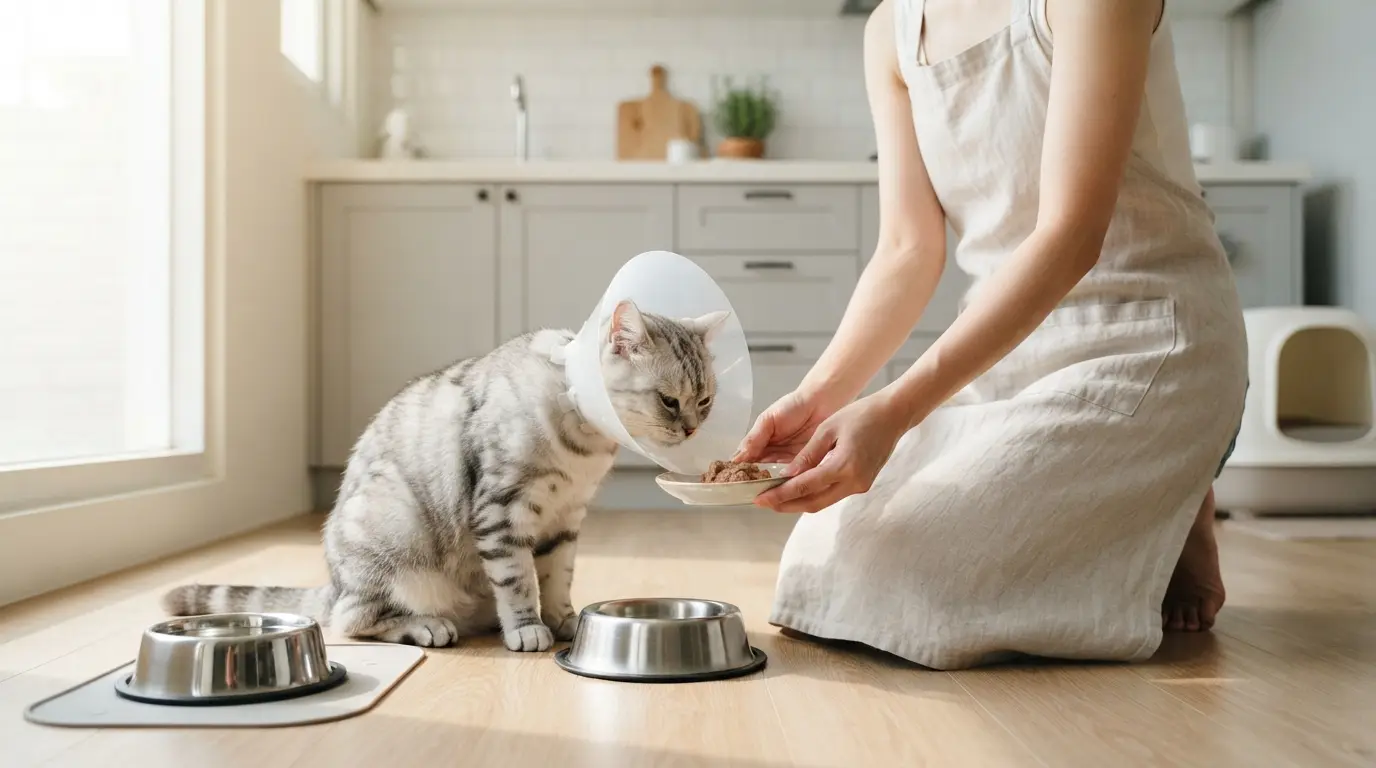
  • Hard Plastic Elizabethan Collar (E-collar): Provides the most thorough protection but hinders eating, drinking, and walking, and can cause collisions. Suitable for cats with a strong urge to lick.
  • Soft/Fabric Donut Collar: More comfortable and better for sleeping, but cats with short necks or high flexibility can still reach the scrotum. Test this type thoroughly: Observe for 10 minutes after putting it on to see if the cat can reach their inner thighs by lowering their head.
  • Surgical Suit (Bodysuit, Four-Legged Pants): Very effective for female cats' abdominal incisions. However, for male cats, the scrotum is in the rear, and needs ventilation and dryness. Covering it can lead to a damp, stuffy environment and urine contamination. E-collars are generally recommended over full-body suits for male cats.

Practical Advice

  • Wear continuously for 7-10 days. Do not take "breaks". The 8 hours you are at work are enough for your cat to lick the incision open.
  • E-collar fit: It should be loose enough to fit one to two fingers between the collar and the neck, but not so loose that it can slip off or so tight that it constricts the throat.
  • During e-collar wear, raise food and water bowls 5-8 cm (2-3 inches) or use shallow dishes, otherwise, the cat may not be able to eat, leading to decreased appetite.
  • If the cat completely stops eating or drinking for over 24 hours due to the e-collar, contact your vet to discuss alternative options; don't force it.
  • Check the e-collar edges daily for any skin irritation or abrasions on the neck.

5 Daily Metrics to Record

Use your phone's notes app or a piece of paper taped to the refrigerator. Record these five items daily; your vet will appreciate it during follow-up visits:

1. Food Intake: What percentage did they eat? From day 2 onwards, they should be eating at least 70% of their usual amount.

2. Urination Frequency and Urine Clump Size.

3. Bowel Movements: Anesthesia and pain medication can cause constipation. A bowel movement should occur within 48-72 hours post-surgery. Report if there's no movement after 3 days.

4. Scrotal Swelling Level: Take a daily photo from the same angle and distance with your phone; this is much more accurate than subjective "feelings."

5. Mental State and Temperature Sensation: Ears and paws are abnormally hot, combined with hiding, lethargy, and rapid breathing, may indicate a fever. For guidance on assessing temperature and dangerous levels, refer to What to Do If Your Cat Has a Fever? Normal Temperature, How to Measure, and Danger Signs Explained.

Situations Requiring Immediate Veterinary Visit or Emergency Care

  • Scrotal swelling continues to enlarge after day 5, feels hot to the touch, skin turns purplish-black, or there's foul-smelling pus.
  • The wound continuously bleeds (not just slight blood-tinged fluid), with blood staining fur in patches.
  • No urination for over 24 hours, or difficulty urinating accompanied by crying.
  • Vomiting twice or more consecutively, or complete lack of appetite for over 24 hours.
  • Extreme lethargy, pale gums or ear canals, rapid breathing (over 40 breaths/minute at rest).
  • Wound dehiscence, exposing subcutaneous tissue.

There is no room for "wait and see" with these symptoms, especially urinary issues and significant bleeding.

What If You Have to Travel During the First Two Weeks Post-Op?

Honestly, the ideal approach is to schedule the surgery so it doesn't conflict with your travel plans. Ideally, the cat should be at home for the first 0-7 days post-op, where someone can monitor urination and the e-collar status at all times.

If travel is unavoidable, provide the caregiver with: surgery date, veterinary clinic contact information and patient ID, current medications and schedule, planned e-collar removal date, and the daily observation checklist. When we board post-surgical cats, they are housed separately, we record the number of urine clumps with each litter box cleaning, and we confirm post-op instructions with the original veterinary clinic. For a comparison of in-home care versus boarding, see How to Arrange Cat Care During the Mid-Autumn Festival Holiday: In-Home Sitting, Pet Sitters, and Boarding Options, or directly Book Boarding to discuss post-operative care arrangements.

Frequently Asked Questions

How long does swelling last after male cat neutering?

Scrotal swelling is typically most noticeable 24-72 hours post-surgery, then gradually reduces. It should visibly subside within 3-7 days, returning to a stable appearance in about 10-14 days. If swelling continues to increase, feels hot, or produces pus after day 5, consult your vet to rule out hematoma or infection.

Does the incision need medication or disinfection after male cat neutering?

In most cases, no. Male cat scrotal incisions are often left unsutched and heal through drying and contraction. Applying iodine, ointments, or using wet wipes can delay healing and increase infection risk. Always follow your veterinarian's specific instructions.

Is the e-collar absolutely necessary? Can it only be worn when I'm not home?

It is strongly recommended to wear the e-collar continuously for 7-10 days. Licking only takes a few minutes to tear open an unsutched wound. The practice of removing it when supervised has a high failure rate in our experience. If your cat completely stops eating or drinking for over 24 hours due to the e-collar, discuss alternative options with your vet.

How soon can a male cat be bathed after neutering?

Bathing is recommended 14 days post-surgery, once the wound is completely dry and closed. During this period, if the fur is soiled, perform localized dry cleaning, avoiding the scrotal area. For long-haired cats with severe matting, gentle brushing that avoids the surgical site may be necessary.

How long does it take for spraying and yowling to stop after neutering?

It takes 4-6 weeks for hormone levels to decrease significantly. Spraying, yowling, and roaming behaviors typically reduce gradually within 1-3 months. Older male cats with established habits may retain some spraying behavior, which requires environmental management.


Finally, a candid remark: While aftercare for male cat neutering is indeed less demanding than for females, its "seemingly easy" nature is precisely what leads to problems – owner complacency, premature e-collar removal, and neglecting urination monitoring. Diligently tracking the five metrics mentioned above for 10 days will ensure a smooth recovery.

If any symptoms worsen or you are uncertain about your cat's condition, always prioritize your veterinarian's judgment. Seeking prompt medical attention is always safer than observing at home.

Article by CatGarden Editorial Team

CatGarden offers curated supplies, cat boarding, and grooming

Book services or shop online.
Back

Blog

Post-Neutering Care for Male Cats: A 0-14 Day Timeline for Swelling, Urination Monitoring, and Preventing Licking

CatGarden Editorial TeamPublished 2026/08/20Updated 2026/10/05
Male cat neutering aftercareCat sterilizationPost-operative careCat health
Post-Neutering Care for Male Cats: A 0-14 Day Timeline for Swelling, Urination Monitoring, and Preventing Licking

The core of post-neutering care for male cats boils down to three things: protecting the scrotal incision from licking, ensuring normal urination within 8-12 hours post-op, and restricting jumping activities for 7-10 days. Most male cats' scrotal swelling will significantly subside within 3-7 days. Since the incisions on both sides are usually left unsutched (or with a single stitch), they will appear mostly healed in about 7-10 days, making the overall recovery considerably faster than an abdominal spay for female cats.

We annually board many cats whose owners are traveling right after neutering, and we often have owners bring in cats for grooming after their e-collars have been removed. The following timeline is a compilation of veterinary post-operative instructions and our practical observations from caring for post-surgical cats, designed for you to follow at home.

Key Takeaways

  • Male cat neutering involves closed or open scrotal incisions, most of which are left unsutched. The wound heals through self-contraction, making "no water contact, no licking" even more critical than for female cats.
  • Scrotal swelling peaks 24-72 hours post-surgery, then gradually subsides. It should visibly reduce within 3-7 days. If it continues to enlarge, feel hot, or ooze blood after day 5, it's abnormal and requires a vet visit.
  • Post-surgery, the first urination should occur within 8-12 hours. A complete lack of urination for over 24 hours, or repeated attempts to urinate with only a few drops produced and signs of pain, is an emergency room-level warning sign.
  • E-collars or surgical suits are recommended for continuous wear for 7-10 days. Removing them prematurely because the cat "looks fine" is the most common cause of complications.
  • It takes approximately 4-6 weeks for male cats to have no viable sperm in their ejaculate. Isolation from unneutered female cats is still necessary during this period.

How Does Male Neutering Aftercare Differ from Female Spaying?

Many owners who have both a male and female cat neutered at the same time tend to care for them identically, which is incorrect. The surgical procedures are fundamentally different:

ItemMale Cat (Testicle Removal)Female Cat (Ovariohysterectomy)
Incision LocationSides of the scrotum, one small incision eachMid-abdomen or flank
SuturesOften unsutched or single stitch, usually absorbableRequires suturing, with subcutaneous and skin layers
Incision SizeApprox. 0.5-1 cmApprox. 1.5-4 cm
Primary RisksScrotal swelling, hematoma, licking/infectionInternal bleeding, wound dehiscence, hernia
Recovery PeriodApprox. 7-10 daysApprox. 10-14 days
Activity RestrictionNo strenuous jumping for 7-10 daysStrict restriction for at least 14 days
E-collar Duration7-10 days10-14 days (depending on suture status)

If your female cat also recently had surgery, consider reading our companion article: How to Care for a Female Cat After Spaying? A Complete 0-14 Day Timeline for Incisions, E-collars, Diet, and Activity Restrictions. Simply put: Male cats win in faster recovery, but lose in having unsutched wounds in an area cats are prone to licking.

(As a side note, if you're still trying to determine the sex of your kitten and which surgery is appropriate, you can refer to How to Tell Kitten Gender: 3 Home Observation Points and Common Misidentification Reasons. We've encountered many cases where owners thought they had a female kitten, only to discover it was male at the vet's office.)

Complete Timeline for Male Cat Neutering Aftercare (Days 0-14)

Day 0: The First 12 Hours Home Require the Most Attention

Anesthesia hasn't fully worn off yet. The focus today isn't "wound care" but preventing injury and ensuring physiological functions are recovering.

  • Environment: Confine your cat to a quiet room or large cage with no elevated surfaces. Block off all cat trees, window perches, and cabinets – cats under anesthesia can fall and injure themselves.
  • Thermoregulation: Cats may have low body temperature after anesthesia. Maintain room temperature at 25-27°C (77-81°F) and provide a dry blanket for them to choose whether to use. Cold paws and shivering are normal metabolic processes, but if they persist for over 4 hours, contact your vet.
  • Water: Offer a small amount of water 2-3 hours after returning home, once the cat can stand steadily.
  • Feeding: It's generally recommended to offer 1/3 to 1/2 of their usual portion 4-6 hours after returning home, once you're sure they won't vomit. Don't overfeed them. A reduced appetite on the first night is normal for some cats.
  • First Urination: This is the most crucial thing to record for male cats post-surgery. The goal is to see urine within 8-12 hours of returning home. Lightly line the litter box with litter (about 3 cm or 1.2 inches deep) to easily observe urine volume and color.

> Pro Tip: For the first few days post-surgery, we switch to low-sided, open litter boxes to make it easier for the cat to step in without lifting their legs. If you normally use a covered box, temporarily remove the lid. Ventilation and ease of observation are more important than odor control during this period. You can refer to Covered vs. Open Litter Box: Odor, Heat, and Acceptance for a comparison.

Days 1-3: Peak Swelling Period - Don't Be Alarmed by Enlargement

This is the stage where most owners call, asking, "Did it fail? Why is it bigger than before surgery?"

  • Scrotal swelling peaks within 24-72 hours due to inflammatory fluid and a small amount of blood accumulating in the empty scrotal sac. It's considered normal if it feels slightly warm to the touch and the cat doesn't strongly resist being touched.
  • Slight oozing is normal: pale pink or yellow, minimal amount, drying into a thin crust.
  • Complete the pain medication course: Many owners stop pain medication once the cat appears active. Insufficient pain control can lead the cat to lick the wound. Administer oral pain relievers (commonly NSAIDs or opioids) as prescribed. Never give human painkillers (like acetaminophen or ibuprofen) as they are toxic to cats.
  • Do not apply ointments or rinse with iodine unless specifically instructed by your vet. Unsutched incisions heal best when kept dry; applying substances can delay healing.
  • No water contact: Do not bathe or use wet wipes near the wound. If the cat's hindquarters get dirty during this period, use a dry towel or a Quick-Dry Pet Towel for local dry cleaning, avoiding the scrotal area.

Days 4-7: Swelling Reduction Observation Period

  • The normal progression is for the swelling to be slightly smaller each day. By day 7, it should be close to its normal size (some cats may have loose scrotal skin that gradually tightens).
  • Appetite, energy levels, and playfulness usually return fully by days 3-4 – this is the most dangerous time as the cat starts wanting to jump and run, potentially removing the e-collar.
  • Activity must still be restricted: No jumping on high surfaces, no running up and down stairs, no vertical leaps for wand toys. Opt for slow-paced floor play or scent games.

Days 8-14: Returning to Normalcy, But Don't Rush

  • Most male cats can have their e-collar removed around days 7-10 (or as advised by your vet if sutures were used).
  • Bathing is recommended only after 14 days post-surgery and once the wound is completely dry and closed. If long-haired cats require cleaning, opt for localized dry shampooing or washing only the front half. When booking grooming appointments, we always ask for the surgery date; if it's less than two weeks prior, we'll suggest postponing or performing only partial care. You can Book a Grooming Appointment to discuss scheduling.
  • Fertility: Surgery does not mean immediate sterilization. Viable sperm may still be present for 4-6 weeks post-surgery, so continue to isolate from unneutered female cats.
  • Behavioral changes are not immediate: Reduced spraying, yowling, or fighting typically takes 1-3 months. Older cats with deeply ingrained behaviors may take longer.

Urination Monitoring: The Non-Negotiable Post-Neutering Task for Male Cats

Male cats already have narrower urinary tracts than females. Any post-operative stress, pain, or insufficient water intake can lead to urination problems. During boarding, we meticulously record urination for all post-surgical cats.

What Normal Urination Looks Like

  • 2-4 urinations within 24 hours; urine clumps are similar in size to normal (approx. 4-6 cm or 1.5-2.5 inches diameter for adult cats).
  • Color ranges from pale yellow to yellow, without blood.
  • The cat squats in the litter box, finishes within 10-20 seconds, and does not repeatedly return to squat after leaving.

Warning Signs to Watch For

  • No urination for over 24 hours post-surgery.
  • Repeatedly entering and exiting the litter box, squatting for a long time but producing only a few drops, or crying during urination.
  • Blood in the urine (pale red, pink, or with blood streaks).
  • Urinating outside the litter box, such as on bathroom tiles – this is often a sign of pain or discomfort.
  • Excessive licking of the genital area, a hard or tense abdomen, or refusal to allow palpation of the lower abdomen.

Urinary blockage is an emergency in male cats. Delaying treatment for 24-48 hours can cause kidney damage or be fatal. Seek immediate emergency veterinary care; do not wait for the next day's appointment.

Also, pay attention to adequate water intake. When cats are less active and feeling unwell post-surgery, they often forget to drink. Place an extra water bowl near their resting area, switch to wet food, or add water to their kibble. For methods to check for dehydration, refer to How to Check for Cat Dehydration: Skin Elasticity, Oral Mucosa, and Water Intake - 3 Home Checks. Using a high-moisture food like our Tuna & Scallop Feast with Vitamins mixed with warm water is usually more effective than forcing plain water.

If your cat is constantly digging in the litter box without producing anything, don't dismiss it as just behavioral. Refer to Cat Constantly Digging in Litter Box? for diagnostic methods. During the post-operative period, prioritize ruling out urination issues.

Preventing Licking: Choosing and Wearing E-collars and Surgical Suits

Failure to prevent licking is the most common source of complications in post-neutering care for male cats. Licking can repeatedly tear open unsutched incisions and introduce bacteria from the tongue, leading to scrotal cellulitis or abscesses, essentially negating the surgery.

Practical Pros and Cons of Three Types of Protection

  • Hard Plastic Elizabethan Collar (E-collar): Provides the most thorough protection but hinders eating, drinking, and walking, and can cause collisions. Suitable for cats with a strong urge to lick.
  • Soft/Fabric Donut Collar: More comfortable and better for sleeping, but cats with short necks or high flexibility can still reach the scrotum. Test this type thoroughly: Observe for 10 minutes after putting it on to see if the cat can reach their inner thighs by lowering their head.
  • Surgical Suit (Bodysuit, Four-Legged Pants): Very effective for female cats' abdominal incisions. However, for male cats, the scrotum is in the rear, and needs ventilation and dryness. Covering it can lead to a damp, stuffy environment and urine contamination. E-collars are generally recommended over full-body suits for male cats.

Practical Advice

  • Wear continuously for 7-10 days. Do not take "breaks". The 8 hours you are at work are enough for your cat to lick the incision open.
  • E-collar fit: It should be loose enough to fit one to two fingers between the collar and the neck, but not so loose that it can slip off or so tight that it constricts the throat.
  • During e-collar wear, raise food and water bowls 5-8 cm (2-3 inches) or use shallow dishes, otherwise, the cat may not be able to eat, leading to decreased appetite.
  • If the cat completely stops eating or drinking for over 24 hours due to the e-collar, contact your vet to discuss alternative options; don't force it.
  • Check the e-collar edges daily for any skin irritation or abrasions on the neck.

5 Daily Metrics to Record

Use your phone's notes app or a piece of paper taped to the refrigerator. Record these five items daily; your vet will appreciate it during follow-up visits:

1. Food Intake: What percentage did they eat? From day 2 onwards, they should be eating at least 70% of their usual amount.

2. Urination Frequency and Urine Clump Size.

3. Bowel Movements: Anesthesia and pain medication can cause constipation. A bowel movement should occur within 48-72 hours post-surgery. Report if there's no movement after 3 days.

4. Scrotal Swelling Level: Take a daily photo from the same angle and distance with your phone; this is much more accurate than subjective "feelings."

5. Mental State and Temperature Sensation: Ears and paws are abnormally hot, combined with hiding, lethargy, and rapid breathing, may indicate a fever. For guidance on assessing temperature and dangerous levels, refer to What to Do If Your Cat Has a Fever? Normal Temperature, How to Measure, and Danger Signs Explained.

Situations Requiring Immediate Veterinary Visit or Emergency Care

  • Scrotal swelling continues to enlarge after day 5, feels hot to the touch, skin turns purplish-black, or there's foul-smelling pus.
  • The wound continuously bleeds (not just slight blood-tinged fluid), with blood staining fur in patches.
  • No urination for over 24 hours, or difficulty urinating accompanied by crying.
  • Vomiting twice or more consecutively, or complete lack of appetite for over 24 hours.
  • Extreme lethargy, pale gums or ear canals, rapid breathing (over 40 breaths/minute at rest).
  • Wound dehiscence, exposing subcutaneous tissue.

There is no room for "wait and see" with these symptoms, especially urinary issues and significant bleeding.

What If You Have to Travel During the First Two Weeks Post-Op?

Honestly, the ideal approach is to schedule the surgery so it doesn't conflict with your travel plans. Ideally, the cat should be at home for the first 0-7 days post-op, where someone can monitor urination and the e-collar status at all times.

If travel is unavoidable, provide the caregiver with: surgery date, veterinary clinic contact information and patient ID, current medications and schedule, planned e-collar removal date, and the daily observation checklist. When we board post-surgical cats, they are housed separately, we record the number of urine clumps with each litter box cleaning, and we confirm post-op instructions with the original veterinary clinic. For a comparison of in-home care versus boarding, see How to Arrange Cat Care During the Mid-Autumn Festival Holiday: In-Home Sitting, Pet Sitters, and Boarding Options, or directly Book Boarding to discuss post-operative care arrangements.

Frequently Asked Questions

How long does swelling last after male cat neutering?

Scrotal swelling is typically most noticeable 24-72 hours post-surgery, then gradually reduces. It should visibly subside within 3-7 days, returning to a stable appearance in about 10-14 days. If swelling continues to increase, feels hot, or produces pus after day 5, consult your vet to rule out hematoma or infection.

Does the incision need medication or disinfection after male cat neutering?

In most cases, no. Male cat scrotal incisions are often left unsutched and heal through drying and contraction. Applying iodine, ointments, or using wet wipes can delay healing and increase infection risk. Always follow your veterinarian's specific instructions.

Is the e-collar absolutely necessary? Can it only be worn when I'm not home?

It is strongly recommended to wear the e-collar continuously for 7-10 days. Licking only takes a few minutes to tear open an unsutched wound. The practice of removing it when supervised has a high failure rate in our experience. If your cat completely stops eating or drinking for over 24 hours due to the e-collar, discuss alternative options with your vet.

How soon can a male cat be bathed after neutering?

Bathing is recommended 14 days post-surgery, once the wound is completely dry and closed. During this period, if the fur is soiled, perform localized dry cleaning, avoiding the scrotal area. For long-haired cats with severe matting, gentle brushing that avoids the surgical site may be necessary.

How long does it take for spraying and yowling to stop after neutering?

It takes 4-6 weeks for hormone levels to decrease significantly. Spraying, yowling, and roaming behaviors typically reduce gradually within 1-3 months. Older male cats with established habits may retain some spraying behavior, which requires environmental management.


Finally, a candid remark: While aftercare for male cat neutering is indeed less demanding than for females, its "seemingly easy" nature is precisely what leads to problems – owner complacency, premature e-collar removal, and neglecting urination monitoring. Diligently tracking the five metrics mentioned above for 10 days will ensure a smooth recovery.

If any symptoms worsen or you are uncertain about your cat's condition, always prioritize your veterinarian's judgment. Seeking prompt medical attention is always safer than observing at home.

Article by CatGarden Editorial Team

One email a month of cat-care tips

Hand-picked care, behavior and grooming tips once a month. Subscribe and we will send you our three most-read articles right away.

Keep reading