How Long Can Cat Food Be Stored After Opening? Taiwan Summer Humidity, Food Storage Containers, and Spoilage Detection Explained

For dry cat food opened in Taiwan's summer, it's recommended to finish it within 3-4 weeks. You can determine if it's still good to feed using a three-step method: check the number of days since opening, smell for rancidity, and feel the kibble's texture. This article covers portioning methods, the difference between oxygen absorbers and desiccants, key considerations for choosing food storage containers, and how to handle spoiled food that causes soft stools.
CatGarden Editorial TeamPublished 2026/08/11Updated 2026/10/06
cat food storagefood container recommendationscat food humiditycat food spoilagesummer cat care
How Long Can Cat Food Be Stored After Opening? Taiwan Summer Humidity, Food Storage Containers, and Spoilage Detection Explained

How long can cat food be stored after opening? In Taiwan's summer months (June-September), it's generally recommended to finish dry cat food within "3-4 weeks of opening." In cooler, drier autumn and winter conditions, this can be extended to 5-6 weeks. Beyond this timeframe, even if no mold is visible, the fats will have oxidized, affecting palatability and potentially causing digestive upset. Before discarding, you can use a practical three-step method to determine if it's still safe to feed: first, check the number of days since opening; second, smell for any rancid odor; and finally, feel the kibble's texture to see if it has become soft and sticky.

At our facility, we handle food brought in by over a dozen boarding cats daily. The most common issue we encounter isn't "wrongly chosen food" but "poor storage." Owners often buy large 5kg bags during sales and continue feeding them into the fifth week after opening. The cats then become picky eaters, followed by soft stools. Switching brands seems to fix the problem, but it's not the brand itself; it's that the food has been stored for too long in Taiwan's humid and hot air.

Key Takeaways

  • For dry cat food opened in Taiwan's summer (room temperature above 28°C, humidity above 70%), it's recommended to finish within 3-4 weeks. In cooler autumn and winter environments, this can be extended to 5-6 weeks.
  • The rate of fat oxidation increases significantly with temperature. The same bag of food stored in a 30°C kitchen will go stale twice as fast as one stored in a 22°C air-conditioned room.
  • To determine if food has spoiled, check three things: opened for over 4 weeks, a rancid smell (like old nuts or a used deep fryer), or the kibble surface feeling soft, sticky, or forming clumps of powder. If any of these are true, do not feed it.
  • An average 4-5kg adult cat eats about 50-65 grams of dry food per day, totaling 1.5-2kg per month. Buying 1.5-2kg bags is safer than buying large 5kg bags.
  • The correct method is to "roll and seal the original bag and place it inside an opaque, airtight container," not to pour the food directly into the container. The container should be thoroughly washed and completely dried before each new bag of food is added.
  • Canned/wet food is safest if consumed within 24 hours of opening and refrigerating. If left in a bowl at room temperature for more than 30-60 minutes, it should be discarded.

"How Long Can It Last?" Depends on Three Variables

The expiration date on the food bag refers to the unopened product. The clock starts ticking the moment it's opened. How long it actually lasts depends on these three factors:

1. Packaging Type and How Well It's Resealed

Bags with zippers are the easiest to manage. For those with heat-sealed closures, after opening, roll the bag down three folds and secure it tightly with a binder clip or sealing clip, squeezing out as much air as possible. Food left with a large opening and loosely folded bag will noticeably lose its flavor within two weeks.

2. Fat Content and Antioxidant Design

Foods high in fat, high in meat content, or advertised as having "added oil for palatability" smell great but oxidize quickly. Formulas emphasizing natural antioxidants (like Vitamin E and rosemary extract) have a milder antioxidant effect than synthetic ones, meaning you need to be stricter about the opening date. Kitten food and high-protein, grain-free formulas generally fall into the "finish quickly" category.

3. Your Home Environment (The Most Crucial Factor in Taiwan)

Taiwan's summer indoor humidity often reaches 75-85%. If food is stored in a ventilated kitchen or balcony, it will continuously absorb moisture from the air. Dry food naturally contains only 8-10% moisture. Once it absorbs moisture to over 12%, it enters the range where mold can easily grow. This is why "the same bag of food can last a month in an air-conditioned home but develop a strange smell within two weeks in a home without air conditioning." Incidentally, controlling indoor temperature and humidity in the summer not only affects the food but also directly impacts your cat's comfort. You can refer to our article on Do Cats Fear Heat? Understanding Their Heat Tolerance, Cooling Methods, and When to Use Air Conditioning in Taiwan.

Three-Step Detection Method: Days Opened → Smell → Kibble Texture

These are the three steps we actually take at our facility when receiving food brought in by boarding cats. They allow for a quick assessment within 30 seconds.

Step 1: Check the Days Since Opening (Please Write the Date!)

On the day of opening, use a permanent marker to write "8/2 Open" on the bag, or attach a label. This is the cheapest and most effective trick. Assessment criteria:

  • 0-3 Weeks: Normal, feed with confidence.
  • 3-4 Weeks: Reasonable upper limit. You can continue feeding but should smell it daily.
  • Over 4 Weeks (Summer): Even without an off-smell, palatability and fat-soluble vitamins have decreased. It's recommended to stop feeding and not force yourself to finish it.

Step 2: Smell for "Rancid Odor"

Fresh dry food has a scent of baked meat, grains, and a hint of oil. Spoiled food smells like:

  • Rancid Odor: Like old nuts, a used deep fryer, or old crayons – this is the most typical smell of fat oxidation (rancidity). If present, do not feed.
  • Musty Moldy Smell/Earthy Smell: Indicates moisture absorption and mold activity. Discard the entire bag; don't just pick out suspicious pieces.
  • Overall Faint Smell, Almost No Aroma: Not necessarily spoiled, but the loss of aroma can lead to picky eating.

Tip: Take a small handful, cup it in your palm, rub it gently to warm it up, then bring it closer to smell. The aroma will be much more noticeable than just sticking your nose into the bag.

Step 3: Feel the Kibble Texture

This step is often overlooked but is very accurate:

  • Normal: Dry, hard, crisp. It breaks cleanly when pinched, leaving only a faint powder on your fingers.
  • Slightly Stale: It can be pinched but isn't crisp, like old crackers. Your fingers feel slightly sticky after touching it.
  • Noticeably Stale: The kibble surface is oily and sticky. Your fingers will pick up an oily film. The powder at the bottom of the bag forms clumps, or a few pieces stick together.
  • Dangerous: White, green, or grayish-black fuzzy spots appear, or the food clumps together into a solid mass. Discard the entire bag immediately, and wash and dry the container thoroughly.

What Happens If a Cat Eats Stale or Spoiled Food?

The most common reactions seen in clinics are gastrointestinal issues: soft stools, foul-smelling stool, increased frequency of defecation, vomiting, and excessive gas. Some cats will simply "refuse to eat" – they can detect the rancid odor, which is far more sensitive than humans. So, if your cat suddenly loses interest in food it's been eating for a long time, first check the food's freshness, then consider picky eating. This behavioral change is often misunderstood. You can compare it with Is Your Cat Constantly Crying at the Food Bowl Because They're Hungry? Distinguish Between Begging, Mealtime, or Habitual Behavior.

More serious risks include mycotoxins (like aflatoxins), which primarily damage the liver. Symptoms include lethargy, decreased appetite, vomiting, and jaundice (yellowish gums or skin inside the ears). This is not a situation to manage at home: If your cat experiences continuous vomiting for over 24 hours, refuses to eat for over 24 hours, shows lethargy, or has jaundice, seek veterinary attention immediately. Bring the food bag (including the batch number) with you.

For short-term mild soft stools, besides immediately stopping the questionable food and switching back to a fresh bag, you can also use specialized probiotics to help stabilize the gut for a few days. However, if it doesn't improve within three days, or if there's blood in the stool or signs of dehydration, don't try to manage it yourself. For a more comprehensive understanding of foods that are inherently risky, refer to the series main article What Foods Are Toxic to Cats? Common Household Dangers and Poisoning Symptoms.

Cat Food Portioning: The Correct Method is "Original Bag + Container"

Many people buy beautiful food containers and immediately pour the entire bag of food into them, discarding the original bag. This is actually the most moisture-prone method because the inner lining of food bags typically has an aluminum or oxygen-barrier coating, offering better moisture and oxygen resistance than most plastic containers.

Our Recommended Method:

1. Roll and Seal the Original Bag: Keep the food in its original bag. Squeeze out the air, roll the opening down three folds, and secure it tightly with a sealing clip. Then, place the sealed bag inside the storage container. The container protects from light, insects, and crushing; the bag provides oxygen and moisture barrier.

2. Portion for One Week: If you can only buy large bags, portion them out on the day of opening. Use resealable bags or vacuum-seal bags to divide the food into 5-7 day portions (about 350-450 grams per bag for an adult cat). Place one oxygen absorber in each bag. Only open the bag for the current week's consumption. This minimizes the number of times the main bag is opened, significantly reducing oxidation risk.

3. Pour Daily Portions into a Small Container: The small container you scoop from daily should hold enough food for 3-5 days. Wash and completely dry it after each use before refilling. Old crumbs and oils at the bottom of the container are sources of off-odors and insect eggs.

4. Do Not Leave Measuring Cups in the Food Container Long-Term: Measuring cups repeatedly transfer moisture from your hands into the food. It's best to remove the cup after measuring and hang it outside the container.

Oxygen Absorbers vs. Desiccants: Don't Mix Them Up

  • Oxygen Absorber: Removes oxygen from the bag, primarily preventing "fat oxidation" and mold. Ideal for sealed portion bags, it's the most effective small tool for extending food freshness.
  • Desiccant (Silica Gel): Absorbs moisture, primarily preventing "moisture absorption." Suitable for high-humidity environments.

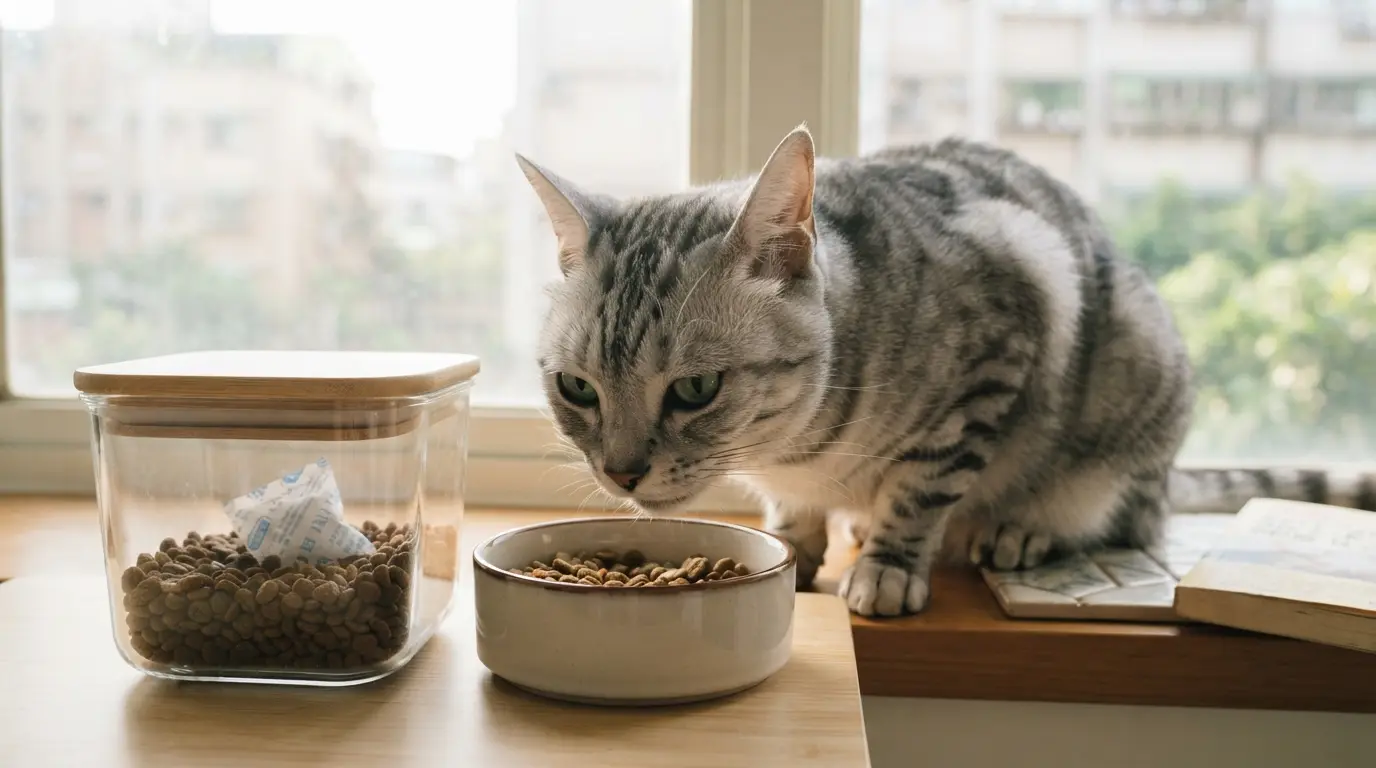
In Taiwan's summer, using both together is ideal (oxygen absorber inside the bag, desiccant next to the food bag inside the container). However, secure them with paper towels or a small mesh bag to prevent the cat from biting or accidentally ingesting them. If you have a cat that tips over containers, placing the desiccant in a fixed compartment on the inside of the container lid is safest. Don't discard the original desiccant packet that came with the food; keep it inside the bag after opening.

How to Choose a Food Container: 5 Checkpoints

There's a wide price range for food containers on the market. You don't need the most expensive one, but these points directly impact storage effectiveness:

1. Opaque Material: Food-grade PP or stainless steel is preferred. Transparent containers look nice, but light accelerates fat oxidation. They are only suitable for storage in completely dark cabinets.

2. Lid with Silicone Seal Strip + Snap-Closure: It should feel firm when pressed down and snapped shut. Models that simply have a lid resting on top, relying on weight for sealing, offer almost no moisture protection.

3. Large Opening, No Dead Corners Inside: You should be able to fit your whole hand inside to clean it, with no hard-to-reach seams that can accumulate grease. Removable liners are a plus.

4. Capacity Matches Your Purchasing Rhythm: Bigger isn't always better. For a single-cat household, a 3-6 liter container (holding about 1.5-2kg) is sufficient. Buying a larger container may encourage you to stockpile more and store it for longer.

5. Cat-Proof: Many cats learn to open lids with their heads. Choose models with latches or those requiring two hands to operate. Place it away from high places, as a tipped-over container could injure the cat.

A reminder: Store food containers in a cool, dry, indoor location away from direct sunlight. Considering common locations in Taiwanese homes, the order of preference is: inside a cabinet in an air-conditioned living room > inside a bedroom cabinet > lower kitchen cabinets (away from the stove and hot water pipes) > balcony > car (absolutely not; car interiors can reach over 50°C in the afternoon).

Dry cat food is not recommended for refrigerator storage: The temperature difference from repeatedly taking it in and out will cause condensation on the kibble surface, leading to mold growth. Additionally, the food can absorb refrigerator odors.

The Trade-off of Stockpiling: Savings vs. Risk of Spoilage

We understand that sales are tempting, but cat food is different from cat litter. Cat litter can be stored for a year without issues (for stockpiling logic, see How Much Cat Litter Does One Cat Use Per Month? Litter Usage Calculation, Refill Frequency, and Stockpiling Tips). However, cat food is a perishable food item that oxidizes.

Let's do the math: A 4.5kg adult cat eats about 55-60 grams per day, totaling about 1.7kg per month. The money saved by buying a large 5kg bag often doesn't outweigh the cost of spoiled food from weeks 5-8 – the cat eats reluctantly, develops soft stools, and you end up throwing it away. For single-cat households, buy 1.5-2kg bags. If you must stockpile, stockpile "multiple small bags" rather than "one large bag." Large bags are only suitable for multi-cat households that can finish 5kg within a month.

If your cat is on a weight management plan, smaller packaging is more conducive to accurate weighing (use an electronic scale, don't rely on measuring cups for estimation). This can be combined with Is Your Cat Constantly Gaining Weight Just Because? First, Assess Body Condition, Waistline, and 3 Warning Signs to See a Vet.

Canned Food and Wet Food Storage Times

Beyond dry food, wet food has even stricter rules:

  • Unconsumed After Opening: Transfer to a glass or ceramic container (do not refrigerating the entire can). It's safest to consume within 24 hours of refrigeration, and no more than 48 hours.
  • During Feeding: Refrigerated wet food can be warmed in a bowl of warm water to near body temperature (about 35-38°C) for best palatability. Microwaving is not recommended as it can create localized hot spots.
  • Left in the Bowl Unfinished: In a 30°C room during summer, discard after 30 minutes. In an air-conditioned room, this can be extended to 1 hour. Discard if the surface looks dry, discolored, or smells sour.
  • Portioning and Freezing: This is possible, but do not refreeze after thawing. Consume within 24 hours of refrigeration.

How to Transport Cat Food When Traveling or Boarding

Our preferred method for boarding cats is: Portion by day, one small bag per day. This prevents caregivers from measuring incorrectly and avoids repeatedly opening the entire bag. During summer, avoid exposing food to direct sunlight in the car during transport. Upon arrival, we store it in a cool storage locker. If your cat has a sensitive stomach, bring enough food for the entire stay; changing food mid-stay is a common cause of soft stools. If you're considering boarding your cat, before booking accommodation, you can review Cat Boarding Checklist: Required Vaccinations, Health Certificates, Flea Prevention, and What to Pack to prepare food, medications, and vaccination records.

Frequently Asked Questions

How long is cat food safe to store after opening?

In Taiwan's summer (high temperature and humidity), it's recommended to finish within 3-4 weeks. In cooler, drier autumn and winter, it can last 5-6 weeks. Regardless of the timeframe, if you detect a rancid smell or the kibble feels soft and sticky, stop feeding it.

If dry food is stale but not moldy, can I dry it out or bake it before feeding?

Not recommended. Staleness indicates that mold may have already begun to grow, and mycotoxins are heat-resistant. Drying or heating only removes moisture, not toxins, and the already oxidized fats will not become fresh again. Discarding the entire bag is safer than taking a risk.

Can dry cat food be stored in the refrigerator?

Not recommended. The temperature fluctuations from repeated opening and closing can cause condensation on the kibble surface, accelerating mold growth. The food can also absorb refrigerator odors. Storing it in a cool, opaque container with a sealing lid is more ideal.

How often should food containers be washed?

Wash every time you change to a new bag of food. Use a mild detergent, scrub thoroughly, and air dry completely before use (residual moisture is the biggest culprit). If there were any off-odors, insects, or mold spots, wash with hot water and sun-dry for a day.

My cat has soft stools after switching to a new bag of food. Is the food spoiled?

It's possible the old bag had gone stale, or the new bag's batch is different, or the food change was too abrupt. First, confirm the new bag's smell and texture are normal. Then, try a gradual transition over 7-10 days. If soft stools persist for more than three days, or if there's blood in the stool, vomiting, or lethargy, consult a veterinarian. Daily necessities and health supplements can be found at our online shop.


This article was written by the CatGarden editorial team. The advice provided is based on practical experience from our cat hotel and grooming services and cannot replace veterinary diagnosis. If your cat experiences continuous vomiting, refuses to eat, shows lethargy, or has jaundice, please seek veterinary care immediately.

CatGarden offers curated supplies, cat boarding, and grooming

Book services or shop online.
Back

Blog

How Long Can Cat Food Be Stored After Opening? Taiwan Summer Humidity, Food Storage Containers, and Spoilage Detection Explained

CatGarden Editorial TeamPublished 2026/08/11Updated 2026/10/06
cat food storagefood container recommendationscat food humiditycat food spoilagesummer cat care
How Long Can Cat Food Be Stored After Opening? Taiwan Summer Humidity, Food Storage Containers, and Spoilage Detection Explained

How long can cat food be stored after opening? In Taiwan's summer months (June-September), it's generally recommended to finish dry cat food within "3-4 weeks of opening." In cooler, drier autumn and winter conditions, this can be extended to 5-6 weeks. Beyond this timeframe, even if no mold is visible, the fats will have oxidized, affecting palatability and potentially causing digestive upset. Before discarding, you can use a practical three-step method to determine if it's still safe to feed: first, check the number of days since opening; second, smell for any rancid odor; and finally, feel the kibble's texture to see if it has become soft and sticky.

At our facility, we handle food brought in by over a dozen boarding cats daily. The most common issue we encounter isn't "wrongly chosen food" but "poor storage." Owners often buy large 5kg bags during sales and continue feeding them into the fifth week after opening. The cats then become picky eaters, followed by soft stools. Switching brands seems to fix the problem, but it's not the brand itself; it's that the food has been stored for too long in Taiwan's humid and hot air.

Key Takeaways

  • For dry cat food opened in Taiwan's summer (room temperature above 28°C, humidity above 70%), it's recommended to finish within 3-4 weeks. In cooler autumn and winter environments, this can be extended to 5-6 weeks.
  • The rate of fat oxidation increases significantly with temperature. The same bag of food stored in a 30°C kitchen will go stale twice as fast as one stored in a 22°C air-conditioned room.
  • To determine if food has spoiled, check three things: opened for over 4 weeks, a rancid smell (like old nuts or a used deep fryer), or the kibble surface feeling soft, sticky, or forming clumps of powder. If any of these are true, do not feed it.
  • An average 4-5kg adult cat eats about 50-65 grams of dry food per day, totaling 1.5-2kg per month. Buying 1.5-2kg bags is safer than buying large 5kg bags.
  • The correct method is to "roll and seal the original bag and place it inside an opaque, airtight container," not to pour the food directly into the container. The container should be thoroughly washed and completely dried before each new bag of food is added.
  • Canned/wet food is safest if consumed within 24 hours of opening and refrigerating. If left in a bowl at room temperature for more than 30-60 minutes, it should be discarded.

"How Long Can It Last?" Depends on Three Variables

The expiration date on the food bag refers to the unopened product. The clock starts ticking the moment it's opened. How long it actually lasts depends on these three factors:

1. Packaging Type and How Well It's Resealed

Bags with zippers are the easiest to manage. For those with heat-sealed closures, after opening, roll the bag down three folds and secure it tightly with a binder clip or sealing clip, squeezing out as much air as possible. Food left with a large opening and loosely folded bag will noticeably lose its flavor within two weeks.

2. Fat Content and Antioxidant Design

Foods high in fat, high in meat content, or advertised as having "added oil for palatability" smell great but oxidize quickly. Formulas emphasizing natural antioxidants (like Vitamin E and rosemary extract) have a milder antioxidant effect than synthetic ones, meaning you need to be stricter about the opening date. Kitten food and high-protein, grain-free formulas generally fall into the "finish quickly" category.

3. Your Home Environment (The Most Crucial Factor in Taiwan)

Taiwan's summer indoor humidity often reaches 75-85%. If food is stored in a ventilated kitchen or balcony, it will continuously absorb moisture from the air. Dry food naturally contains only 8-10% moisture. Once it absorbs moisture to over 12%, it enters the range where mold can easily grow. This is why "the same bag of food can last a month in an air-conditioned home but develop a strange smell within two weeks in a home without air conditioning." Incidentally, controlling indoor temperature and humidity in the summer not only affects the food but also directly impacts your cat's comfort. You can refer to our article on Do Cats Fear Heat? Understanding Their Heat Tolerance, Cooling Methods, and When to Use Air Conditioning in Taiwan.

Three-Step Detection Method: Days Opened → Smell → Kibble Texture

These are the three steps we actually take at our facility when receiving food brought in by boarding cats. They allow for a quick assessment within 30 seconds.

Step 1: Check the Days Since Opening (Please Write the Date!)

On the day of opening, use a permanent marker to write "8/2 Open" on the bag, or attach a label. This is the cheapest and most effective trick. Assessment criteria:

  • 0-3 Weeks: Normal, feed with confidence.
  • 3-4 Weeks: Reasonable upper limit. You can continue feeding but should smell it daily.
  • Over 4 Weeks (Summer): Even without an off-smell, palatability and fat-soluble vitamins have decreased. It's recommended to stop feeding and not force yourself to finish it.

Step 2: Smell for "Rancid Odor"

Fresh dry food has a scent of baked meat, grains, and a hint of oil. Spoiled food smells like:

  • Rancid Odor: Like old nuts, a used deep fryer, or old crayons – this is the most typical smell of fat oxidation (rancidity). If present, do not feed.
  • Musty Moldy Smell/Earthy Smell: Indicates moisture absorption and mold activity. Discard the entire bag; don't just pick out suspicious pieces.
  • Overall Faint Smell, Almost No Aroma: Not necessarily spoiled, but the loss of aroma can lead to picky eating.

Tip: Take a small handful, cup it in your palm, rub it gently to warm it up, then bring it closer to smell. The aroma will be much more noticeable than just sticking your nose into the bag.

Step 3: Feel the Kibble Texture

This step is often overlooked but is very accurate:

  • Normal: Dry, hard, crisp. It breaks cleanly when pinched, leaving only a faint powder on your fingers.
  • Slightly Stale: It can be pinched but isn't crisp, like old crackers. Your fingers feel slightly sticky after touching it.
  • Noticeably Stale: The kibble surface is oily and sticky. Your fingers will pick up an oily film. The powder at the bottom of the bag forms clumps, or a few pieces stick together.
  • Dangerous: White, green, or grayish-black fuzzy spots appear, or the food clumps together into a solid mass. Discard the entire bag immediately, and wash and dry the container thoroughly.

What Happens If a Cat Eats Stale or Spoiled Food?

The most common reactions seen in clinics are gastrointestinal issues: soft stools, foul-smelling stool, increased frequency of defecation, vomiting, and excessive gas. Some cats will simply "refuse to eat" – they can detect the rancid odor, which is far more sensitive than humans. So, if your cat suddenly loses interest in food it's been eating for a long time, first check the food's freshness, then consider picky eating. This behavioral change is often misunderstood. You can compare it with Is Your Cat Constantly Crying at the Food Bowl Because They're Hungry? Distinguish Between Begging, Mealtime, or Habitual Behavior.

More serious risks include mycotoxins (like aflatoxins), which primarily damage the liver. Symptoms include lethargy, decreased appetite, vomiting, and jaundice (yellowish gums or skin inside the ears). This is not a situation to manage at home: If your cat experiences continuous vomiting for over 24 hours, refuses to eat for over 24 hours, shows lethargy, or has jaundice, seek veterinary attention immediately. Bring the food bag (including the batch number) with you.

For short-term mild soft stools, besides immediately stopping the questionable food and switching back to a fresh bag, you can also use specialized probiotics to help stabilize the gut for a few days. However, if it doesn't improve within three days, or if there's blood in the stool or signs of dehydration, don't try to manage it yourself. For a more comprehensive understanding of foods that are inherently risky, refer to the series main article What Foods Are Toxic to Cats? Common Household Dangers and Poisoning Symptoms.

Cat Food Portioning: The Correct Method is "Original Bag + Container"

Many people buy beautiful food containers and immediately pour the entire bag of food into them, discarding the original bag. This is actually the most moisture-prone method because the inner lining of food bags typically has an aluminum or oxygen-barrier coating, offering better moisture and oxygen resistance than most plastic containers.

Our Recommended Method:

1. Roll and Seal the Original Bag: Keep the food in its original bag. Squeeze out the air, roll the opening down three folds, and secure it tightly with a sealing clip. Then, place the sealed bag inside the storage container. The container protects from light, insects, and crushing; the bag provides oxygen and moisture barrier.

2. Portion for One Week: If you can only buy large bags, portion them out on the day of opening. Use resealable bags or vacuum-seal bags to divide the food into 5-7 day portions (about 350-450 grams per bag for an adult cat). Place one oxygen absorber in each bag. Only open the bag for the current week's consumption. This minimizes the number of times the main bag is opened, significantly reducing oxidation risk.

3. Pour Daily Portions into a Small Container: The small container you scoop from daily should hold enough food for 3-5 days. Wash and completely dry it after each use before refilling. Old crumbs and oils at the bottom of the container are sources of off-odors and insect eggs.

4. Do Not Leave Measuring Cups in the Food Container Long-Term: Measuring cups repeatedly transfer moisture from your hands into the food. It's best to remove the cup after measuring and hang it outside the container.

Oxygen Absorbers vs. Desiccants: Don't Mix Them Up

  • Oxygen Absorber: Removes oxygen from the bag, primarily preventing "fat oxidation" and mold. Ideal for sealed portion bags, it's the most effective small tool for extending food freshness.
  • Desiccant (Silica Gel): Absorbs moisture, primarily preventing "moisture absorption." Suitable for high-humidity environments.

In Taiwan's summer, using both together is ideal (oxygen absorber inside the bag, desiccant next to the food bag inside the container). However, secure them with paper towels or a small mesh bag to prevent the cat from biting or accidentally ingesting them. If you have a cat that tips over containers, placing the desiccant in a fixed compartment on the inside of the container lid is safest. Don't discard the original desiccant packet that came with the food; keep it inside the bag after opening.

How to Choose a Food Container: 5 Checkpoints

There's a wide price range for food containers on the market. You don't need the most expensive one, but these points directly impact storage effectiveness:

1. Opaque Material: Food-grade PP or stainless steel is preferred. Transparent containers look nice, but light accelerates fat oxidation. They are only suitable for storage in completely dark cabinets.

2. Lid with Silicone Seal Strip + Snap-Closure: It should feel firm when pressed down and snapped shut. Models that simply have a lid resting on top, relying on weight for sealing, offer almost no moisture protection.

3. Large Opening, No Dead Corners Inside: You should be able to fit your whole hand inside to clean it, with no hard-to-reach seams that can accumulate grease. Removable liners are a plus.

4. Capacity Matches Your Purchasing Rhythm: Bigger isn't always better. For a single-cat household, a 3-6 liter container (holding about 1.5-2kg) is sufficient. Buying a larger container may encourage you to stockpile more and store it for longer.

5. Cat-Proof: Many cats learn to open lids with their heads. Choose models with latches or those requiring two hands to operate. Place it away from high places, as a tipped-over container could injure the cat.

A reminder: Store food containers in a cool, dry, indoor location away from direct sunlight. Considering common locations in Taiwanese homes, the order of preference is: inside a cabinet in an air-conditioned living room > inside a bedroom cabinet > lower kitchen cabinets (away from the stove and hot water pipes) > balcony > car (absolutely not; car interiors can reach over 50°C in the afternoon).

Dry cat food is not recommended for refrigerator storage: The temperature difference from repeatedly taking it in and out will cause condensation on the kibble surface, leading to mold growth. Additionally, the food can absorb refrigerator odors.

The Trade-off of Stockpiling: Savings vs. Risk of Spoilage

We understand that sales are tempting, but cat food is different from cat litter. Cat litter can be stored for a year without issues (for stockpiling logic, see How Much Cat Litter Does One Cat Use Per Month? Litter Usage Calculation, Refill Frequency, and Stockpiling Tips). However, cat food is a perishable food item that oxidizes.

Let's do the math: A 4.5kg adult cat eats about 55-60 grams per day, totaling about 1.7kg per month. The money saved by buying a large 5kg bag often doesn't outweigh the cost of spoiled food from weeks 5-8 – the cat eats reluctantly, develops soft stools, and you end up throwing it away. For single-cat households, buy 1.5-2kg bags. If you must stockpile, stockpile "multiple small bags" rather than "one large bag." Large bags are only suitable for multi-cat households that can finish 5kg within a month.

If your cat is on a weight management plan, smaller packaging is more conducive to accurate weighing (use an electronic scale, don't rely on measuring cups for estimation). This can be combined with Is Your Cat Constantly Gaining Weight Just Because? First, Assess Body Condition, Waistline, and 3 Warning Signs to See a Vet.

Canned Food and Wet Food Storage Times

Beyond dry food, wet food has even stricter rules:

  • Unconsumed After Opening: Transfer to a glass or ceramic container (do not refrigerating the entire can). It's safest to consume within 24 hours of refrigeration, and no more than 48 hours.
  • During Feeding: Refrigerated wet food can be warmed in a bowl of warm water to near body temperature (about 35-38°C) for best palatability. Microwaving is not recommended as it can create localized hot spots.
  • Left in the Bowl Unfinished: In a 30°C room during summer, discard after 30 minutes. In an air-conditioned room, this can be extended to 1 hour. Discard if the surface looks dry, discolored, or smells sour.
  • Portioning and Freezing: This is possible, but do not refreeze after thawing. Consume within 24 hours of refrigeration.

How to Transport Cat Food When Traveling or Boarding

Our preferred method for boarding cats is: Portion by day, one small bag per day. This prevents caregivers from measuring incorrectly and avoids repeatedly opening the entire bag. During summer, avoid exposing food to direct sunlight in the car during transport. Upon arrival, we store it in a cool storage locker. If your cat has a sensitive stomach, bring enough food for the entire stay; changing food mid-stay is a common cause of soft stools. If you're considering boarding your cat, before booking accommodation, you can review Cat Boarding Checklist: Required Vaccinations, Health Certificates, Flea Prevention, and What to Pack to prepare food, medications, and vaccination records.

Frequently Asked Questions

How long is cat food safe to store after opening?

In Taiwan's summer (high temperature and humidity), it's recommended to finish within 3-4 weeks. In cooler, drier autumn and winter, it can last 5-6 weeks. Regardless of the timeframe, if you detect a rancid smell or the kibble feels soft and sticky, stop feeding it.

If dry food is stale but not moldy, can I dry it out or bake it before feeding?

Not recommended. Staleness indicates that mold may have already begun to grow, and mycotoxins are heat-resistant. Drying or heating only removes moisture, not toxins, and the already oxidized fats will not become fresh again. Discarding the entire bag is safer than taking a risk.

Can dry cat food be stored in the refrigerator?

Not recommended. The temperature fluctuations from repeated opening and closing can cause condensation on the kibble surface, accelerating mold growth. The food can also absorb refrigerator odors. Storing it in a cool, opaque container with a sealing lid is more ideal.

How often should food containers be washed?

Wash every time you change to a new bag of food. Use a mild detergent, scrub thoroughly, and air dry completely before use (residual moisture is the biggest culprit). If there were any off-odors, insects, or mold spots, wash with hot water and sun-dry for a day.

My cat has soft stools after switching to a new bag of food. Is the food spoiled?

It's possible the old bag had gone stale, or the new bag's batch is different, or the food change was too abrupt. First, confirm the new bag's smell and texture are normal. Then, try a gradual transition over 7-10 days. If soft stools persist for more than three days, or if there's blood in the stool, vomiting, or lethargy, consult a veterinarian. Daily necessities and health supplements can be found at our online shop.


This article was written by the CatGarden editorial team. The advice provided is based on practical experience from our cat hotel and grooming services and cannot replace veterinary diagnosis. If your cat experiences continuous vomiting, refuses to eat, shows lethargy, or has jaundice, please seek veterinary care immediately.

One email a month of cat-care tips

Hand-picked care, behavior and grooming tips once a month. Subscribe and we will send you our three most-read articles right away.

Keep reading