Can Senior Cats Stay at a Cat Hotel? A Comprehensive Guide to Assessing Elderly Cat Boarding, Chronic Illness Medication, and Choosing the Right Cat Hotel
Most senior cats over 7 years old can board safely if their chronic conditions are well-controlled and they have recent health check-up records. The key factors are the hotel's ability to administer medication on schedule, its affiliated veterinarian, and the availability of low-level, accessible rooms. This article provides a complete assessment and checklist for choosing a suitable facility.
Senior cats can stay at cat hotels, and often it's safer than enduring long trips or leaving them with untrained individuals. The key to whether a cat can board isn't its age, but three things: Is their chronic illness stable? Can the hotel provide "timed and measured medication administration + daily records"? And are there low-level, accessible rooms and an affiliated veterinarian for emergencies?
At our Banqiao branch, we regularly board cats over 10 years old. Our oldest guest was an 18-year-old tri-color cat with both chronic kidney disease (CKD) and hyperthyroidism. These cats thrive not because of "special gentleness," but because every pill, every meal, and every urine clump is meticulously recorded. Here's a comprehensive guide on what to assess and what to ask when boarding a senior cat.
Key Takeaways
- Cats are considered mature at 7 years old, senior at 11+, and geriatric at 15+. Boarding for cats 7+ should follow a "senior cat care protocol," not standard boarding.
- Before boarding, senior cats should have bloodwork + kidney function tests (BUN/CREA/SDMA) from the last 3-6 months. Hyperthyroid cats should also provide T4 results. This data helps the hotel assess risks and report issues early.
- Medication for chronic conditions has very little room for error: Hyperthyroid medication (methimazole) requires administration every 12 hours, with no more than a 1-hour deviation. After administering oral medication, always follow with 3-6 ml of water or wet food to reduce the risk of esophageal irritation.
- For senior cat rooms, prioritize three points: Ramp or step height no more than 25-30 cm, litter box entrance height below 10 cm, and ambient temperature maintained at 26-28°C (with a heating pad in winter, but also a cool area to retreat to).
- The most crucial indicators for senior cat boarding are daily food intake, water consumption, urine clump count, and weight. Weigh them every 2-3 days; a drop of over 5% in a short period warrants contacting a veterinarian.
What Age is "Senior"? How Does Boarding Differ from Adult Cats?
The internationally recognized feline age classifications are:
| Stage | Age | Key Boarding Considerations |
|---|---|---|
| Adult | 3-6 years | Standard boarding procedures are sufficient |
| Mature | 7-10 years | Potential for chronic diseases, health check-ups recommended |
| Senior | 11-14 years | Medication or dietary management often required |
| Geriatric | 15+ years | Requires low-level rooms, daily reporting, veterinary backup |
What's the difference? For adult cats, we observe "adaptation and appetite"; for senior cats, we monitor "metabolic strain." Senior cats have reduced reserves in their kidneys, heart, and joints. If they eat or drink too little for 24 consecutive hours, dehydration and fatty liver disease develop much faster than in younger cats. Therefore, the core of senior cat boarding isn't about enthusiastic care, but about early detection of abnormalities.
Which Senior Cats Are Suitable for Boarding? Which Need Alternative Arrangements?
Suitable for Boarding (Stable Senior Cats)
- Chronic conditions have been managed with medication for over 3 months, with stable weight and appetite.
- Daily medication frequency is 1-3 times, and medication is in oral tablet, liquid, or ear gel form.
- They eat independently, use the litter box independently, and can move around, albeit slowly.
- They have prior boarding or hospitalization experience and do not exhibit extreme avoidance behaviors.
Consult a Veterinarian First, or Consider Other Options
- Recently adjusted medication, discharged from the hospital, or newly diagnosed within the last 2 weeks: This period involves the most significant changes, making home care or direct hospitalization more suitable.
- Require subcutaneous fluids, insulin injections, or feeding tube (nasogastric/esophageal): These are medical procedures that most standard cat hotels do not perform (and neither do we). Prioritize veterinary hospital boarding.
- Severe cognitive dysfunction symptoms (midnight howling, disorientation, inability to find the litter box): Environmental changes can exacerbate confusion.
- Complete lack of appetite, ongoing weight loss: Address appetite issues before considering boarding. For this situation, refer to What to Do When a Senior Cat Isn't Eating? From Dental Issues, Reduced Sense of Smell to Chronic Disease Screening, 5 Tips to Safely Boost Your Elderly Cat's Appetite.
If you're still deciding between "boarding at a hotel or hiring in-home care," this article offers a comprehensive comparison: Who is Better to Care for Your Cat When You're Away? A Complete Comparison of Cat Boarding vs. In-Home Pet Sitting: Stress, Costs, and Emergencies. The simple principle: Senior cats requiring precise medication and constant supervision are often better off boarding than with in-home care that visits only once a day. Conversely, if the cat strongly dislikes going out and has a simple condition, in-home care might be gentler.
Health Assessment Before Senior Cat Boarding: Bring These Records
When we accept senior cats for boarding, we ask owners to prepare a "handover package" including:
1. Blood test reports from the last 3-6 months (including kidney and liver function tests; for hyperthyroid cats, add T4; for diabetic cats, add blood glucose/fructosamine).
2. Name, phone number, and appointment hours of their primary veterinary clinic, along with the date of their last visit.
3. Medication list: Drug name, dosage (e.g., fraction of a pill), timing, and relationship to food (with meals/empty stomach).
4. Dietary records: Number of meals per day, grams or cans per meal, typical daily water intake, and whether they are on a prescription diet.
5. Baseline of normal abnormal behaviors: For example, "normally vomits hairballs once a day" or "normally drags their right hind leg when walking." This is crucial; without a baseline, we cannot identify new problems.
6. Emergency authorization form: Maximum authorized amount, and whether they can be sent to a vet if you are unreachable.
Common Chronic Diseases in Senior Cats and Boarding Precautions
- Chronic Kidney Disease (CKD): Focus on water intake and urine output. Place at least 2 water bowls and 1 water fountain in the room. Record urine clump count and size daily. For understanding causes, see Why Do Cats Get Kidney Disease? Understanding the 4 Main Causes: Aging, Diet, Dehydration, and Genetics.
- Hyperthyroidism: Good appetite but weight loss, rapid heart rate, and potential for over-excitement in unfamiliar environments. Medication timing must be precise. For detailed symptoms, see The Complete Guide to Feline Hyperthyroidism (Cat Hyperthyroid Disease).
- Arthritis / Degenerative Joint Disease: Extremely common in cats over 12, yet often overlooked. Symptoms include reluctance to jump, hesitation using the litter box, and reduced grooming. Requires low-level rooms and soft bedding.
- Heart Disease: Sensitive to heat and stress. Monitor respiratory rate (over 40 breaths per minute while resting quietly is a cause for concern).
- Dental Disease: Slower eating of dry food, dropping kibble, chewing on one side. Inform staff beforehand if food needs to be softened.
Cat Boarding Medication Administration: How Professional Hotels Actually Do It
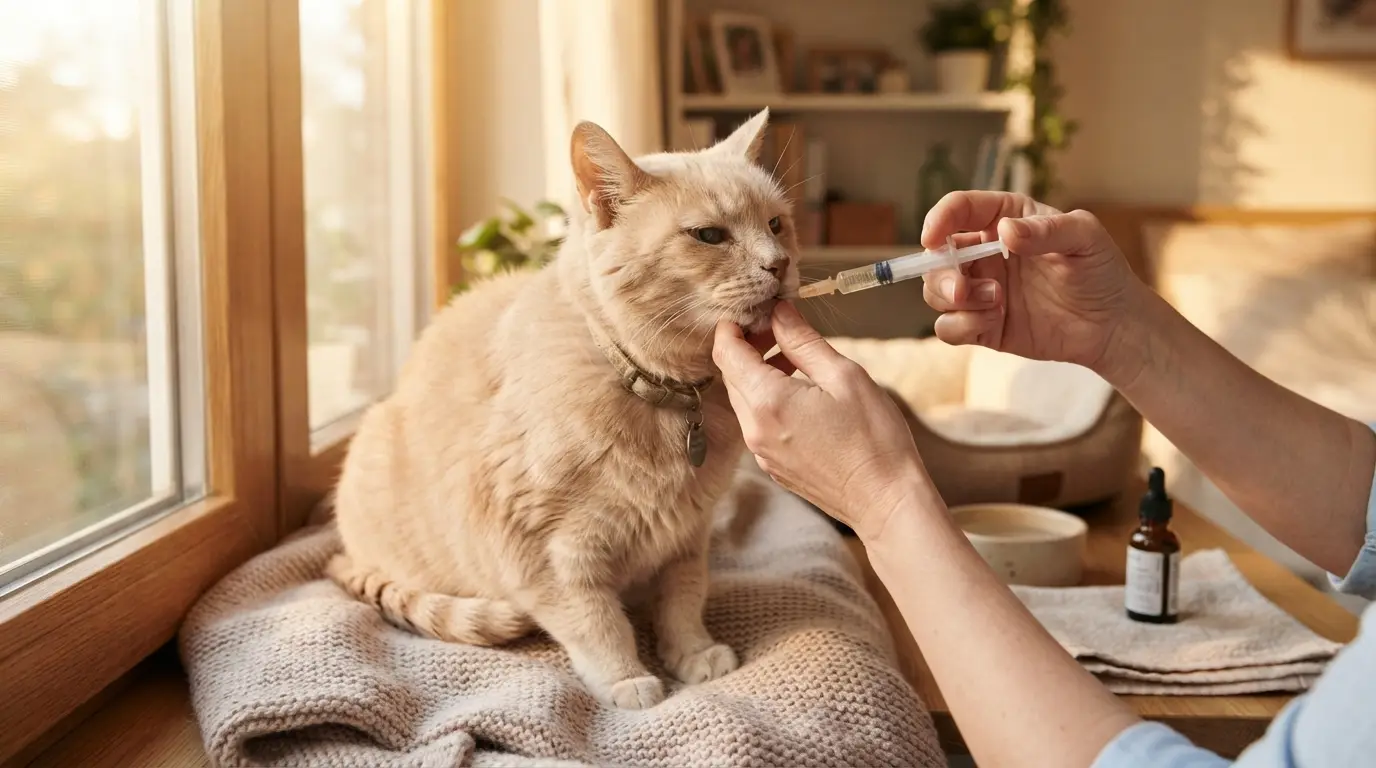
"Cat boarding medication administration" is a frequent question from senior cat owners. Our practical process is as follows:
1. Medication Demonstration on Arrival Day
Ask the owner to administer the medication once in front of staff. We observe your technique, the cat's reaction, and confirm the medication form. We also ascertain: Does the cat eat medication hidden in treats, or does it require oral administration? These 3 minutes can prevent 5 days of disaster.
2. Medication Pre-portioning and Double-Check
Ask the owner to pre-portion the medication (using a weekly pill organizer, with each compartment labeled with the date and time), rather than handing over a whole bottle for staff to divide. During administration, we follow a four-step process: "Retrieve medication – Verify with medication sheet – Administer – Sign." We also record the actual time and the cat's reaction (e.g., vomited, drooled) on the record sheet.
3. Timing Precision
- Once-daily medication: Administer at the same time each day, within a ±2 hour window.
- Twice-daily (q12h, e.g., hyperthyroid medication): Maintain a ±1 hour window, e.g., 8 AM and 8 PM.
- Medication with meals (e.g., phosphate binders, some gastrointestinal meds): Must be administered concurrently with actual feeding times; do not "administer medication first and then wait for them to eat."
4. Safety Details
- After administering oral tablets, always provide 3-6 ml of water or diluted broth to help the pill go down. Dry-swallowed pills can lodge in the esophagus and cause inflammation.
- Do not consider medication administered simply by mixing it into dry food. Staff must visually confirm ingestion and ensure no medication residue is left in the bowl.
- If the cat refuses medication, vomits it, or if there's suspected missed dosage, notify the owner the same day. Do not self-administer a double dose.
5. Daily Reporting
Senior cat boarding includes a "Daily Care Report": food intake (grams), water consumption, urine clump count, stool consistency, medication completion status, and activity level, plus 2-3 photos. These are not just cute marketing photos but data you can use to discuss with your veterinarian while abroad.
Senior Cat Room Design: Low-Level, Accessible Rooms Make a Big Difference
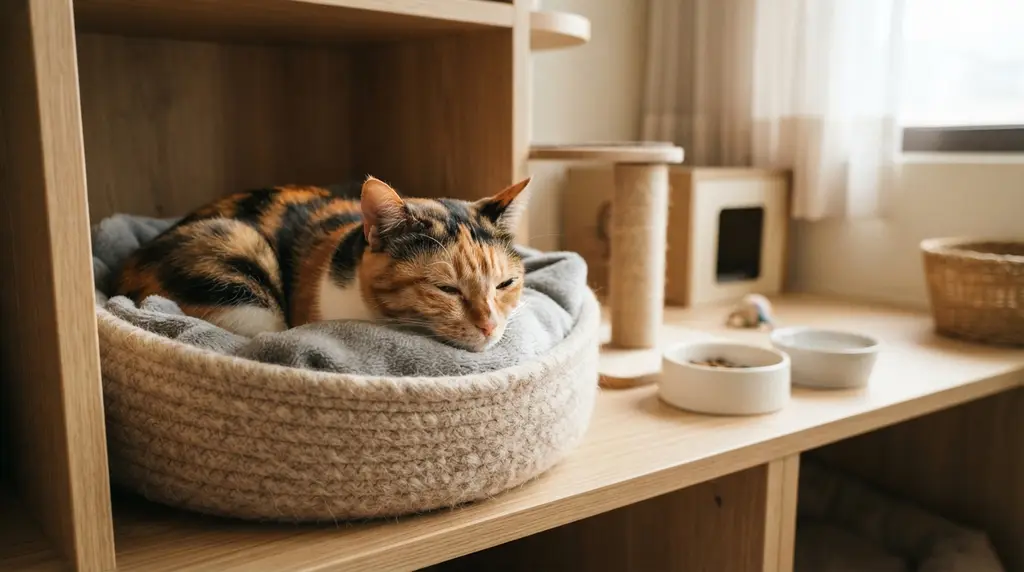
Many hotels feature "three-level ramps + high hammocks," which are great for young cats but present an obstacle course for senior cats with arthritis. Room selection priorities:
- Step height within 25-30 cm, or use ramps or tiered steps.
- Litter boxes with low entrances (below 10 cm) or an open side. Senior cats holding their urine can easily lead to accidents on the bedding, misdiagnosed as inappropriate elimination.
- Do not force the use of high sleeping spots. Provide thick, soft bedding, fully enclosed hiding boxes, or semi-enclosed beds on the ground level.
- Temperature maintained at 26-28°C. Use heating pads in winter but ensure there's always an area to move away from the heat source. Senior cats have poor thermoregulation, making both overheating and chilling dangerous.
- Non-slip flooring. Smooth floors can be stressful for cats with weak hind legs.
- Individual enclosures, no cat-to-cat interaction. This prevents the stress of being chased by younger cats, which can cause chronic tension in senior cats.
Litter should also be mentioned: Senior cats are sensitive to dust and texture. Changing litter types in a new environment often leads to litter box avoidance. It's recommended to bring your usual cat litter or ask the hotel what they use beforehand. Our facility primarily uses low-dust Odor Control Mineral Litter 3.0. Many owners concerned about weight and dust switch to Ultra-Fine Tofu Litter 3.0. For a comparison of material differences, see Cat Litter Recommendations: How to Choose Between Mineral, Tofu, and Wood Litters - Pros, Cons, and Comparisons.
10 Essential Questions to Ask When Choosing a Cat Hotel for Senior Cats
Use this checklist when calling to book. If they can answer more than half satisfactorily, they're likely qualified:
1. Do you accept cats over 12 years old with chronic illnesses? Is there an age limit?
2. How many times a day can you administer medication? Can you reliably administer q12h medications on schedule?
3. Do you keep medication records? Can you send them to me daily?
4. Do you have an affiliated veterinarian or partner animal hospital? How far away is it? How are emergencies handled at night?
5. What is your protocol for notifying owners of emergencies? How soon will you contact me?
6. Do you have low-level/accessible rooms? Can the cat stay only on the ground level?
7. What are your room temperature control methods? Do you have heating pads in winter? How do you cool rooms in summer?
8. How long will you wait before notifying me if the cat isn't eating, and what steps will you take?
9. Are the cats housed in individual enclosures and not allowed to interact with other cats?
10. Do you have 24-hour surveillance cameras? Is there staff on-site overnight, or are there records of overnight checks?
For comparisons of regional pricing, room types, and environmental conditions, refer to this article: New Taipei Cat Hotel Recommendations: How to Choose in Banqiao, Sanchong, Xinzhuang? Pricing and 6 Key Selection Points. Senior cat boarding often incurs an additional daily "care fee/medication fee" of NT$100-300. This fee typically covers records and labor, not luxurious decor. It's more practical to compare prices after clarifying what services are included.
Preparations 1 Week Before Boarding
1. Schedule a vet visit for medication refills: Obtain an extra 2-3 days' supply to avoid running out due to travel delays.
2. Confirm food supply and use original packaging: Ensure sufficient quantity of prescription food and regular canned food. Senior cats' appetites may decrease in unfamiliar environments; bringing a "rescue food" they absolutely love is very helpful. We often recommend owners leave a can of highly aromatic, gravy-rich Luxury Functional Canned Food as an emergency appetite stimulant. For portion calculations, refer to How Much Should a Senior Cat Eat Daily? Calculating Portions, Wet Food Ratios, and Arranging Small, Frequent Meals.
3. Measure baseline weight and record it on the handover form.
4. Place the travel carrier in the living room with the door open a few days prior to reduce stress during transport. For carrier selection, see Cat Carrier Recommendations: How to Choose? A Complete Comparison for Vet Visits, Long Trips, and Escape Prevention.
5. Bring an old blanket or piece of clothing with familiar scents from home (unwashed). This can be more comforting for senior cats than toys.
If you are abroad and time differences make communication difficult, remember to clearly outline the scope of your authorization in advance. For long-term stays or arrangements including pick-up/drop-off services, refer to How to Arrange Cat Boarding for Overseas Trips? Calculating Days, Pricing, and Pick-up/Drop-off Essentials.
Red Flags During Boarding
In the following situations, the hotel should immediately contact the owner and consider veterinary care. Owners should also be highly vigilant upon receiving reports:
- Complete lack of appetite for 24 consecutive hours, or intake below half of normal for over 2 days.
- No urine clumps for an entire day (especially in male cats), or frequent straining with little urine output.
- Repeated vomiting, vomiting yellow liquid, or expelling medication (Further reading: Why Do Cats Vomit Yellow Liquid? Diagnosing and Seeking Veterinary Care for Bile Vomiting on an Empty Stomach, Hairball Irritation, and Acute Pancreatitis).
- Rapid breathing while resting, open-mouth breathing, hiding in a corner and remaining still.
- Noticeable staggering gait, hind leg weakness, sudden unusual vocalizations.
- Weight loss exceeding 5% in a short period.
If symptoms persist or worsen, seek veterinary care immediately. Do not wait until you return. The speed of medical decision-making during boarding often impacts the outcome more than the comfort of the stay.
Conclusion: Senior Cat Boarding is About "Systems," Not Age
A 16-year-old cat with Stage 3 kidney disease but stable medication, staying at a hotel with a record-keeping system, an affiliated vet, and low-level rooms, is often safer than staying home with a once-daily check-in. Conversely, an 8-year-old cat that appears healthy but is boarded at a facility that cannot administer medication and has only high-level rooms presents a higher risk. When choosing a hotel, asking those 10 questions will likely reveal whether they have genuine experience caring for senior cats.
If you have a senior cat that requires regular medication and has mobility issues, feel free to bring their health check-up reports and medication list to discuss. We will arrange low-level rooms and a care plan based on their condition for boarding at our Banqiao Cat Hotel.
Frequently Asked Questions
Is there an age limit for senior cat boarding?
Most professional cat hotels do not have strict age limits but assess based on health status and medication complexity. If subcutaneous fluids, insulin injections, or tube feeding are required, veterinary hospital boarding is recommended for safety.
Can cat hotels administer medication? Is there an extra fee?
Hotels experienced in senior cat care can typically assist with oral tablets, liquids, and ear gels, providing daily records. Market rates often include a daily care or medication fee of approximately NT$100-300. Medical procedures like injections and IV fluids are usually not offered.
Will boarding stress worsen my senior cat's chronic conditions?
It's possible, which is why environmental design and early detection are crucial. Individual enclosures, low-level rooms, temperatures of 26-28°C, bringing familiar food and blankets, along with daily records of food and urine intake, can significantly reduce risks and allow for intervention before conditions worsen.
Do senior cats need a health check-up before boarding?
It's recommended to have a complete blood test (including kidney function tests) within 3-6 months prior to boarding. For hyperthyroid cats, a T4 test should also be included. This information allows the hotel and veterinarian to make quick assessments during emergencies and protects your rights and your cat's well-being.
How many days is reasonable for senior cat boarding?
There's no absolute number, but for cats with chronic illnesses, it's advisable not to exceed 2-3 weeks per stay, with arrangements for follow-up vet visits or assistance from the hotel to take them to the affiliated veterinarian. For long-term boarding, pre-arrangements for follow-up visits and emergency authorization are essential.
_Article by: CatGarden Editorial Department_
CatGarden offers curated supplies, cat boarding, and grooming
Book services or shop online.