Choosing a Boarding Facility for a Fearful Cat: 5 Key Indicators for High-Sensitivity and Easily Stressed Cats, Plus a Stress Reduction Guide
Fearful cats that hiss and are shy can still be boarded, but it requires choosing the right environment and care. This article compiles 5 key selection indicators based on frontline cat hotel experience, an assessment checklist you can use directly, and a two-week pre-stay stress reduction plan.
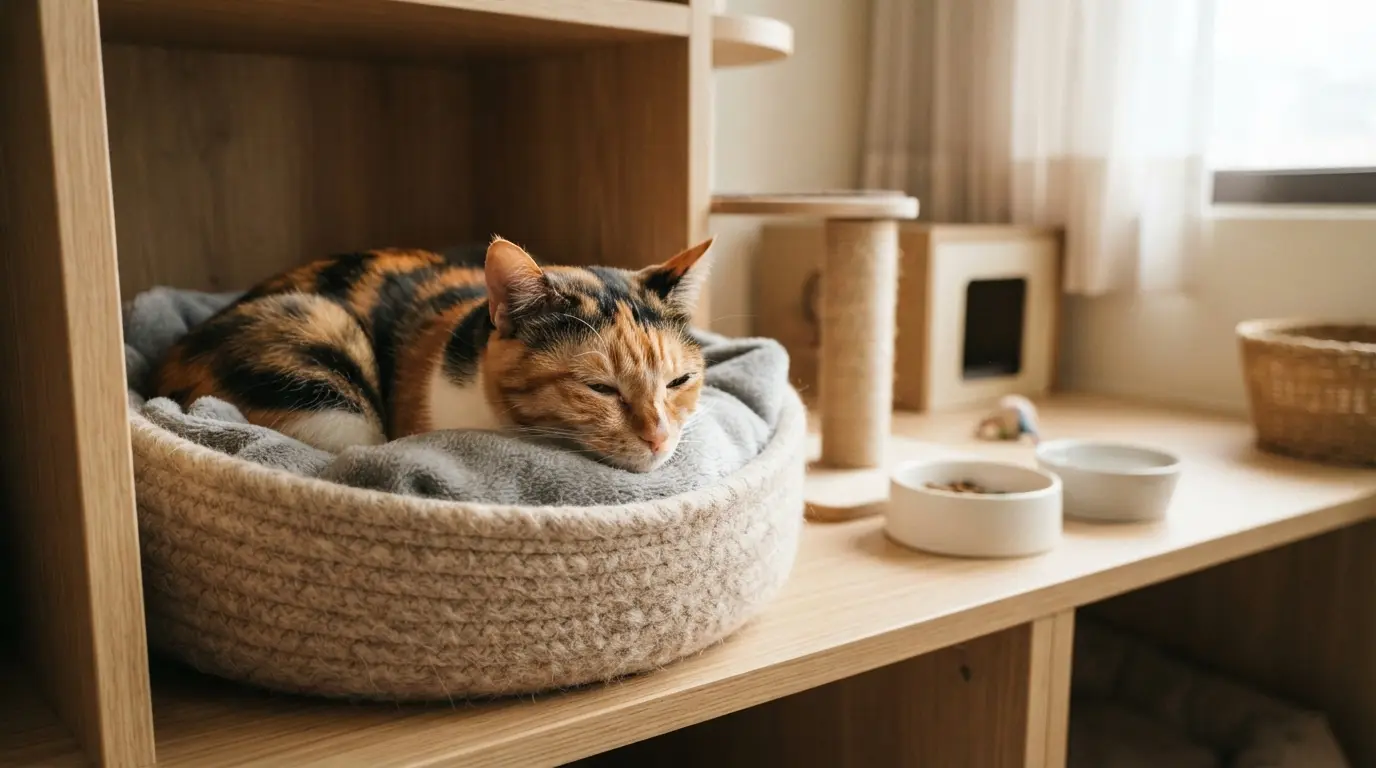
The key to boarding a fearful cat isn't "finding a very luxurious hotel," but rather finding a cat hotel that offers truly private, soundproof rooms, promises no forced interaction, and reports daily food and urine output. As long as environmental stimuli are kept low and care routines are consistent, most high-sensitivity cats that hiss or hide in their carriers will start eating and using the litter box normally within 24-48 hours of check-in, which is often more stable than leaving them at home with unfamiliar people entering and exiting daily to feed them.
Here are the selection indicators and practical tips we've compiled based on our experience with over a thousand cats at our Banqiao branch, many of whom were "brought in hissing, biting, with owners feeling guilty."
Key Takeaways
- The 5 most important indicators for boarding fearful cats are, in order: physical private rooms + soundproofing, no forced interaction SOP, accessible hiding spaces, environmental temperature/humidity control and pheromone calming, and a daily incident reporting mechanism.
- The two most dangerous numbers for cat boarding stress are: complete lack of food for 24 consecutive hours and no urination for 24 consecutive hours. Both should be immediately reported to the owner and assessed for medical attention.
- The adaptation curve for high-sensitivity cats after check-in is typically: Day 1 hiding and not eating, Day 2 starting to eat at night, Day 3 resuming bowel movements; if they still completely refuse to eat or drink after 72 hours, it's not a normal adaptation period.
- Cat stress is one of the most common triggers for Feline Idiopathic Cystitis (FIC). Frequent urination, straining in the litter box, and only producing a few drops of bloody urine after being stressed is a medical emergency.
- Bringing "about 1/3 of used cat litter from home mixed with new litter" and "an old towel with their own scent" are the two most cost-effective and impactful stress-reduction actions in practice.
Why is Boarding Fearful Cats Higher Risk?
Cats are animals that build security through "environmental familiarity." When changing locations, they have to process unfamiliar scents, sounds, people, and unseen other cats simultaneously. Their sympathetic nervous system remains activated for extended periods, leading to a chain reaction:
- Appetite Suppression: Appetite is the first thing to disappear when stressed, especially for cats that are already picky eaters.
- Holding Urine and Feces: They are afraid to leave their hiding spot to use the litter box, leading to prolonged bladder fullness.
- Gastrointestinal Upset: Soft stools, diarrhea, or conversely, no bowel movements for two to three days.
- Lower Urinary Tract Issues: Stress is a classic trigger for Feline Idiopathic Cystitis (FIC). Urinary blockage in male cats is a life-threatening emergency.
Therefore, the real question of "can fearful cats be boarded" is: Can the hotel's design and procedures minimize stimuli to a level that the cat is willing to eat and urinate? This is entirely separate from whether the decor is beautiful or if there are large playrooms. For high-sensitivity cats, open, large spaces are often the worst choice.
Indicator 1: Physical Private Rooms and Soundproofing, Not "Caged Cubicles"
This is the first hurdle for boarding fearful cats, and where most confusion lies.
Details to Confirm:
- Are the rooms fully enclosed with solid walls and a door, or are they just side-by-side cages? Even with fabric covers, cages allow sound and scent to pass through.
- Can the cat directly see another cat from within the room? Prolonged eye contact is a continuous stressor for timid cats.
- Is there independent ventilation to prevent respiratory infections and cross-contamination of odors?
- Does the hotel have zoning: Can fearful cats be placed in an area with low foot traffic, away from the entrance and the sound of dryers?
For extremely stressed cats at our facility, we place them in the room at the very end of the hallway, where staff traffic is minimal during the day, and add a fabric curtain to the door to block sightlines. This kind of "positional adjustment" is a benchmark for whether a hotel truly considers fearful cats. For a more detailed look at room differences, refer to How to Choose Private Rooms for Cat Boarding: Single Cat Cubicles, Soundproof Ventilation, and Multi-Cat Family Room Guide.
Indicator 2: No Forced Interaction SOP (The Most Overlooked Item)
Eight out of ten times, boarding a stressed cat fails not due to the environment, but because humans act too quickly. Ask the hotel these three questions directly:
1. How will the cat be released from its carrier upon arrival?
The correct answer is: Open the carrier door and place it in the room, allowing the cat to come out on its own. No forceful grabbing or tipping. It's okay if the cat stays in the carrier for half a day.
2. What will be done if the cat hides or hisses?
It should be: "Lower your body, avoid eye contact, don't reach out, place food within its reach, and then withdraw," not "comfort it, pet it to get it used to you."
3. How will the litter box be cleaned for a fearful cat?
The practical method is to quickly clean with one hand while the cat retreats to the other end of the room, or use a long-handled scoop. If necessary, gently cover the cat with a towel to obscure its vision before moving it. Never drag it by the scruff of its neck.
If the staff confidently says, "Our employees are very good at petting cats, and they'll let us pet them in two days," this is actually a red flag for high-sensitivity cats. The goal of care for fearful cats is "to be left alone just enough," not to be tamed.
Indicator 3: Accessible Hiding Spaces and Vertical Perches
Hiding is a cat's self-regulation behavior; it's not a bad thing. Cats that are willing to hide usually recover faster than those who remain frozen in place. The room should have at least:
- A semi-enclosed hiding spot: A cardboard box, a cat house, or even the owner's carrier left as a den (we use this most often because it's the only familiar scent).
- A high perch: A height that allows the cat to survey the doorway, significantly increasing their sense of control.
- Visual obstruction: A fabric curtain or partial cover on the door, allowing the cat to see out but not be constantly observed.
Litter Box Details Determine Urination
Fearful cats often hold their urine in unfamiliar environments due to an unfamiliar litter box. In practice, the effective method is to ask the owner to bring a small bag of used cat litter (about 1/3 of the new litter box) to mix in. Familiarity of scent directly affects the timing of the first urination. If the cat is accustomed to a certain texture, it's also recommended to bring their own. Our facility usually stocks fine-grained Odor Control Mineral Litter 3.0, but we will use the owner's preferred litter type if specified. For elderly cats or those with joint issues, consider the entry height. For this, refer to How to Choose a Litter Box for Senior Cats: Low-Entry Accessible Modifications, Troubleshooting Accidents, and Arthritis Care Guide.
Indicator 4: Environmental Parameters and Emotional Calming Devices
"Emotional calming" is not metaphysics; it can be quantitatively checked:
- Temperature 24-26°C, Humidity 50-60%: Too cold makes cats more tense, too hot affects appetite.
- Synthetic Feline Pheromone Diffuser or Spray: Sprays should be applied to fabric or corners of the room and allowed to sit for 10-15 minutes for the alcohol smell to dissipate before the cat is exposed, otherwise the pungent smell can be counterproductive.
- Background Noise Control: Hair dryers, bathing areas, and dog barking should not directly reach the boarding area. Having grooming and boarding in the same space without physical separation is a common hidden stressor.
- Fixed Lighting Schedule: Leave a low-brightness night light on, not completely dark or fully lit.
- Catnip or Toys Not Pushed: Cats in a stressed state usually don't react to catnip. Wait until they start exploring the room before offering it. Items like Premium Catnip are usually offered on the third day or later; the wrong timing is just a waste.
Indicator 5: Incident Reporting Mechanism and Veterinary Support
This determines whether incidents can be handled promptly. Clarify:
- Whether daily reports on food intake (in grams or cans), number of urine clumps, and stool condition are provided, not just a cute photo.
- How long without eating will trigger a notification? Our standard is to report if the cat hasn't eaten at all for over 12 hours, and discuss enhanced guidance or medical assessment if they still don't eat after 24 hours.
- Whether there is a partner veterinary hospital and if they can arrange for emergency visits on weekends.
- Whether there are surveillance cameras for review, and if night vision is available. For a detailed look at equipment differences, refer to Is Cat Boarding CCTV Important? Live Video, Night Vision, and Cat Hotel Security Equipment Checklist.
Also, a reminder: For fearful cats, excessively frequent video call requests can lead to staff constantly entering the room to adjust the camera. A better approach is to have fixed angles for the owner to view independently, without asking to "call the cat out for me to see."
Fearful Cat Hotel Assessment Checklist: Ask Directly On-Site
When calling or visiting, ask these 10 questions. If they can't answer or are vague, you can immediately disqualify them:
| # | Question | Direction of Acceptable Answer |
|---|---|---|
| 1 | Is it a physical private room or stacked cages? | Has a door, solid walls |
| 2 | Can the room see other cats? | Can arrange for obstruction or offset placement |
| 3 | Can fearful cats be placed in a low-traffic area? | Yes, and they will proactively explain the location |
| 4 | How will the cat be released from its carrier upon arrival? | Comes out on its own, no grabbing |
| 5 | What is the principle for handling hissing or hiding? | No forced interaction, withdraw |
| 6 | Can I leave my carrier as a den? | Yes |
| 7 | Can I bring used cat litter and towels from home? | Welcome |
| 8 | How is the room temperature and humidity controlled? | Specific numbers provided |
| 9 | After how many hours without eating will I be notified? | Clear threshold provided |
| 10 | How are emergencies handled on weekends? | Partner hospital and procedures in place |
We truly recommend visiting in person. What details can only be seen on-site are summarized in What to Look for When Visiting a Cat Hotel: 6 On-Site Inspection Details: Ventilation, CCTV, Soundproofing, and Traffic Flow Checklist. If you are still comparing areas and prices, you can also refer to New Taipei Cat Hotel Recommendations: How to Choose in Banqiao, Sanchong, Xinzhuang? Pricing and 6 Key Selection Points Explained.
Two-Week Pre-Stay Stress Reduction Schedule
Half the success of boarding a fearful cat is determined before leaving home.
Day 14-8: Carrier Desensitization
Remove the carrier door or fix it open. Place it in a common area where the cat frequently passes. Put familiar bedding inside and occasionally toss treats in. The goal is to change the carrier from something that triggers fear to "a den."
Day 7-4: Short Car Ride Practice
Carry the carrier around the house for 3-5 minutes, go downstairs and around the block, then return. The key is that each session ends with "returning home without incident."
Day 3: Pack Supplies
- Dry food/canned food they normally eat, plus 2-3 extra days' worth (changing food is another stressor).
- A small bag of used cat litter from home.
- An old towel or piece of clothing with their own scent (do not wash).
- Regular medications, medical records, or recent blood test results.
- If their stomach is prone to upset from stress, start giving Specialty Probiotics 5-7 days in advance. Pre-emptive building is more effective than post-event repair.
Day 1: Day of Departure
Feed them about 70% of their usual amount at their normal feeding time to avoid car sickness. Do not intentionally play with them to "tire them out."
> If time permits, consider a one-night trial stay for the first boarding. We often advise owners to do a one-night stay a month before a real trip, then observe their recovery speed at home, essentially a rehearsal for the cat.
On the Day of Handover: Clarify 3 Things
1. List of Triggers: Where not to touch, whether they might suddenly roll over and bite, what sounds they dislike. Honesty is best. Saying "my cat is very aggressive and will bite" won't lead to rejection; hiding it will cause problems.
2. Baseline Behavior: How much they normally eat at home, how often they defecate, whether they are naturally shy. Without a baseline, staff cannot identify abnormalities.
3. Decision Authority: To what extent medical attention is needed, cost limits, and who can make decisions if you cannot be reached.
Do not linger at the door for extended periods of comforting the cat during handover. Place the carrier down, convey the information, leave quickly. This is the best approach for a fearful cat – the more anxious you are, the more certain they are that this place is dangerous.
Observation Indicators During Boarding: What is Normal Adaptation and What to Worry About
Normal Adaptation Period (1-3 Days):
- Hiding in their den or carrier and not coming out.
- Not eating during the day, only at night.
- Hissing at people, swatting, ears pinned back.
- Less frequent bowel movements, slightly softer stools.
Red Flags Requiring Immediate Action:
- Complete lack of food for 24 consecutive hours (threshold is lower for kittens, diabetic cats, and seniors).
- No urination for 24 consecutive hours, or repeatedly straining in the litter box and producing only small amounts of bloody urine.
- Persistent open-mouth breathing, rapid breathing (normal resting respiratory rate for cats is about 20-30 breaths per minute).
- Excessive drooling, vomiting more than 2-3 times, severe diarrhea.
- Complete immobility, a "frozen" state with no reaction to sound lasting more than a day.
These situations should be proactively reported by the hotel, and medical assessment should be considered. If symptoms persist or worsen, seek veterinary care immediately; do not wait until you pick up the cat.
Recovery Period After Returning Home
After bringing them home, place the carrier in a familiar corner and let them come out on their own. Do not pick them up to show family members "if they've lost weight." Multi-cat households especially need to be aware: the returning cat carries unfamiliar scents, and their original companions may hiss or even fight. It's recommended to separate them for a few hours and use towels to exchange scents by rubbing. For multi-cat boarding room selection and conflict prevention, refer to How to Choose Boarding for Multi-Cat Families: Shared Large Rooms vs. Separate Room Stays, Fee Calculation, and Fighting Stress Prevention Guide.
Generally, cats will return to their normal routines within 24-48 hours. If they still have a poor appetite, hide, or show frequent urination with blood after more than 3 days, seek veterinary attention.
If you are looking for a place for your high-sensitivity cat, you are welcome to visit our facility first before deciding. We can arrange room placement and care routines based on your cat's personality. You can also book cat hotel boarding and specifically note "fearful, no interaction needed."
Frequently Asked Questions
Will a fearful, biting cat be refused by a cat hotel?
Most professional cat hotels will not refuse a cat simply because it is aggressive. We actually prefer owners to be honest so we can arrange low-interference rooms and handling procedures. Cats that are typically refused are those with symptoms of infectious diseases, incomplete vaccinations, or those with aggression that prevents safe medication administration.
Does a fearful cat need to be prescribed sedatives by a vet before boarding?
In most cases, no. Sedatives or anti-anxiety medications must be prescribed by a veterinarian after individual assessment. They should also be tested at home once to confirm the reaction. Never use human medication or leftover medication from another cat. Most fearful cats adapt well with private rooms and no forced interaction.
How many days is best for a first-time boarding stay?
If time permits, it is recommended to arrange a one-night trial stay first. Observe their appetite and urine recovery speed, then decide on the duration and room type for a longer stay. Cats with prior trial stay experience usually adapt significantly faster on their second visit.
Is it better to have someone come to the house to feed a fearful cat than to board them?
Not necessarily. The advantage of in-home feeding is a familiar environment. The disadvantage is only a brief visit once a day. If the cat develops urinary blockage, vomiting, or ingests something harmful in the middle of the night, it may be delayed for over ten hours before being discovered. For timid but healthy cats, both options are viable. For cats with chronic illnesses, a history of lower urinary tract disease, or elderly cats, boarding with constant observation is usually safer.
After returning home, my cat keeps hiding and ignoring me. Is this normal?
Within 1-2 days, it is normal. Let them come out on their own and maintain their usual feeding schedule. If they still refuse to eat or drink, or show frequent urination with blood, or persistent vomiting after more than 3 days, seek veterinary attention promptly.
Article by CatGarden Editorial Team
CatGarden offers curated supplies, cat boarding, and grooming
Book services or shop online.