Will Your Cat Bow Its Head in Apology When Scolded? A Guide to Stress Signals, Misguided Training, and Positive Guidance
Let's get straight to the point: When a cat lowers its head after being scolded, it doesn't necessarily mean it's admitting fault. Many owners interpret a cat's lowered head, squinting eyes, or turning away after being reprimanded as a sign of "knowing it did wrong." However, from a feline behavior perspective, these reactions are more often signals of stress, avoidance, and conflict mitigation.

Key takeaways
- When cats lower their heads, squint, or turn away after being scolded, it signals stress, avoidance, and conflict reduction, not an understanding of moral responsibility or admitting fault like humans.
- Common stress signals in cats when scolded include: lowering the head or tucking the body, ears flattened backward, dilated pupils, rapid tail flicking, lip licking or yawning, and hiding.
- Scolding cats is often ineffective in establishing rules. It can increase environmental stress due to loud noises and excessive movements, potentially leading to behaviors like inappropriate urination, excessive grooming, decreased appetite, or defensive aggression.
- The correct steps to improve problematic cat behavior are: calmly interrupt the conflict, identify behavioral needs (e.g., scratching, energy expenditure), provide alternatives (like scratching posts or wand toys), and immediately reward correct behavior.
- Sudden aggression, blood in urine, inability to urinate, excessive shedding, or prolonged hiding and refusal to eat may indicate underlying health issues like pain or urinary tract problems, requiring veterinary attention rather than just training or punishment.
Let's Get Straight to the Point: When Your Cat Lowers Its Head After Being Scolded, It Doesn't Necessarily Mean It's Admitting Fault
Many owners see their cats lower their heads, squint their eyes, or turn away after being scolded and believe the cat "knows it did wrong." However, from a feline behavior perspective, these reactions are more often signals of stress, avoidance, and conflict mitigation, rather than an understanding of moral responsibility like humans have.
Cats don't intentionally act out or are inherently disobedient. They simply find it difficult to precisely connect "you are angry now" with "that specific behavior just now was unacceptable." If owners rely solely on punishment, cats often learn not about rules, but that "approaching humans can be dangerous."
As we move further into 2026, more and more owners are recognizing the importance of feline behavioral psychology. Indoor cats increasingly rely on environmental setup, quality of interaction, and stress management for their well-being. To address issues like scratching, inappropriate urination, biting, or nighttime vocalization, the key isn't to scold louder, but to identify the needs behind the behavior.
6 Common Stress Signals When Your Cat is Scolded
A cat's body language is subtle. When being scolded, a cat might not be feeling "guilty," but is using its body to tell you: the cat is tense, confused, or wants the conflict to end quickly.
- Lowering head or tucking body: Reducing their presence to avoid being noticed.
- Ears flattened back: Indicates tension, defensiveness, or discomfort.
- Dilated pupils: May indicate alertness, fear, or excitement.
- Rapid tail flicking: Building emotion, potentially leading to an outburst.
- Licking lips, yawning: Common appeasement signals, not necessarily relaxation.
- Hiding or ignoring you: Actively avoiding the source of stress.
If your cat starts hiding under the bed, refuses to approach you, or becomes more aggressive after being scolded, it may have begun associating you with stress. Continuing to scold at this point will only make rebuilding trust more difficult.
Why Scolding Cats Usually Doesn't Work
Cats can learn, but they require clear, immediate, and predictable feedback. The biggest problem with scolding is that it often happens too late, is too vague, and involves excessive emotional intensity.
1. Cats Don't Always Know What You're Scolding Them For
Suppose you come home to find the sofa scratched and immediately get angry at your cat. To you, the reason is clear; but to your cat, they only know "you are scary when you come home." The cat may not be able to connect the sofa scratching from hours ago with your current anger.
2. Scolding Increases Environmental Stress
Cats are sensitive to sounds, movements, and smells. Loud reprimands, slamming tables, or chasing can put a cat into a defensive state. Over time, this stress can manifest as inappropriate urination, excessive grooming, decreased appetite, or aggressive behavior.
3. Punishment Doesn't Teach Cats "What They Can Do"
Simply saying "no" doesn't provide alternative options. A cat scratching the sofa might need to sharpen its claws; a cat meowing at night might not have had enough activity during the day; a cat biting hands might be due to a misunderstanding of play. Truly effective training involves providing the correct outlets.
Common Behavioral Myths: Cats Aren't Seeking Revenge or Being Deliberately Naughty
Many owners tend to interpret cat behavior as emotional revenge, such as "my cat is peeing outside the litter box to spite me," "my cat is biting me because it's angry," or "my cat is knocking over the trash can to provoke me." However, cat behavior is mostly related to resources, health, stress, and learning experiences.
- Inappropriate urination: May be due to urinary tract issues, litter box aversion, an unsafe location, or increased stress.
- Scratching furniture: Usually due to the need to sharpen claws, stretching, scent marking, and releasing emotions.
- Sudden biting: Could be due to overstimulation during petting, pain, unclear play boundaries, or fear.
- Rummaging through trash: May be due to food scents, boredom, exploratory needs, or inadequate environmental management.
Interpreting behavior as "intentional" makes owners more inclined to punish; viewing it as a "signal" helps us find the real cause.
What Should Owners Do When a Cat "Misbehaves"?
Step 1: Stop Escalating the Conflict
If your cat is scratching the sofa, jumping onto a dangerous surface, or biting, calmly interrupt the behavior. Do not chase, yell, or grab the cat to punish it. You can remove the dangerous item, pause the interaction, or use a toy to guide the cat away from the situation.
Step 2: Identify the Function of the Behavior
Every problem behavior has a function. Scratching furniture fulfills the need to sharpen claws, nighttime vocalization might be due to unspent energy, and inappropriate urination could be a health warning sign. Ask yourself: What is the cat getting out of this behavior? Is it attention, food, escape, play, or a sense of security?
Step 3: Provide Alternative Options
Change "you can't do this" to "you can do this instead." Place a sturdy scratching post near the sofa; set up high observation points near the dining table; satisfy hunting instincts with a wand toy; if hands are being bitten, stop hand play and use a toy to create distance.
Step 4: Reward the Behavior You Want to See
When your cat uses the scratching post, waits patiently, or allows grooming, immediately offer a small treat, praise, or interaction the cat enjoys. Cats are more likely to repeat behaviors that lead to positive outcomes.
3 Scenario Demonstrations: Shifting From Scolding to Positive Guidance
Scenario 1: Cat Scratching the Sofa
Don't wait until the sofa is ruined to punish. Place scratching posts near the sofa, trying different materials like sisal rope, corrugated cardboard, or wood. Immediately reward your cat when it uses the scratching post; if it scratches the sofa, calmly redirect it and use anti-scratch tape or furniture arrangement to reduce success.
Scenario 2: Cat Biting Hands
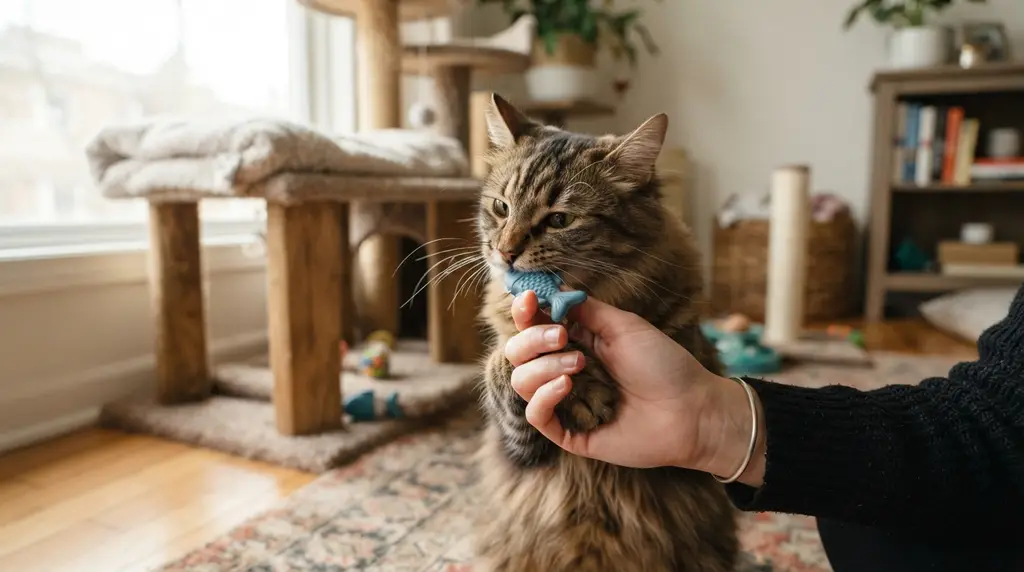
Hands should not become prey. When bitten, don't scream and pull away, as this can make the play more exciting. Stop the interaction for a few seconds and then offer a wand toy, feather wand, or kicker toy. Schedule short play sessions daily that mimic hunting, ending with a treat to provide a complete sense of satisfaction.
Scenario 3: Cat Urinating Inappropriately
Don't punish inappropriate urination first; rule out health issues. Especially if there's frequent urination, blood in urine, reduced urine output, or repeated attempts to urinate with no success, seek veterinary attention promptly. If health is not the issue, check the number of litter boxes, litter material, cleaning frequency, multi-cat resources, and sources of stress.
When to Seek Help from a Veterinarian or Behavior Specialist
If problem behaviors appear suddenly, increase in frequency, or are accompanied by changes in appetite, elimination, or activity levels, it's not recommended to rely solely on training. Pain, endocrine issues, urinary problems, skin conditions, or gastrointestinal discomfort can all make a cat sensitive, defensive, or anxious.
- Sudden aggression towards people or other cats.
- Inappropriate urination, blood in urine, or inability to urinate.
- Excessive grooming, hair loss, or red, inflamed skin.
- Prolonged hiding, refusal to eat, or unwillingness to interact.
- Persistent high anxiety after environmental changes.
When behaviors impact quality of life, veterinary examination combined with behavioral consultation is usually faster and safer than punishment alone.
Frequently Asked Questions (FAQ)
When my cat lowers its head after being scolded, does it know it did wrong?
Not necessarily. Lowering the head, avoiding eye contact, and flattening ears are usually signals of stress or avoidance. The cat may know you are angry, but doesn't necessarily understand which specific behavior was deemed wrong.
Is my cat urinating inappropriately to get revenge on me?
Usually not. Inappropriate urination is often related to urinary tract diseases, litter box stress, environmental changes, or competition for resources among multiple cats. If there is blood in the urine, frequent urination, or difficulty urinating, seek veterinary care first.
Can I use a spray bottle to punish my cat?
It's not recommended. Spraying water may temporarily interrupt the behavior, but it can also make the cat fearful of you, increase hiding, or lead to defensiveness. A better approach is environmental management and rewarding alternative behaviors.
My cat keeps misbehaving, does positive training really work?
Yes, but it requires consistency. Positive training isn't about permissiveness; it's about clearly arranging the environment, reducing the likelihood of mistakes, and letting the cat know that doing the right thing leads to good outcomes.
My cat is ignoring me after being scolded. How can I repair our relationship?
First, give your cat space and avoid forcing cuddles or close proximity. Establish predictable positive experiences through consistent feeding, gentle talk, short play sessions, and treats to help your cat feel safe again.
This article was written by the Cat Care Team based on years of practical experience at Banqiao Pure Cat Hotel. It is for owner reference only. If your cat has health concerns, please consult a veterinarian. If you need boarding or grooming services, you are welcome to use CatGarden's AI Smart Recommendation System to find the most suitable plan based on your cat's condition. All reservation information is managed in the cloud.
CatGarden | Banqiao Villa-Style Pure Cat Hotel, Offering Boarding and Grooming Services.
Further Reading
- What to Do When Your Cat Suddenly Becomes Aggressive in 2026: A Complete Guide to Environmental Stress, Pain Signals, and Safe Soothing
- Why Won't My Cat Listen to Training? 2026 Positive Reinforcement Training Basics: 5 Techniques to Get Your Cat to Cooperate
- What to Do When Your Cat Constantly Rummages Through the Trash in 2026: Essential Needs Assessment and Safe Improvement Methods for Owners
- 2026 Cat Ownership Myths Debunked: Multiple Cats Aren't Lonely, Cats Don't Need Socialization - 6 Must-Know Beginner Care Bugs
Conclusion: Understanding Signals Solves Problems Better Than Punishing Cats
Your cat's reaction after being scolded is not proof of an owner's victory or defeat, but a clue that the cat is under stress. When we shift from thinking "the cat is doing it on purpose" to "what does the cat need," we can more quickly find safe, effective, and less emotionally taxing solutions.
If you need to travel for business or leisure soon and are concerned about your cat's stress in a new environment, or if you want to understand emotional care during boarding, feel free to consult with cat hotels and professional care services. This will help your cat maintain a stable and safe living rhythm even when away from home.
→ Learn about [CatGarden - The Brand Closest to Cats](/ "CatGarden - The Brand Closest to Cats")
FAQ
When a cat lowers its head after being scolded, does it mean it knows it did something wrong?
Not necessarily. Lowering the head, avoiding eye contact, or flattening the ears are usually signs of stress and conflict avoidance. While cats can sense their owner's anger, they often cannot connect that anger to a specific prior action.
Is my cat urinating inappropriately out of revenge?
No. Inappropriate urination in cats is usually related to urinary tract diseases, litter box issues, environmental changes, or stress. If accompanied by frequent urination, blood in urine, or inability to urinate, seek veterinary attention first.
Can I use a spray bottle to punish my cat and stop bad habits?
It is not recommended. While spraying water can temporarily interrupt a behavior, it can lead to fear of humans, increased defensiveness, and hiding. The best approach is to modify the environment and reward alternative behaviors.
My cat is hiding and ignoring me after being scolded. How can I repair our relationship?
Give your cat sufficient personal space and avoid forcing cuddles or approaching them aggressively. Owners can rebuild trust by providing consistent feeding, speaking gently, engaging in short play sessions, and offering treats to establish predictable security.
How should I correctly respond when my cat bites my hand?
When bitten, avoid screaming or pulling away, as this can intensify predatory excitement. Calmly stop the interaction for a few seconds, redirect their attention with a wand toy or kicker toy, and end play sessions with a treat.
CatGarden offers curated supplies, cat boarding, and grooming
Book services or shop online.