What to Do When Your Cat Bites? Training Methods for Kittens Who Bite Hands and Feet, Teething Chewing, and Sudden Attacks

Cat bites are rarely due to "bad temper"; they stem from play, teething, overstimulation, or fear-based defense. This article breaks down how to identify the four main motivations behind biting and provides non-punitive, in-clinic training steps for redirection and desensitization.
CatGarden Editorial TeamPublished 2026/08/29Updated 2026/10/06
Cat BehaviorKitten CareCat Training
What to Do When Your Cat Bites? Training Methods for Kittens Who Bite Hands and Feet, Teething Chewing, and Sudden Attacks

Nine times out of ten, when a cat bites, it's not because they have a "bad personality." It's because they see your hand as a toy, they're teething and their gums itch, they want to end an interaction, or they feel scared and are defending themselves. The key to correcting this behavior lies in two things: immediately stop the interaction (no hitting, no scolding, no yelling), and engage in consistent hunting-style play every day to redirect their biting urges towards toys. If you do these two things correctly, most kitten biting issues will significantly decrease within 2-6 weeks.

We interact with hundreds of cats at our Banqiao branch every month, and the ones who bite the most are often not "aggressive cats," but rather energetic and super affectionate kittens aged 3-6 months. They don't dislike you; they just want to play too much—they just don't know how to play correctly.

Key Takeaways

  • Cat biting motivations can be categorized into four main types: playful aggression (most common, seen in 2-6 month olds), teething chewing (around 3-6 months old), petting-induced aggression, and fear/pain-induced defensive aggression.
  • Kitten teething occurs approximately from 3-6 months of age, with the process of losing baby teeth and growing adult teeth completing around 7 months. During this period, chewing needs significantly increase, which is a normal physiological phenomenon.
  • The most effective way to correct playful biting is "the moment they bite, the game ends": the instant they bite, stop moving, withdraw your hand, and leave the area for 30-60 seconds. This establishes a clear consequence: biting equals the end of play.
  • Twice daily, for 10-15 minutes each session, engaging in interactive wand toy hunting games (stalk, pounce, bite, eat, sleep) is the most effective preventative measure to reduce biting hands and feet.
  • Absolutely do not hit, flick their nose, grab their scruff, or yell loudly: These actions can escalate playful biting into fear-based aggression, making it much harder to manage. If biting suddenly occurs and is accompanied by vocalizations of pain, hiding, or decreased appetite, consult a veterinarian first to rule out pain.

First, Understand: The 4 Motivations Behind Cat Bites

Even though it's still "biting," the approach to each situation is completely different. Classify first, then train.

1. Playful Aggression (Most Common in Kittens Biting Hands)

Typical Scenario: You walk down the hallway, and the cat darts out from under the sofa, grabs your ankle, bites a couple of times, and runs off. Or, you reach out to pet them, and they roll over, kick with their hind legs, and bite your hand.

Identifying Features:

  • Dilated pupils, hindquarters raised, tail swishing, but ears are forward and there's no growling or hissing.
  • The bite force varies, and they release after biting, seeming eager to continue.
  • Most common when you've just returned home, late at night, or shortly after they wake up from a nap.

This is a lack of an outlet for their hunting instincts. It's most common in single-cat households, kittens weaned too early, or cats that humans have played with directly using their hands.

2. Teething Chewing

Kittens start teething around 3-6 months old. Their gums become swollen and itchy, leading them to seek things to chew on. At this stage, they typically bite fingers, earlobes, noses, electrical cords, and charging cables—anything with a soft yet firm texture will be tested.

You might observe: small, needle-like baby teeth on the litter box or floor, increased drooling, or the cat tilting its head to chew dry kibble. The biting during this phase is usually gentle, like gnawing, not aggressive.

3. Petting-Induced Aggression

This is the most easily misunderstood type, often mistaken as the cat "suddenly turning on you." Your cat might purr on your lap for five minutes, then suddenly turn and bite you before jumping off.

The reason is that repeated petting can cause sensory nerves in the skin to accumulate stimulation, becoming uncomfortable once a threshold is reached. There are always warning signals before a bite, but humans often overlook them:

  • Tail begins to swish or twitch rhythmically.
  • Skin twitches, and back muscles ripple.
  • Ears turn to the sides (airplane ears).
  • Stops purring, head turns towards your hand.

When you see these signals, it's time to stop petting. This way, you'll never get bitten.

4. Fear/Pain-Induced Defensive Aggression

If an adult cat suddenly starts biting, this type should be suspected first. Characteristics include a lowered body posture, flattened ears pulled back, fully dilated pupils, hissing or growling, raised fur, and a strong bite that they hold onto, often accompanied by scratching.

Common Triggers:

  • Nail trimming, being picked up, ear cleaning, being forcibly removed from a high place.
  • Pain (arthritis, dental pain, bladder inflammation, injury).
  • Redirected aggression: Seeing stray cats outside the window, hearing loud noises, and having nowhere to release their pent-up emotions, so they lash out at whoever is nearby.

If your cat was previously gentle and has recently become prone to biting, and also shows signs like decreased appetite, hiding, slower movement, less jumping, or cat not eating, drinking, or sleeping all day, consult a veterinarian first to rule out pain before attempting behavior modification. Behavior training cannot cure a toothache.

The Core of Non-Punitive Correction: The Four-Step "The Moment They Bite, The Game Ends" Method

This is the consistent approach we use with kittens at our facility, and it's easily replicable at home.

Step 1 | The Instant They Bite, Make Your Hand Uninteresting. Don't yank your hand away or pull it out quickly—a fast movement can trigger a stronger hunting response and make them bite harder. Instead, relax your entire hand and hold it still, while making a short, low-pitched "Ah" sound (not a scream).

Step 2 | The Moment They Release, Immediately Withdraw Your Hand and Leave. You can go into the bathroom or close the door to another room. The goal is to make yourself "disappear" for 30-60 seconds. The cat needs to learn the cause-and-effect: biting = the fun thing disappears.

Step 3 | After Returning, Don't Scold. Immediately Redirect to a Toy. Offer a wand toy or a plush toy for them to bite to their heart's content. The aim isn't to punish the act of biting, but to change the target of the bite.

Step 4 | Be Consistent Every Time. Everyone in the household must follow the same procedure. If even one person continues to play "hand-fighting" with the cat, the training will fail. A cat's logic is: "Sometimes it's okay" means "I can try anytime."

Practices You Must Avoid

Common MistakeWhy It's Ineffective
Spanking, flicking the noseCats won't associate it with "biting," only with "this person's hand hurts me." It escalates playful biting into defensive biting.
Yelling loudlySome cats become more excited, perceiving it as a game. Others experience long-term anxiety.
Grabbing the scruff and liftingFor adult cats, grabbing the scruff is a threat posture and significantly increases the risk of aggression.
Poking them with fingers, teasing them to chase your handThis directly trains them that "hands are prey."
Spraying water or deterrent spraysCats learn that "approaching you is unsafe," damaging trust.

Kitten Biting Hands and Feet: Daily Routines to "Use Up" Hunting Needs

When dealing with kittens biting, 80% of your effort should be on prevention, not correction.

Two Full Hunting Cycles Daily

A cat's natural behavior chain is: stalk → creep → chase → pounce → bite → groom → sleep. Toy play should follow this entire sequence for the cat to feel truly "satisfied."

  • Timing: Once in the morning before leaving, and once at night before bed. Each session should last 10-15 minutes.
  • Method: Use a wand toy to mimic a bird or mouse—crawl along the ground, hide behind furniture, suddenly freeze. Avoid waving it aimlessly in the air.
  • Conclusion: Finally, let them successfully pounce and hold the toy, biting it for ten seconds. Immediately follow this with a small portion of wet food or a treat. They will then groom themselves and go to sleep.
  • Taboo: Do not end the game with a laser pointer. The inability to catch a physical object can lead to frustration, and some cats may redirect their aggression by biting.

In practice, we often observe that kittens who have played enough during the day are significantly less likely to dart out and bite feet at night. If your cat is particularly active at night, try moving the second play session to within 30 minutes of bedtime for better results.

Provide Them with Legal Things to Bite

Kittens need toys they can hold with their whole body and bite. The thin end of a wand toy isn't sufficient.

  • Kicker toys: Long, cylindrical toys that cats can hold with their hind legs and bite.
  • Catnip toys or a small pinch of premium catnip: Catnip induces rolling and biting, making it the quickest way to redirect biting away from hands (about 30% of cats don't react to catnip; try silvervine instead).
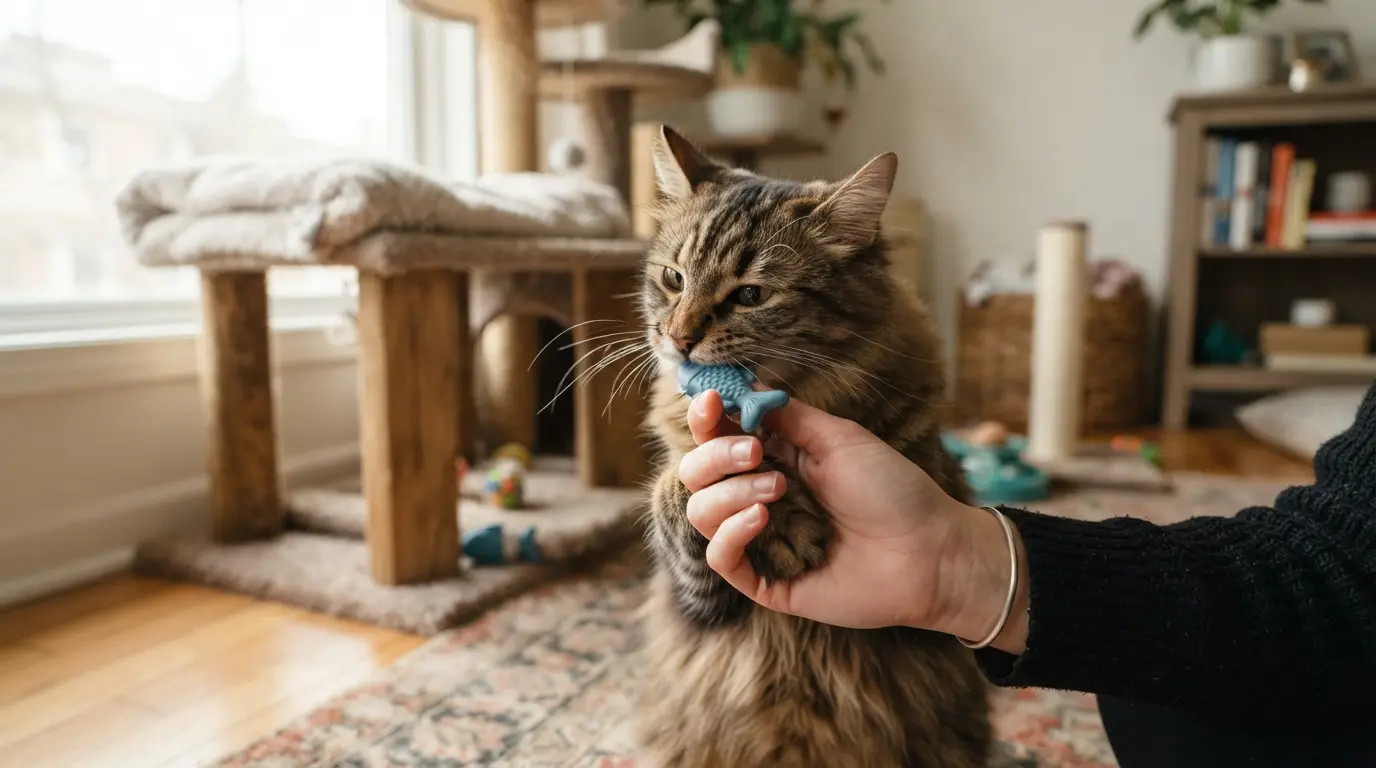
  • For teething: Chilled silicone teething toys, edible dental chews.

Also, don't overlook the need for scratching and chewing outlets. Cats lacking sufficient outlets for scratching tend to have a lower threshold for overall excitement and are more prone to biting. Ensure you have at least one scratching post they actually use. Choosing the wrong material often results in it being ignored, so consider reading How to Choose a Cat Scratcher before buying.

Environmental Enrichment: It's Not About Having More Toys

  • Vertical Space: High vantage points by windows overlooking the outdoors provide effortless entertainment.
  • Food Puzzles: Put 1/3 of their daily dry food ration into puzzle feeders or hide it in cardboard boxes.
  • Predictable Routine: Cats are sensitive to changes in routine. The start of school, returning from vacation, or periods of overtime are prime times for behavioral issues to emerge. The routine adjustment methods in What to Do About Cat Separation Anxiety When Returning to School or Adjusting Routines are equally applicable here.
  • Consider a Second Cat? Playful wrestling between same-aged kittens can indeed reduce biting significantly. However, improper introduction can increase stress, so it's not a magic bullet.

Desensitization Training for Petting-Induced Aggression: The 3-Second Rule

If your cat tends to "bite mid-petting," use this method.

1. Establish a Baseline: Count how many strokes it takes for your cat to start swishing their tail. Let's say it's 15 strokes.

2. Proactively Stop Before the Threshold: Only pet 8-10 strokes, then proactively stop and offer a small treat. This teaches them that "ending" is a pleasant experience, rather than something they must achieve by biting.

3. Pet Only Safe Zones: Chin, sides of the cheeks, forehead, behind the ears—these are areas cats groom each other. The lower back, base of the tail, belly, and limbs are high-risk areas; avoid them during the training period.

4. Give Them the Right to Say No: Offer a finger and let them come to you to rub against it. If they don't initiate contact, don't pet them. With this step mastered, many cats' biting problems will resolve on their own.

5. Increase by 1-2 Strokes Every 1-2 Weeks: Gradually extend the petting duration.

This logic is similar to how we desensitize cats who are afraid of nail trims: always end before they become overwhelmed. To understand how cats typically express trust through posture and location, you can read What Does Your Cat's Sleeping Position Mean? Interpreting Sleep Postures, Locations, and Their Affection Level to better recognize early signs of discomfort.

Safely Handling Sudden Attacks

For cats in a true aggressive state (growling, hissing, fur raised, pupils fully dilated), training is ineffective; focus on de-escalation first:

  • Do not reach out to comfort them, do not pick them up, do not make direct eye contact. Slowly turn sideways and back away.
  • Use a large towel, cardboard box, or thick cardboard as a visual barrier to separate them from the trigger.
  • Allow them to be alone in a quiet, dimly lit room for at least 30-60 minutes. In severe cases, it may take several hours to return to baseline. Attempting to interact too soon will likely result in another bite.
  • Afterward, try to identify the "trigger": Was there a cat outside? Did you just trim their nails? Was there a stranger present? Documenting this will help you avoid it in the future.

Any bite that causes bleeding must be treated. Cat teeth are long and thin, creating small but deep wounds that can easily introduce bacteria into deeper tissues, posing a higher infection risk than it might appear. Rinse the wound with clean water for 5 minutes, disinfect it, and if you notice redness, swelling, heat, throbbing pain, or fever, seek medical attention promptly.

When to Seek Professional Help

  • Aggression suddenly appears in a previously gentle adult cat (consult a veterinarian first to rule out pain and thyroid or neurological issues).
  • The cat bites and holds on, causing injuries that require medical attention.
  • You have consistently implemented the "the moment they bite, the game ends" method and daily play for 6-8 weeks with no improvement.
  • There are young children or elderly individuals with mobility issues in the household.

In these cases, it's recommended to consult a veterinarian experienced in feline behavior, possibly with the aid of medication or pheromone supplements. Behavioral issues are easier to manage the earlier they are addressed.

An Often-Overlooked Variable: Unfamiliar Environments Can Exacerbate Biting Behavior

At our New Taipei Cat Boarding facility, we clearly understand one thing: the biting patterns of the same cat can be entirely different in their home environment versus an unfamiliar one. A kitten who bites hands at home might hide and refuse to move all day at the boarding facility; a previously gentle adult cat might bite when forcibly removed from a carrier.

Therefore, if you need to travel, please proactively inform the caregiver about your cat's biting issues, including: triggers for biting, whether they can be petted, where it's safe to pet them, and if bite-resistant gloves are needed. We would rather a pet owner honestly state "my cat bites" than have a caregiver get injured on the first day and then be too afraid to interact for the entire duration—that would be the worst outcome for the cat. If you have specific needs, you can directly book a Banqiao cat boarding stay and note the behavioral information on the check-in form. We will adjust our interaction methods accordingly.

Frequently Asked Questions

Can I hit my cat when it bites?

No. Hitting, flicking their nose, grabbing their scruff, or yelling loudly will not help the cat associate the punishment with "biting." They will only associate it with "this person's hand is dangerous," leading to playful biting escalating into fear-based aggression, which is much harder to correct. The correct approach is to stop the interaction the moment they bite and leave the area for 30-60 seconds.

My kitten bites my hands during teething. Do I need to correct it?

Yes, but the focus should be on "changing the target" rather than stopping the behavior. Teething (around 3-6 months) is a normal physiological need due to itchy gums. Provide chilled silicone teething toys, kicker toys, or dental chews, and strictly avoid playing with your cat using your hands. If you allow them to bite your hands, this habit may persist after their adult teeth come in, but with increased force.

How long does it typically take for cat biting correction to be effective?

For kitten playful biting, if the entire family consistently implements the "the moment they bite, the game ends" method and daily play sessions of 10-15 minutes, you'll usually see a decrease in frequency within 2-3 weeks and significant improvement within 6-8 weeks. Fear-based or pain-induced aggression has a much wider time frame and requires addressing medical and environmental factors first.

Why does my cat suddenly bite me when I'm petting them?

This is petting-induced aggression. Repeated petting accumulates sensory stimulation in the skin, becoming uncomfortable once a threshold is reached. There are always warning signs before a bite: tail swishing, skin twitching, ears turning sideways, or stopping purring. Proactively stop petting before these signals appear, and avoid the lower back, base of the tail, and belly.

My adult cat suddenly started biting. Is it sick?

It's possible. If a previously gentle adult cat suddenly becomes aggressive, the first priority is to rule out pain (dental, arthritis, bladder inflammation, injury) and thyroid or neurological issues, especially if accompanied by decreased appetite, hiding, reduced activity, or changes in vocalization. Please consult a veterinarian first and do not solely treat it as a behavioral problem.


If you'd like to provide your cat with more legal outlets for biting, scratching, and playing, you can browse our selection of toys and dental chews in the Shop.

This article was written by the CatGarden editorial team. The advice provided is based on frontline experience from our cat boarding and grooming services and cannot replace veterinary diagnosis. If your cat's biting is accompanied by signs of pain or causes injuries requiring medical attention, please consult a veterinarian promptly.

CatGarden offers curated supplies, cat boarding, and grooming

Book services or shop online.

Back

Blog

What to Do When Your Cat Bites? Training Methods for Kittens Who Bite Hands and Feet, Teething Chewing, and Sudden Attacks

CatGarden Editorial TeamPublished 2026/08/29Updated 2026/10/06
Cat BehaviorKitten CareCat Training
What to Do When Your Cat Bites? Training Methods for Kittens Who Bite Hands and Feet, Teething Chewing, and Sudden Attacks

Nine times out of ten, when a cat bites, it's not because they have a "bad personality." It's because they see your hand as a toy, they're teething and their gums itch, they want to end an interaction, or they feel scared and are defending themselves. The key to correcting this behavior lies in two things: immediately stop the interaction (no hitting, no scolding, no yelling), and engage in consistent hunting-style play every day to redirect their biting urges towards toys. If you do these two things correctly, most kitten biting issues will significantly decrease within 2-6 weeks.

We interact with hundreds of cats at our Banqiao branch every month, and the ones who bite the most are often not "aggressive cats," but rather energetic and super affectionate kittens aged 3-6 months. They don't dislike you; they just want to play too much—they just don't know how to play correctly.

Key Takeaways

  • Cat biting motivations can be categorized into four main types: playful aggression (most common, seen in 2-6 month olds), teething chewing (around 3-6 months old), petting-induced aggression, and fear/pain-induced defensive aggression.
  • Kitten teething occurs approximately from 3-6 months of age, with the process of losing baby teeth and growing adult teeth completing around 7 months. During this period, chewing needs significantly increase, which is a normal physiological phenomenon.
  • The most effective way to correct playful biting is "the moment they bite, the game ends": the instant they bite, stop moving, withdraw your hand, and leave the area for 30-60 seconds. This establishes a clear consequence: biting equals the end of play.
  • Twice daily, for 10-15 minutes each session, engaging in interactive wand toy hunting games (stalk, pounce, bite, eat, sleep) is the most effective preventative measure to reduce biting hands and feet.
  • Absolutely do not hit, flick their nose, grab their scruff, or yell loudly: These actions can escalate playful biting into fear-based aggression, making it much harder to manage. If biting suddenly occurs and is accompanied by vocalizations of pain, hiding, or decreased appetite, consult a veterinarian first to rule out pain.

First, Understand: The 4 Motivations Behind Cat Bites

Even though it's still "biting," the approach to each situation is completely different. Classify first, then train.

1. Playful Aggression (Most Common in Kittens Biting Hands)

Typical Scenario: You walk down the hallway, and the cat darts out from under the sofa, grabs your ankle, bites a couple of times, and runs off. Or, you reach out to pet them, and they roll over, kick with their hind legs, and bite your hand.

Identifying Features:

  • Dilated pupils, hindquarters raised, tail swishing, but ears are forward and there's no growling or hissing.
  • The bite force varies, and they release after biting, seeming eager to continue.
  • Most common when you've just returned home, late at night, or shortly after they wake up from a nap.

This is a lack of an outlet for their hunting instincts. It's most common in single-cat households, kittens weaned too early, or cats that humans have played with directly using their hands.

2. Teething Chewing

Kittens start teething around 3-6 months old. Their gums become swollen and itchy, leading them to seek things to chew on. At this stage, they typically bite fingers, earlobes, noses, electrical cords, and charging cables—anything with a soft yet firm texture will be tested.

You might observe: small, needle-like baby teeth on the litter box or floor, increased drooling, or the cat tilting its head to chew dry kibble. The biting during this phase is usually gentle, like gnawing, not aggressive.

3. Petting-Induced Aggression

This is the most easily misunderstood type, often mistaken as the cat "suddenly turning on you." Your cat might purr on your lap for five minutes, then suddenly turn and bite you before jumping off.

The reason is that repeated petting can cause sensory nerves in the skin to accumulate stimulation, becoming uncomfortable once a threshold is reached. There are always warning signals before a bite, but humans often overlook them:

  • Tail begins to swish or twitch rhythmically.
  • Skin twitches, and back muscles ripple.
  • Ears turn to the sides (airplane ears).
  • Stops purring, head turns towards your hand.

When you see these signals, it's time to stop petting. This way, you'll never get bitten.

4. Fear/Pain-Induced Defensive Aggression

If an adult cat suddenly starts biting, this type should be suspected first. Characteristics include a lowered body posture, flattened ears pulled back, fully dilated pupils, hissing or growling, raised fur, and a strong bite that they hold onto, often accompanied by scratching.

Common Triggers:

  • Nail trimming, being picked up, ear cleaning, being forcibly removed from a high place.
  • Pain (arthritis, dental pain, bladder inflammation, injury).
  • Redirected aggression: Seeing stray cats outside the window, hearing loud noises, and having nowhere to release their pent-up emotions, so they lash out at whoever is nearby.

If your cat was previously gentle and has recently become prone to biting, and also shows signs like decreased appetite, hiding, slower movement, less jumping, or cat not eating, drinking, or sleeping all day, consult a veterinarian first to rule out pain before attempting behavior modification. Behavior training cannot cure a toothache.

The Core of Non-Punitive Correction: The Four-Step "The Moment They Bite, The Game Ends" Method

This is the consistent approach we use with kittens at our facility, and it's easily replicable at home.

Step 1 | The Instant They Bite, Make Your Hand Uninteresting. Don't yank your hand away or pull it out quickly—a fast movement can trigger a stronger hunting response and make them bite harder. Instead, relax your entire hand and hold it still, while making a short, low-pitched "Ah" sound (not a scream).

Step 2 | The Moment They Release, Immediately Withdraw Your Hand and Leave. You can go into the bathroom or close the door to another room. The goal is to make yourself "disappear" for 30-60 seconds. The cat needs to learn the cause-and-effect: biting = the fun thing disappears.

Step 3 | After Returning, Don't Scold. Immediately Redirect to a Toy. Offer a wand toy or a plush toy for them to bite to their heart's content. The aim isn't to punish the act of biting, but to change the target of the bite.

Step 4 | Be Consistent Every Time. Everyone in the household must follow the same procedure. If even one person continues to play "hand-fighting" with the cat, the training will fail. A cat's logic is: "Sometimes it's okay" means "I can try anytime."

Practices You Must Avoid

Common MistakeWhy It's Ineffective
Spanking, flicking the noseCats won't associate it with "biting," only with "this person's hand hurts me." It escalates playful biting into defensive biting.
Yelling loudlySome cats become more excited, perceiving it as a game. Others experience long-term anxiety.
Grabbing the scruff and liftingFor adult cats, grabbing the scruff is a threat posture and significantly increases the risk of aggression.
Poking them with fingers, teasing them to chase your handThis directly trains them that "hands are prey."
Spraying water or deterrent spraysCats learn that "approaching you is unsafe," damaging trust.

Kitten Biting Hands and Feet: Daily Routines to "Use Up" Hunting Needs

When dealing with kittens biting, 80% of your effort should be on prevention, not correction.

Two Full Hunting Cycles Daily

A cat's natural behavior chain is: stalk → creep → chase → pounce → bite → groom → sleep. Toy play should follow this entire sequence for the cat to feel truly "satisfied."

  • Timing: Once in the morning before leaving, and once at night before bed. Each session should last 10-15 minutes.
  • Method: Use a wand toy to mimic a bird or mouse—crawl along the ground, hide behind furniture, suddenly freeze. Avoid waving it aimlessly in the air.
  • Conclusion: Finally, let them successfully pounce and hold the toy, biting it for ten seconds. Immediately follow this with a small portion of wet food or a treat. They will then groom themselves and go to sleep.
  • Taboo: Do not end the game with a laser pointer. The inability to catch a physical object can lead to frustration, and some cats may redirect their aggression by biting.

In practice, we often observe that kittens who have played enough during the day are significantly less likely to dart out and bite feet at night. If your cat is particularly active at night, try moving the second play session to within 30 minutes of bedtime for better results.

Provide Them with Legal Things to Bite

Kittens need toys they can hold with their whole body and bite. The thin end of a wand toy isn't sufficient.

  • Kicker toys: Long, cylindrical toys that cats can hold with their hind legs and bite.
  • Catnip toys or a small pinch of premium catnip: Catnip induces rolling and biting, making it the quickest way to redirect biting away from hands (about 30% of cats don't react to catnip; try silvervine instead).
  • For teething: Chilled silicone teething toys, edible dental chews.

Also, don't overlook the need for scratching and chewing outlets. Cats lacking sufficient outlets for scratching tend to have a lower threshold for overall excitement and are more prone to biting. Ensure you have at least one scratching post they actually use. Choosing the wrong material often results in it being ignored, so consider reading How to Choose a Cat Scratcher before buying.

Environmental Enrichment: It's Not About Having More Toys

  • Vertical Space: High vantage points by windows overlooking the outdoors provide effortless entertainment.
  • Food Puzzles: Put 1/3 of their daily dry food ration into puzzle feeders or hide it in cardboard boxes.
  • Predictable Routine: Cats are sensitive to changes in routine. The start of school, returning from vacation, or periods of overtime are prime times for behavioral issues to emerge. The routine adjustment methods in What to Do About Cat Separation Anxiety When Returning to School or Adjusting Routines are equally applicable here.
  • Consider a Second Cat? Playful wrestling between same-aged kittens can indeed reduce biting significantly. However, improper introduction can increase stress, so it's not a magic bullet.

Desensitization Training for Petting-Induced Aggression: The 3-Second Rule

If your cat tends to "bite mid-petting," use this method.

1. Establish a Baseline: Count how many strokes it takes for your cat to start swishing their tail. Let's say it's 15 strokes.

2. Proactively Stop Before the Threshold: Only pet 8-10 strokes, then proactively stop and offer a small treat. This teaches them that "ending" is a pleasant experience, rather than something they must achieve by biting.

3. Pet Only Safe Zones: Chin, sides of the cheeks, forehead, behind the ears—these are areas cats groom each other. The lower back, base of the tail, belly, and limbs are high-risk areas; avoid them during the training period.

4. Give Them the Right to Say No: Offer a finger and let them come to you to rub against it. If they don't initiate contact, don't pet them. With this step mastered, many cats' biting problems will resolve on their own.

5. Increase by 1-2 Strokes Every 1-2 Weeks: Gradually extend the petting duration.

This logic is similar to how we desensitize cats who are afraid of nail trims: always end before they become overwhelmed. To understand how cats typically express trust through posture and location, you can read What Does Your Cat's Sleeping Position Mean? Interpreting Sleep Postures, Locations, and Their Affection Level to better recognize early signs of discomfort.

Safely Handling Sudden Attacks

For cats in a true aggressive state (growling, hissing, fur raised, pupils fully dilated), training is ineffective; focus on de-escalation first:

  • Do not reach out to comfort them, do not pick them up, do not make direct eye contact. Slowly turn sideways and back away.
  • Use a large towel, cardboard box, or thick cardboard as a visual barrier to separate them from the trigger.
  • Allow them to be alone in a quiet, dimly lit room for at least 30-60 minutes. In severe cases, it may take several hours to return to baseline. Attempting to interact too soon will likely result in another bite.
  • Afterward, try to identify the "trigger": Was there a cat outside? Did you just trim their nails? Was there a stranger present? Documenting this will help you avoid it in the future.

Any bite that causes bleeding must be treated. Cat teeth are long and thin, creating small but deep wounds that can easily introduce bacteria into deeper tissues, posing a higher infection risk than it might appear. Rinse the wound with clean water for 5 minutes, disinfect it, and if you notice redness, swelling, heat, throbbing pain, or fever, seek medical attention promptly.

When to Seek Professional Help

  • Aggression suddenly appears in a previously gentle adult cat (consult a veterinarian first to rule out pain and thyroid or neurological issues).
  • The cat bites and holds on, causing injuries that require medical attention.
  • You have consistently implemented the "the moment they bite, the game ends" method and daily play for 6-8 weeks with no improvement.
  • There are young children or elderly individuals with mobility issues in the household.

In these cases, it's recommended to consult a veterinarian experienced in feline behavior, possibly with the aid of medication or pheromone supplements. Behavioral issues are easier to manage the earlier they are addressed.

An Often-Overlooked Variable: Unfamiliar Environments Can Exacerbate Biting Behavior

At our New Taipei Cat Boarding facility, we clearly understand one thing: the biting patterns of the same cat can be entirely different in their home environment versus an unfamiliar one. A kitten who bites hands at home might hide and refuse to move all day at the boarding facility; a previously gentle adult cat might bite when forcibly removed from a carrier.

Therefore, if you need to travel, please proactively inform the caregiver about your cat's biting issues, including: triggers for biting, whether they can be petted, where it's safe to pet them, and if bite-resistant gloves are needed. We would rather a pet owner honestly state "my cat bites" than have a caregiver get injured on the first day and then be too afraid to interact for the entire duration—that would be the worst outcome for the cat. If you have specific needs, you can directly book a Banqiao cat boarding stay and note the behavioral information on the check-in form. We will adjust our interaction methods accordingly.

Frequently Asked Questions

Can I hit my cat when it bites?

No. Hitting, flicking their nose, grabbing their scruff, or yelling loudly will not help the cat associate the punishment with "biting." They will only associate it with "this person's hand is dangerous," leading to playful biting escalating into fear-based aggression, which is much harder to correct. The correct approach is to stop the interaction the moment they bite and leave the area for 30-60 seconds.

My kitten bites my hands during teething. Do I need to correct it?

Yes, but the focus should be on "changing the target" rather than stopping the behavior. Teething (around 3-6 months) is a normal physiological need due to itchy gums. Provide chilled silicone teething toys, kicker toys, or dental chews, and strictly avoid playing with your cat using your hands. If you allow them to bite your hands, this habit may persist after their adult teeth come in, but with increased force.

How long does it typically take for cat biting correction to be effective?

For kitten playful biting, if the entire family consistently implements the "the moment they bite, the game ends" method and daily play sessions of 10-15 minutes, you'll usually see a decrease in frequency within 2-3 weeks and significant improvement within 6-8 weeks. Fear-based or pain-induced aggression has a much wider time frame and requires addressing medical and environmental factors first.

Why does my cat suddenly bite me when I'm petting them?

This is petting-induced aggression. Repeated petting accumulates sensory stimulation in the skin, becoming uncomfortable once a threshold is reached. There are always warning signs before a bite: tail swishing, skin twitching, ears turning sideways, or stopping purring. Proactively stop petting before these signals appear, and avoid the lower back, base of the tail, and belly.

My adult cat suddenly started biting. Is it sick?

It's possible. If a previously gentle adult cat suddenly becomes aggressive, the first priority is to rule out pain (dental, arthritis, bladder inflammation, injury) and thyroid or neurological issues, especially if accompanied by decreased appetite, hiding, reduced activity, or changes in vocalization. Please consult a veterinarian first and do not solely treat it as a behavioral problem.


If you'd like to provide your cat with more legal outlets for biting, scratching, and playing, you can browse our selection of toys and dental chews in the Shop.

This article was written by the CatGarden editorial team. The advice provided is based on frontline experience from our cat boarding and grooming services and cannot replace veterinary diagnosis. If your cat's biting is accompanied by signs of pain or causes injuries requiring medical attention, please consult a veterinarian promptly.

One email a month of cat-care tips

Hand-picked care, behavior and grooming tips once a month. Subscribe and we will send you our three most-read articles right away.

Keep reading