How to Choose a Cat Scratching Post: A Complete Guide to Materials, Shapes, and Cat Acceptance

Choosing a cat scratching post hinges on three key factors: matching your cat's natural scratching posture, ensuring it's large and stable enough, and placing it along their usual pathways. This guide, with material comparison charts and size recommendations, will help you pick the right one without wasting money.
CatGarden Editorial TeamPublished 2026/08/24Updated 2026/10/06
cat scratching posthow to choose cat scratching postcat scratching post recommendationscat scratching post materialsnew cat owner
How to Choose a Cat Scratching Post: A Complete Guide to Materials, Shapes, and Cat Acceptance

Choosing a cat scratching post doesn't have to be a confusing price comparison game. Just confirm three things, and you won't buy the wrong one: does it match their natural scratching posture (standing or lying down), is it large and stable enough not to wobble, and is it placed along their daily routes? If even one of these points is off, even the most expensive scratching post will just become a dust collector in your living room.

We deal with dozens of cats with different personalities at our cat hotel every day. Our rooms always have two types of scratching posts (a slanted corrugated cardboard one and a vertical sisal post). Over more than a decade, we've come to a clear conclusion: cats often reject not the material, but the size and placement. This article will clarify everything from a purchasing perspective, covering materials, shapes, sizes, placement, and introduction methods all at once.

Key Takeaways

  • For vertical scratching posts, choose one over 60 cm tall: Adult cats need 50-70 cm in height to stretch fully when standing. Posts shorter than 50 cm don't allow cats to fully extend their back muscles, leading to significantly lower acceptance.
  • For flat scratching pads, aim for a length of at least 45 cm: When a cat scratches lying down, their front paws to chest alone can take up over 30 cm. If it's too short, they won't fit comfortably.
  • The practical formula for the number of scratching posts is number of cats + 1, distributed across different rooms. If you only have one in a multi-cat household, a dominant cat might monopolize it.
  • Corrugated cardboard scratchers typically last 1-3 months (you can flip them over once one side is used up). Sisal lasts about 6-12 months, and wood/solid wood posts can last for years. When calculated monthly, sisal and wood are actually more cost-effective.
  • For the first 3 days with a new scratching post, place it within 1 meter of your cat's sleeping area and sprinkle a small amount of catnip to encourage use. Most cats will start using it consistently within 3-7 days.

Why Doesn't My Cat Use the Scratching Post I Bought?

Let's clarify the reasons first, so you know what to choose. The most common complaint we hear is, "I bought three, and none of them worked; they only scratch the sofa." In reality, the reasons almost always fall into these four categories:

1. Incorrect Posture: If your cat scratches the sides of the sofa or door frames, it means they are the "standing scratcher" type. Buying a flat cardboard pad, of course, they won't use it.

2. Wobbles or Slips: When scratching, if the post moves, the cat perceives it as "unreliable" and gives up after one try. This is a common problem with lightweight plastic posts and cardboard pads without non-slip bases.

3. Placed in a Corner: Scratching is a behavior that also leaves scent and visual markers, requiring a place that is "visible to everyone." Hiding it on the balcony or behind the sofa renders its purpose useless.

4. Too Small: The main point of scratching for a cat is to stretch their entire back. If the pad isn't long enough or the post isn't tall enough, they can't stretch properly and won't want to use it.

So, when choosing, what you really need to compare isn't the color or pattern, but posture, stability, and size.

Cat Scratching Post Material Comparison: The Real Differences Between Four Mainstream Materials

MaterialFeel & DurabilityDebris AmountSuitable For CatsApproximate Lifespan
Corrugated CardboardSoft, crumbly feel, easiest to start withHigh, needs frequent vacuumingKittens, cats new to scratching posts, older cats with less strength1-3 months
Sisal/JuteTough, resistant, most durableLowCats with strong claws, those who scratch fabric furniture6-12 months
Wood/Solid Wood PostHard, mimics the feel of scratching tree barkAlmost noneCats who like scratching door frames, wooden cabinets, or wood floorsSeveral years
Carpet/PlushSoft, "sticky" scratching feelLow, but can snag threadsFew cats who prefer fabric textures6+ months

Here are some insights from our frontline experience:

  • Corrugated cardboard isn't inferior; it's consumable. It's the most widely accepted entry-level material, with the downside of producing a lot of debris and needing replacement. If your cat scratches aggressively and wears out a cardboard post in 3 weeks, consider "high-density, vertically arranged paper" models, which are more durable than horizontally pressed ones.
  • Sisal depends on the wrapping method. Posts tightly wrapped in coils with secured ends are durable. Cheap versions often unravel after two months, with cats biting off loose threads, posing a swallowing risk.
  • Carpet material requires careful consideration. Because the feel is too similar to home carpets or sofa fabrics, some cats get confused. We generally don't recommend it for cats being trained away from scratching sofas.
  • Wood is best for cats who scratch door frames. If your furniture victims are door frames and cabinet legs, directly choose a post with a mix of rope and bare wood; the success rate is much higher.

How to Choose the Shape? Observe Where They Scratch Now

Vertical Cat Scratching Post: For Cats Who Scratch Standing Up or Sofa Sides

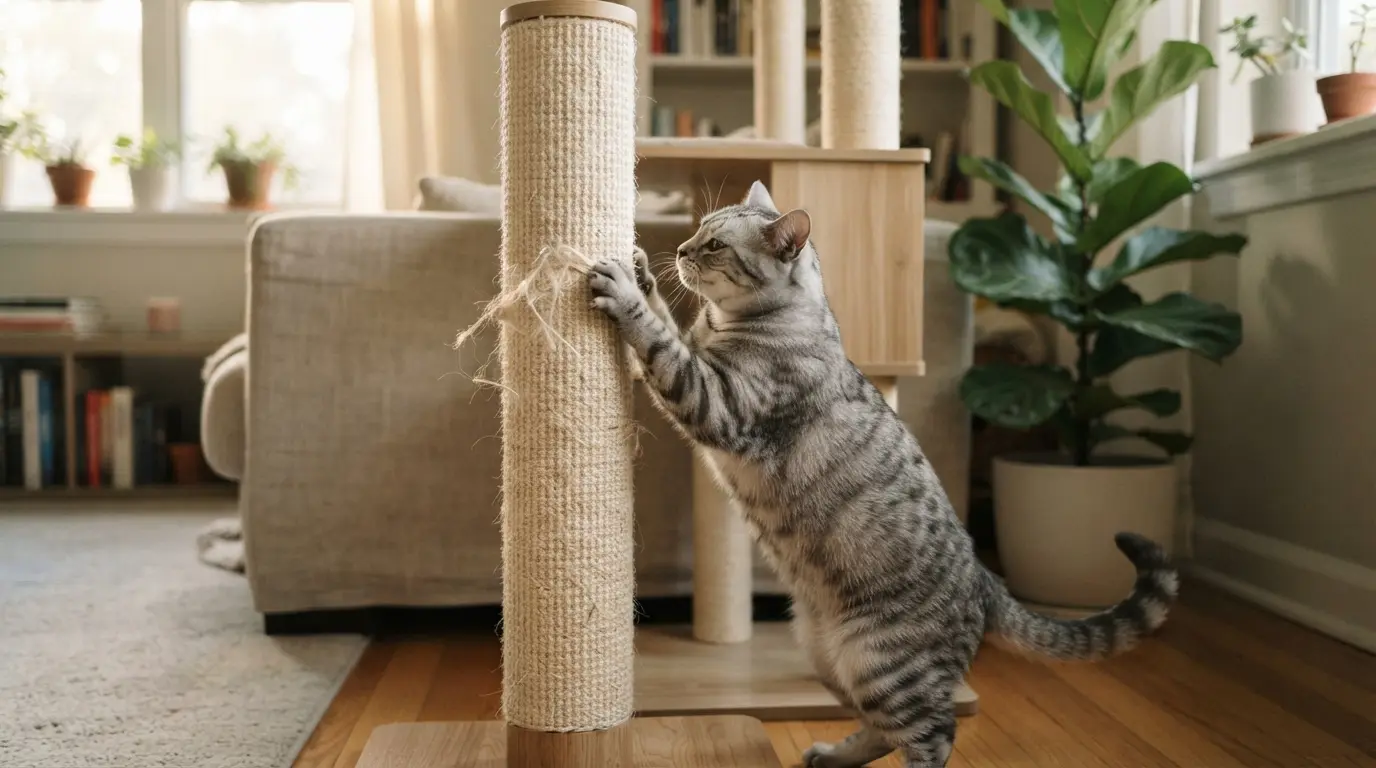
For vertical scratching posts, choose one over 60 cm tall with a base of at least 30x30 cm and an overall weight of over 2 kg (or one that can be wall-mounted). A practical test for stability: push the top of the post sideways with your hand; if it wobbles noticeably, don't buy it. Cats put their weight on the post when scratching, and a wobbly post won't be used a second time.

Inclined Scratchers: The "Safe Bet" with Highest Acceptance

An incline of about 30-45 degrees allows for both lying down and semi-standing scratching. This is a standard fixture in our hotel rooms. If you're buying for the first time and aren't sure of your cat's preference, an inclined scratcher has the lowest chance of being a miss.

Flat Scratchers (Including Bowl and Bed Types): For Cats Who Scratch Lying Down or Like to Lounge on Them

The advantages are affordability and that they can double as a sleeping spot. The disadvantage is they can be easily pushed around, so always choose models with non-slip bases or significant weight. Skip any that are less than 40 cm long.

Sofa Corner Protectors / Wall-Mounted Scratchers: Ideal for Renters and Quick Fixes

If the "disaster zone" is clearly defined (sofa corners, wall corners, bedside), directly "sticking" a scratcher to the affected area is more effective than buying a post next to new furniture. You don't need to break the habit immediately; first, redirect the scratching behavior to an acceptable object.

Do Scratching Posts on Cat Trees Count?

Yes, and they save space. However, note that scratching posts attached to cat trees are often only 30-40 cm tall, which is too short for adult cats. You'll usually need to supplement with a separate, taller post. For details on choosing cat tree height and stability, refer to this guide: How to Choose a Cat Tree That Won't Be Ignored? A Complete Guide to Height, Stability, and Cat Acceptance. The selection logic is almost identical.

Recommended Scratching Post Combinations by Scenario

  • First-time Buyer: One inclined corrugated cardboard pad + one sisal post over 60 cm tall. Offer both scratching styles and observe which one they prefer, then stock up on that type.
  • Newly Adopted Kitten / New Family Member: Start with an inexpensive corrugated cardboard pad placed near their resting area. The scratching habits established during kittenhood will last a lifetime. This is as important as other environmental preparations; for details, see How to Care for Your Cat During the First Week Home? Environment, Diet, and Preparations to Make Them Feel Secure.
  • Multi-Cat Household: Number of posts = number of cats + 1, distributed across different areas. Scratching has a marking function, and concentrating resources can easily become a source of tension.
  • Senior Cats (10+ Years Old): Switch to low-angle inclined or flat scratchers to reduce strain on their hind legs. Cats with joint discomfort won't be able to climb tall posts and will give up directly.
  • Sofa Already Destroyed: Sofa corner protectors + a post placed in the same location, along with regular nail trimming.
  • Only Scratches in Front of You, Cries When You Leave: In this case, scratching might be mixed with anxiety. A scratching post is only half the solution; for the other half, see What to Do About Cat Separation Anxiety? Home Adjustment Tips for Routine Changes After School Resumes.

After Bringing It Home: Getting Your Cat to Accept a New Scratching Post Within 3-7 Days

The first week with a new scratching post is crucial. Taking these steps can significantly increase its usage:

1. Placement First: Place it within 1 meter of your cat's sleeping area exit. Cats are most likely to want to scratch when stretching after waking up, making this the easiest time to succeed.

2. Sprinkle Catnip: Lightly rub a small amount of dried catnip into the scratching surface. We often use this trick when new guests arrive at our hotel. Use only a small amount; too much can over-excite some cats, making them ignore the post. Dried leaf types like Premium Catnip are more long-lasting than sprays.

3. Demonstrate: Gently scratch the surface with your fingernails to make a sound. Do not force your cat's paws to rub against it – a cat that has been forced will associate that post with a negative experience.

4. Reward Correct Use: Give treats or head pats immediately when they use it. Consistent rewards for the first three days will help establish the habit.

5. Simultaneously Protect Old Furniture: Apply protective film or cover the scratched sofa corners to make "old options harder to scratch and new options easier to scratch."

6. Don't Discard Old Scratchers Immediately: A worn-out scratcher has their scent. Keep the old and new ones side-by-side for a week or two before discarding; the transition will be much smoother.

Additionally, regular nail trimming is essential. Cats with overgrown nails will snag on everything, making the scratching post experience worse and increasing the likelihood of damaging furniture. For cats that are very difficult to trim, consider choosing tools from Cat Nail Clipper Recommendations: A List of Tools That Can Trim Nails Quickly, Even for Scared Cats. If you can't even manage restraint, we can also handle it during Grooming Appointments. Many owners get their cat's nails trimmed during a bath, solving two tasks at once.

When Should You Replace It? Three Signs to Look For

  • The scratching surface develops through-holes or collapses, causing the cat's claws to get stuck. They will then start scratching elsewhere.
  • The sisal rope becomes loose, with long threads exposed. This poses a risk of entanglement and ingestion, so discard it immediately.
  • Your cat noticeably reduces use and starts scratching new furniture – this usually means the scratching surface has become too smooth, not that they've become "bad."

For cleaning, vacuuming corrugated cardboard debris is fastest. For sisal and wood, brush along the grain; do not soak them, as wet sisal can mold. Do not wash scratching posts to the point where they lose their scent. The scent your cat leaves behind is one reason they will continue to use it.

Finally, a often-overlooked point: when leaving your cat at a hotel or with a sitter, remember to bring a "well-used old scratching post." When we receive new cats, those who bring a familiar scratching post adapt noticeably faster and are much less stressed. This small detail is also mentioned in How to Arrange Cat Boarding for Overseas Trips? A Comprehensive Guide to Calculating Days, Fee Ranges, and Pickup/Drop-off Details. If you'd like to see what scratching posts and home goods are available, feel free to browse our Shop.

Frequently Asked Questions

How Many Cat Scratching Posts Do I Need?

The practical formula is "number of cats + 1," distributed across different rooms or traffic areas. For a single-cat household, at least one flat (or inclined) pad and one vertical post are recommended, allowing them to choose between two scratching styles.

Comparing Cat Scratching Post Materials, Which is the Most Durable?

Durability generally ranks as: Solid Wood > Sisal > Carpet/Plush > Corrugated Cardboard. However, durability doesn't equal high acceptance. For cats with strong claws, sisal or wood is recommended, while kittens just learning to scratch have a higher success rate with corrugated cardboard.

My Cat Still Only Scratches the Sofa, Did I Choose the Wrong Scratching Post?

First, confirm three things: Is the scratching post "vertical" (most cats who scratch sofas scratch standing up)? Is it placed near the sofa? Does it wobble? If you adjust all three and the behavior continues, it usually requires addressing both nail length and the source of environmental stress.

How Often Should Cat Scratching Posts Be Replaced?

Corrugated cardboard lasts about 1-3 months (can be extended by flipping). Sisal lasts about 6-12 months, and wood can last for years. Signs that it's time to replace include through-holes in the scratching surface, loose rope, or the cat starting to scratch new furniture.

When Can Kittens Start Using Cat Scratching Posts?

Around 8 weeks of age, when they start walking and exploring independently, you can introduce them. The scratching habits established at this stage will carry into adulthood, so the earlier you provide them, the less hassle later. If you notice your kitten experiencing unusual pain, redness, or bleeding when scratching, pause use and consult a veterinarian.


This article was compiled by the CatGarden Editorial Team. The content is for general care and purchasing advice and cannot replace veterinary diagnosis. If your cat exhibits significant behavioral changes or physical discomfort, please consult a veterinarian as soon as possible.

CatGarden offers curated supplies, cat boarding, and grooming

Book services or shop online.
Back

Blog

How to Choose a Cat Scratching Post: A Complete Guide to Materials, Shapes, and Cat Acceptance

CatGarden Editorial TeamPublished 2026/08/24Updated 2026/10/06
cat scratching posthow to choose cat scratching postcat scratching post recommendationscat scratching post materialsnew cat owner
How to Choose a Cat Scratching Post: A Complete Guide to Materials, Shapes, and Cat Acceptance

Choosing a cat scratching post doesn't have to be a confusing price comparison game. Just confirm three things, and you won't buy the wrong one: does it match their natural scratching posture (standing or lying down), is it large and stable enough not to wobble, and is it placed along their daily routes? If even one of these points is off, even the most expensive scratching post will just become a dust collector in your living room.

We deal with dozens of cats with different personalities at our cat hotel every day. Our rooms always have two types of scratching posts (a slanted corrugated cardboard one and a vertical sisal post). Over more than a decade, we've come to a clear conclusion: cats often reject not the material, but the size and placement. This article will clarify everything from a purchasing perspective, covering materials, shapes, sizes, placement, and introduction methods all at once.

Key Takeaways

  • For vertical scratching posts, choose one over 60 cm tall: Adult cats need 50-70 cm in height to stretch fully when standing. Posts shorter than 50 cm don't allow cats to fully extend their back muscles, leading to significantly lower acceptance.
  • For flat scratching pads, aim for a length of at least 45 cm: When a cat scratches lying down, their front paws to chest alone can take up over 30 cm. If it's too short, they won't fit comfortably.
  • The practical formula for the number of scratching posts is number of cats + 1, distributed across different rooms. If you only have one in a multi-cat household, a dominant cat might monopolize it.
  • Corrugated cardboard scratchers typically last 1-3 months (you can flip them over once one side is used up). Sisal lasts about 6-12 months, and wood/solid wood posts can last for years. When calculated monthly, sisal and wood are actually more cost-effective.
  • For the first 3 days with a new scratching post, place it within 1 meter of your cat's sleeping area and sprinkle a small amount of catnip to encourage use. Most cats will start using it consistently within 3-7 days.

Why Doesn't My Cat Use the Scratching Post I Bought?

Let's clarify the reasons first, so you know what to choose. The most common complaint we hear is, "I bought three, and none of them worked; they only scratch the sofa." In reality, the reasons almost always fall into these four categories:

1. Incorrect Posture: If your cat scratches the sides of the sofa or door frames, it means they are the "standing scratcher" type. Buying a flat cardboard pad, of course, they won't use it.

2. Wobbles or Slips: When scratching, if the post moves, the cat perceives it as "unreliable" and gives up after one try. This is a common problem with lightweight plastic posts and cardboard pads without non-slip bases.

3. Placed in a Corner: Scratching is a behavior that also leaves scent and visual markers, requiring a place that is "visible to everyone." Hiding it on the balcony or behind the sofa renders its purpose useless.

4. Too Small: The main point of scratching for a cat is to stretch their entire back. If the pad isn't long enough or the post isn't tall enough, they can't stretch properly and won't want to use it.

So, when choosing, what you really need to compare isn't the color or pattern, but posture, stability, and size.

Cat Scratching Post Material Comparison: The Real Differences Between Four Mainstream Materials

MaterialFeel & DurabilityDebris AmountSuitable For CatsApproximate Lifespan
Corrugated CardboardSoft, crumbly feel, easiest to start withHigh, needs frequent vacuumingKittens, cats new to scratching posts, older cats with less strength1-3 months
Sisal/JuteTough, resistant, most durableLowCats with strong claws, those who scratch fabric furniture6-12 months
Wood/Solid Wood PostHard, mimics the feel of scratching tree barkAlmost noneCats who like scratching door frames, wooden cabinets, or wood floorsSeveral years
Carpet/PlushSoft, "sticky" scratching feelLow, but can snag threadsFew cats who prefer fabric textures6+ months

Here are some insights from our frontline experience:

  • Corrugated cardboard isn't inferior; it's consumable. It's the most widely accepted entry-level material, with the downside of producing a lot of debris and needing replacement. If your cat scratches aggressively and wears out a cardboard post in 3 weeks, consider "high-density, vertically arranged paper" models, which are more durable than horizontally pressed ones.
  • Sisal depends on the wrapping method. Posts tightly wrapped in coils with secured ends are durable. Cheap versions often unravel after two months, with cats biting off loose threads, posing a swallowing risk.
  • Carpet material requires careful consideration. Because the feel is too similar to home carpets or sofa fabrics, some cats get confused. We generally don't recommend it for cats being trained away from scratching sofas.
  • Wood is best for cats who scratch door frames. If your furniture victims are door frames and cabinet legs, directly choose a post with a mix of rope and bare wood; the success rate is much higher.

How to Choose the Shape? Observe Where They Scratch Now

Vertical Cat Scratching Post: For Cats Who Scratch Standing Up or Sofa Sides

For vertical scratching posts, choose one over 60 cm tall with a base of at least 30x30 cm and an overall weight of over 2 kg (or one that can be wall-mounted). A practical test for stability: push the top of the post sideways with your hand; if it wobbles noticeably, don't buy it. Cats put their weight on the post when scratching, and a wobbly post won't be used a second time.

Inclined Scratchers: The "Safe Bet" with Highest Acceptance

An incline of about 30-45 degrees allows for both lying down and semi-standing scratching. This is a standard fixture in our hotel rooms. If you're buying for the first time and aren't sure of your cat's preference, an inclined scratcher has the lowest chance of being a miss.

Flat Scratchers (Including Bowl and Bed Types): For Cats Who Scratch Lying Down or Like to Lounge on Them

The advantages are affordability and that they can double as a sleeping spot. The disadvantage is they can be easily pushed around, so always choose models with non-slip bases or significant weight. Skip any that are less than 40 cm long.

Sofa Corner Protectors / Wall-Mounted Scratchers: Ideal for Renters and Quick Fixes

If the "disaster zone" is clearly defined (sofa corners, wall corners, bedside), directly "sticking" a scratcher to the affected area is more effective than buying a post next to new furniture. You don't need to break the habit immediately; first, redirect the scratching behavior to an acceptable object.

Do Scratching Posts on Cat Trees Count?

Yes, and they save space. However, note that scratching posts attached to cat trees are often only 30-40 cm tall, which is too short for adult cats. You'll usually need to supplement with a separate, taller post. For details on choosing cat tree height and stability, refer to this guide: How to Choose a Cat Tree That Won't Be Ignored? A Complete Guide to Height, Stability, and Cat Acceptance. The selection logic is almost identical.

Recommended Scratching Post Combinations by Scenario

  • First-time Buyer: One inclined corrugated cardboard pad + one sisal post over 60 cm tall. Offer both scratching styles and observe which one they prefer, then stock up on that type.
  • Newly Adopted Kitten / New Family Member: Start with an inexpensive corrugated cardboard pad placed near their resting area. The scratching habits established during kittenhood will last a lifetime. This is as important as other environmental preparations; for details, see How to Care for Your Cat During the First Week Home? Environment, Diet, and Preparations to Make Them Feel Secure.
  • Multi-Cat Household: Number of posts = number of cats + 1, distributed across different areas. Scratching has a marking function, and concentrating resources can easily become a source of tension.
  • Senior Cats (10+ Years Old): Switch to low-angle inclined or flat scratchers to reduce strain on their hind legs. Cats with joint discomfort won't be able to climb tall posts and will give up directly.
  • Sofa Already Destroyed: Sofa corner protectors + a post placed in the same location, along with regular nail trimming.
  • Only Scratches in Front of You, Cries When You Leave: In this case, scratching might be mixed with anxiety. A scratching post is only half the solution; for the other half, see What to Do About Cat Separation Anxiety? Home Adjustment Tips for Routine Changes After School Resumes.

After Bringing It Home: Getting Your Cat to Accept a New Scratching Post Within 3-7 Days

The first week with a new scratching post is crucial. Taking these steps can significantly increase its usage:

1. Placement First: Place it within 1 meter of your cat's sleeping area exit. Cats are most likely to want to scratch when stretching after waking up, making this the easiest time to succeed.

2. Sprinkle Catnip: Lightly rub a small amount of dried catnip into the scratching surface. We often use this trick when new guests arrive at our hotel. Use only a small amount; too much can over-excite some cats, making them ignore the post. Dried leaf types like Premium Catnip are more long-lasting than sprays.

3. Demonstrate: Gently scratch the surface with your fingernails to make a sound. Do not force your cat's paws to rub against it – a cat that has been forced will associate that post with a negative experience.

4. Reward Correct Use: Give treats or head pats immediately when they use it. Consistent rewards for the first three days will help establish the habit.

5. Simultaneously Protect Old Furniture: Apply protective film or cover the scratched sofa corners to make "old options harder to scratch and new options easier to scratch."

6. Don't Discard Old Scratchers Immediately: A worn-out scratcher has their scent. Keep the old and new ones side-by-side for a week or two before discarding; the transition will be much smoother.

Additionally, regular nail trimming is essential. Cats with overgrown nails will snag on everything, making the scratching post experience worse and increasing the likelihood of damaging furniture. For cats that are very difficult to trim, consider choosing tools from Cat Nail Clipper Recommendations: A List of Tools That Can Trim Nails Quickly, Even for Scared Cats. If you can't even manage restraint, we can also handle it during Grooming Appointments. Many owners get their cat's nails trimmed during a bath, solving two tasks at once.

When Should You Replace It? Three Signs to Look For

  • The scratching surface develops through-holes or collapses, causing the cat's claws to get stuck. They will then start scratching elsewhere.
  • The sisal rope becomes loose, with long threads exposed. This poses a risk of entanglement and ingestion, so discard it immediately.
  • Your cat noticeably reduces use and starts scratching new furniture – this usually means the scratching surface has become too smooth, not that they've become "bad."

For cleaning, vacuuming corrugated cardboard debris is fastest. For sisal and wood, brush along the grain; do not soak them, as wet sisal can mold. Do not wash scratching posts to the point where they lose their scent. The scent your cat leaves behind is one reason they will continue to use it.

Finally, a often-overlooked point: when leaving your cat at a hotel or with a sitter, remember to bring a "well-used old scratching post." When we receive new cats, those who bring a familiar scratching post adapt noticeably faster and are much less stressed. This small detail is also mentioned in How to Arrange Cat Boarding for Overseas Trips? A Comprehensive Guide to Calculating Days, Fee Ranges, and Pickup/Drop-off Details. If you'd like to see what scratching posts and home goods are available, feel free to browse our Shop.

Frequently Asked Questions

How Many Cat Scratching Posts Do I Need?

The practical formula is "number of cats + 1," distributed across different rooms or traffic areas. For a single-cat household, at least one flat (or inclined) pad and one vertical post are recommended, allowing them to choose between two scratching styles.

Comparing Cat Scratching Post Materials, Which is the Most Durable?

Durability generally ranks as: Solid Wood > Sisal > Carpet/Plush > Corrugated Cardboard. However, durability doesn't equal high acceptance. For cats with strong claws, sisal or wood is recommended, while kittens just learning to scratch have a higher success rate with corrugated cardboard.

My Cat Still Only Scratches the Sofa, Did I Choose the Wrong Scratching Post?

First, confirm three things: Is the scratching post "vertical" (most cats who scratch sofas scratch standing up)? Is it placed near the sofa? Does it wobble? If you adjust all three and the behavior continues, it usually requires addressing both nail length and the source of environmental stress.

How Often Should Cat Scratching Posts Be Replaced?

Corrugated cardboard lasts about 1-3 months (can be extended by flipping). Sisal lasts about 6-12 months, and wood can last for years. Signs that it's time to replace include through-holes in the scratching surface, loose rope, or the cat starting to scratch new furniture.

When Can Kittens Start Using Cat Scratching Posts?

Around 8 weeks of age, when they start walking and exploring independently, you can introduce them. The scratching habits established at this stage will carry into adulthood, so the earlier you provide them, the less hassle later. If you notice your kitten experiencing unusual pain, redness, or bleeding when scratching, pause use and consult a veterinarian.


This article was compiled by the CatGarden Editorial Team. The content is for general care and purchasing advice and cannot replace veterinary diagnosis. If your cat exhibits significant behavioral changes or physical discomfort, please consult a veterinarian as soon as possible.

One email a month of cat-care tips

Hand-picked care, behavior and grooming tips once a month. Subscribe and we will send you our three most-read articles right away.

Keep reading