Cat Tree Recommendations: How to Choose One That Won't Be Ignored

Whether a cat tree ends up being ignored often has more to do with stability, platform size, and placement than the style itself. Drawing from frontline experience at a cat hotel, this guide helps you calculate height, test stability, choose materials, and includes a 7-day introduction plan to get your cat using it.
CatGarden Editorial TeamPublished 2026/08/20
cat treecat suppliesnew cat ownerhome environment
Cat Tree Recommendations: How to Choose One That Won't Be Ignored

The three most crucial factors when choosing a cat tree are stability, platform size, and placement, not how attractive the design is or how many levels it has. If a cat tree wobbles, has platforms too small for a cat to lie down comfortably, or is placed in a corner with no view or human traffic, even the most expensive cat climbing structure will become a clothes rack within two weeks.

At CatGarden's hotel section, we've observed the habits of hundreds of boarding cats using cat trees. We found that cats consistently judge a spot based on: Is it stable? → What can I see? → Is it comfortable to lie on? This article follows that order to guide you on choosing the perfect cat tree.

Key Takeaways

  • Cat Tree Height Calculation: For a healthy adult cat, a total height of 120-180 cm is recommended, with vertical spacing between platforms of 30-40 cm. For kittens, senior cats (over 7 years old), or overweight cats (over 6 kg), reduce the spacing to 20-25 cm.
  • Stability Test Standard: Push the top platform with one hand. If it wobbles more than 2 cm side-to-side, or takes longer than 3 seconds to stop after you let go, your cat will lose confidence and likely abandon it.
  • Platform Size Over Number of Levels: An average domestic cat lying down is about 40-50 cm long. Platforms should be at least 30x30 cm. For larger breeds like mixed breeds or Maine Coons, 40x40 cm or larger is recommended. Circular hammocks less than 30 cm in diameter are often skipped by cats.
  • Placement Determines Usage: Cat trees placed near windows or in high-traffic areas like the living room are used significantly more than those in bedroom corners. After moving a cat tree to a location where it overlooked the walkway in our facility, most cats started using it consistently within 1-2 days.
  • Replaceable Scratching Posts: Sisal rope posts should be at least 8 cm in diameter, and prioritize models with "single post replacement" as they typically need updating every 1-2 years.

Why Do Cat Trees End Up as Clothes Racks? 4 Common Beginner Mistakes

1. Focusing Only on Height, Ignoring Base Weight

Online listings often feature "180 cm super tall cat trees" with a base only 40x40 cm and a total weight under 8 kg. The impact force of a cat jumping from a height is several times its body weight. If the tree wobbles, the cat won't dare to jump again. For trees over 150 cm, a total weight of over 12 kg is recommended, with a base thickness of at least 1.8 cm and an area of at least 50x50 cm.

2. Platforms Too Small or Slippery

Many cheap cat trees have platforms only 25x25 cm, allowing cats to sit but not lie down, so they naturally don't stay long. Also, while carpeted surfaces are okay, slippery laminate or plastic surfaces can cause cats to slip when landing, leading to them being rejected.

3. Irregular Spacing, Making It Impossible for Cats to Reach the Top

A common issue is the first step being 50 cm off the ground, followed by a sudden 45 cm jump in between. Younger cats might manage, but older cats, kittens, or recently spayed cats will give up entirely. Always look at the side view before buying and calculate the height difference between each step.

4. Placed in Unused Corners

This is the most easily overlooked point. Cats climb not just for exercise, but to monitor household activity from a vantage point. Placing it in a guest room, behind a cabinet, or at the end of a windowless hallway won't make it seem like a good spot.

How to Calculate Cat Tree Height: Three Levels Based on Ceiling and Cat Age

Typical residential ceilings in Taiwan are around 240-260 cm (lower if there's a false ceiling). In practice, we categorize as follows:

Cat ConditionRecommended Total HeightRecommended Step Spacing
Healthy Adult Cat (1-7 years)150-180 cm30-40 cm
Kitten (under 6 months)90-120 cm20-25 cm, with ramps or steps
Senior Cat (over 7 years), Overweight, Post-Surgery Recovery100-130 cm20-25 cm, top level should be near a wall or furniture
Multi-Cat Household (3+ cats)180+ cm or tension-rod models30-35 cm, with at least two entry/exit points per level

Some practical tips:

  • Tension-rod models (reaching the ceiling) save space, but if you have a suspended ceiling or wooden structure, the support will be on thin panels, making it more dangerous. In such cases, a floor-standing model with a heavy base is safer.
  • Leave 35-45 cm between the top level and the ceiling so the cat can sit upright without hitting its head.
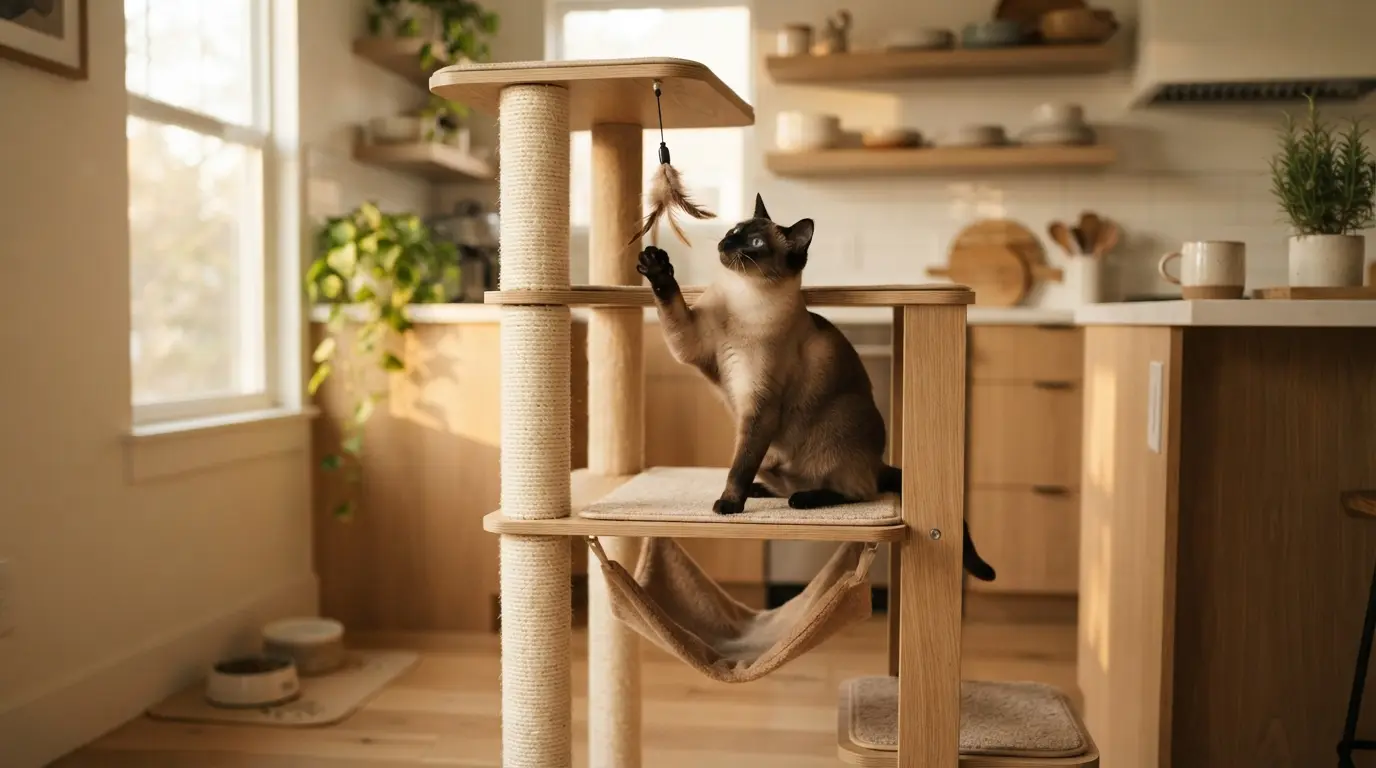
  • Higher isn't always better. We've seen many cats in our hotel only use the 120 cm level – precisely because it aligns with the windowsill. "What can be seen" is more important than "how high."

How to Test Stability? 3 Actions at the Store or Upon Arrival

1. One-Handed Top Push Test: Push the side of the top platform with one hand, applying force equivalent to a 5 kg cat landing. If it wobbles more than 2 cm or takes longer than 3 seconds to stop after you release it, it fails.

2. Weight Test on Hammock: Press down on the center of a hammock or cube with 3-5 kg of force. Check if the support structure deforms or if screw holes shift.

3. Check Screw Points: After assembly, go back and tighten all screws again. Wood screws in particleboard can loosen after 2-3 months. Re-tighten every 3 months. This is the most common but easiest-to-fix reason for abandonment.

For wall-mounted shelves, ensure they are screwed into solid RC walls or find studs. Drywall alone, using only expansion bolts, cannot withstand the sudden force of a cat jumping. For such walls, abandon wall-mounting and opt for floor-standing models.

Material Selection: Real-World Differences in Taiwan's Humid Climate

  • Sisal Rope Posts: Best grip, most durable, the top choice. A diameter of 8 cm or more suits a cat's stretching and scratching posture. The downside is shedding.
  • Corrugated Cardboard Scratchers: Inexpensive, cats love them, but wear out quickly. Best as an "additional scratching area" rather than a main structure.
  • Solid Wood / Laminated Wood: Stable, attractive, durable. Suitable for those wanting to integrate with home decor, but heavy and expensive. If the surface is too slippery, add a layer of burlap or a mat.
  • Particleboard (Composite Board): Most common price range. Taiwan's high summer humidity means if placed on a balcony or where it might get wet, the edges can absorb water and swell, so it's best kept in dry indoor areas.
  • Carpeted Surfaces: Cats love to lie on them, but shed fur gets caught. Choose models with removable and washable hammocks or mats; this makes a big difference for households with long-haired cats.

Incidentally, carpeted platforms on cat trees are a major source of cat hair at home. Regularly wiping them with a pet-specific absorbent cloth makes cleaning much easier. The Quick-Dry Pet Towel we always keep on hand for cleaning cages is also great for quickly wiping down cat tree platforms and hammocks.

Choosing Based on Space: Solutions for Small Apartments

Rooms Under 15 sqm, Renters

Choose vertical models occupying less than 50x50 cm of floor space, around 150 cm high, placed against a wall by a window. Avoid "castle-style" trees that spread over 1 meter horizontally, as they'll block walkways.

Living Room with a Sliding Glass Door

This is the most ideal location. Align the top level of the cat tree 20-30 cm above the bottom edge of the window, allowing the cat to sit at the highest point and look outside. Be mindful of direct sunlight in summer. If the highest level is noticeably warmer than room temperature between 2-4 PM, move it 30 cm to the side or add blackout curtains to prevent overheating.

Maintaining Home Decor Style

Opt for wooden models with off-white/grey fabric, or designs resembling tiered bookshelves. Alternatively, combine "wall-mounted shelves + a low cat tree." The key is not to sacrifice platform size for aesthetics – that's the primary reason for abandonment.

Multi-Cat Households

It's better to buy two 130 cm trees than one 200 cm tree. Cats need "multiple independent high vantage points," not one tall structure requiring queuing. Space them 1-1.5 meters apart to create jumping routes.

Choosing Based on Cat Personality: Different Needs for Shy, Senior, or Overweight Cats

  • Shy, Timid Cats: Prioritize models with enclosed cubbies or semi-enclosed hammocks, and ensure cubbies have two openings (cats dislike dead ends with only one exit). Place them in corners, away from the doorway. If your cat habitually hides under the bed, follow the rhythm in What to Do When Your Shy Cat Always Hides? 5 Stages and Timeline for Socializing Fearful Cats to gradually establish the cat tree as "their own safe high ground."
  • Active, Energetic Young Cats: Height can go up to 180 cm, with staggered platforms to create diagonal jumping routes, and ensure the base is heavy enough.
  • Overweight Cats (over 6 kg): Step spacing of 20-25 cm, platforms of 40x40 cm or larger, and a load capacity of at least 10 kg. These cats are most afraid of "jumping up but not being able to get down," leading to sprains.
  • Senior Cats, Cats with Joint Issues: Switch to step or ramp-style low cat trees, with a total height of under 100 cm. Place a scratching post or low stool next to the highest level as an intermediate step.
  • New Arrivals: Don't rush to set up a fancy cat tree. Environmental security and a stable routine are more important. Refer to How to Care for Your New Cat's First Week Home? Environment, Diet, and Preparations to Make Them Feel Safe. Once they start actively exploring the whole house, introducing a cat tree will lead to much higher acceptance.

How to Get Your Cat to Actually Use It After Buying? The 7-Day Introduction Plan

This is how we help new cats at the hotel "claim their territory," and it works at home too:

  • Day 1: Scent Association: After assembly, don't rush to place your cat on it. Lay an old towel the cat often sleeps on the second level to transfer their scent.
  • Day 2-3: Use Food to Mark the Path: Place 2-3 freeze-dried treats or kibbles on the first and second levels, encouraging them to step on it themselves. Never carry your cat onto it and then let go; this can create a negative association.
  • Day 3: Add Incentives: Sprinkle some Premium Catnip on the middle platforms or use a feather wand to entice jumping above the platform (about one-third of cats don't react to catnip; if yours doesn't, use treats instead).
  • Day 4-5: Establish a Positive Interaction Point: Play near the cat tree for 5-10 minutes daily, and let them rest on the highest level afterward. This step establishes the "cat tree = good things happen here" connection.
  • Day 6-7: Observe and Adjust: If they only use the bottom two levels, the step spacing might be too large or the upper platforms too narrow. If they don't use it at all, first check for wobbling, then consider changing the location. Moving it just 50 cm can change the outcome. Try placing it where it overlooks a window or where family members move around.

A cat's acceptance of new furniture is similar to that of a litter box – shape, opening, and scent all influence their willingness. This "try, observe, adjust" logic is also detailed in Open vs. Covered Litter Boxes: Odor Control, Heat Risks, and Cat Acceptance Explained, which you can cross-reference.

Final Pre-Purchase Checklist

Review these 8 points before ordering to significantly reduce the chance of it being ignored:

1. Base area ≥ 50x50 cm (for models over 150 cm)

2. Total weight ≥ 12 kg, or tension-rod/wall-mounted secure

3. Main platform ≥ 30x30 cm (40x40 cm for large cats)

4. Step spacing 30-40 cm (20-25 cm for senior/young cats)

5. Sisal rope post diameter ≥ 8 cm, and single post replaceable

6. Hammock/mat removable and washable

7. Top level at least 35 cm from the ceiling

8. Placement offers a view of the outdoors or family movement

Also, a safety note: Do not leave toys with thin strings, bells, or small parts hanging unattended on the cat tree. We've seen accidents where cats got tangled in strings or swallowed parts. If hanging toys, choose integrated, stuffing-free designs, and only when you can supervise.

If your cat shows limping, fear of jumping, noticeable hesitation on stairs for more than 1-2 days after using the cat tree, or cries out when touched in a certain area, please consult a veterinarian. Do not attempt to press or apply heat yourself.

Finally, a practical tip: If you're going away for an extended period and there's no one to check the stability of the cat tree at home, boarding might be safer than leaving them to roam freely. Our boarding enclosures have fixed cat trees and resting levels with window views, helping cats avoid anxiety from lacking high vantage points.

Frequently Asked Questions

Does a cat tree have to be ceiling-height?

No. Most domestic cats prefer heights between 120-160 cm, aligning perfectly with windowsills or cabinet tops. The main advantage of tension-rod models is saving floor space, but if the ceiling is suspended or wooden, the support can be unsafe. A floor-standing model with a heavy base is better.

My cat won't use the cat tree; did I waste my money?

First, do three things: Check if it wobbles, measure if the platforms are big enough to lie on, and move the cat tree to a location with a window or where people move around. These three adjustments can save most "neglected" cat trees, and you'll usually see them start using it within 1-2 weeks.

How many cat trees does one cat need?

For a single-cat household, one 150 cm cat tree plus 1-2 high spots by windows is sufficient. For 2+ cats, recommend "number of cats - 1" or more trees, and distribute the high vantage points across different rooms to reduce territorial tension.

The sisal rope is worn out; do I need to replace the whole thing?

No. Prioritize models with replaceable posts. Sisal rope posts typically need replacing every 1-2 years. If only the surface is loose but the core structure is intact, you can re-wrap it with sisal rope yourself.

Do senior cats still need cat trees?

Yes, but with different specifications. Switch to ramp or step-style low cat trees under 100 cm with 20-25 cm spacing, allowing them to maintain a high view without significant jumping. If they start refusing to go to any high places, it might be a sign of joint pain, and a health check-up is recommended.

For more advice on choosing daily cat supplies and environmental enrichment, check out our Shop for items we actually use in our hotel.


By CatGarden Editorial Team

CatGarden offers curated supplies, cat boarding, and grooming

Book services or shop online.
Back

Blog

Cat Tree Recommendations: How to Choose One That Won't Be Ignored

CatGarden Editorial TeamPublished 2026/08/20
cat treecat suppliesnew cat ownerhome environment
Cat Tree Recommendations: How to Choose One That Won't Be Ignored

The three most crucial factors when choosing a cat tree are stability, platform size, and placement, not how attractive the design is or how many levels it has. If a cat tree wobbles, has platforms too small for a cat to lie down comfortably, or is placed in a corner with no view or human traffic, even the most expensive cat climbing structure will become a clothes rack within two weeks.

At CatGarden's hotel section, we've observed the habits of hundreds of boarding cats using cat trees. We found that cats consistently judge a spot based on: Is it stable? → What can I see? → Is it comfortable to lie on? This article follows that order to guide you on choosing the perfect cat tree.

Key Takeaways

  • Cat Tree Height Calculation: For a healthy adult cat, a total height of 120-180 cm is recommended, with vertical spacing between platforms of 30-40 cm. For kittens, senior cats (over 7 years old), or overweight cats (over 6 kg), reduce the spacing to 20-25 cm.
  • Stability Test Standard: Push the top platform with one hand. If it wobbles more than 2 cm side-to-side, or takes longer than 3 seconds to stop after you let go, your cat will lose confidence and likely abandon it.
  • Platform Size Over Number of Levels: An average domestic cat lying down is about 40-50 cm long. Platforms should be at least 30x30 cm. For larger breeds like mixed breeds or Maine Coons, 40x40 cm or larger is recommended. Circular hammocks less than 30 cm in diameter are often skipped by cats.
  • Placement Determines Usage: Cat trees placed near windows or in high-traffic areas like the living room are used significantly more than those in bedroom corners. After moving a cat tree to a location where it overlooked the walkway in our facility, most cats started using it consistently within 1-2 days.
  • Replaceable Scratching Posts: Sisal rope posts should be at least 8 cm in diameter, and prioritize models with "single post replacement" as they typically need updating every 1-2 years.

Why Do Cat Trees End Up as Clothes Racks? 4 Common Beginner Mistakes

1. Focusing Only on Height, Ignoring Base Weight

Online listings often feature "180 cm super tall cat trees" with a base only 40x40 cm and a total weight under 8 kg. The impact force of a cat jumping from a height is several times its body weight. If the tree wobbles, the cat won't dare to jump again. For trees over 150 cm, a total weight of over 12 kg is recommended, with a base thickness of at least 1.8 cm and an area of at least 50x50 cm.

2. Platforms Too Small or Slippery

Many cheap cat trees have platforms only 25x25 cm, allowing cats to sit but not lie down, so they naturally don't stay long. Also, while carpeted surfaces are okay, slippery laminate or plastic surfaces can cause cats to slip when landing, leading to them being rejected.

3. Irregular Spacing, Making It Impossible for Cats to Reach the Top

A common issue is the first step being 50 cm off the ground, followed by a sudden 45 cm jump in between. Younger cats might manage, but older cats, kittens, or recently spayed cats will give up entirely. Always look at the side view before buying and calculate the height difference between each step.

4. Placed in Unused Corners

This is the most easily overlooked point. Cats climb not just for exercise, but to monitor household activity from a vantage point. Placing it in a guest room, behind a cabinet, or at the end of a windowless hallway won't make it seem like a good spot.

How to Calculate Cat Tree Height: Three Levels Based on Ceiling and Cat Age

Typical residential ceilings in Taiwan are around 240-260 cm (lower if there's a false ceiling). In practice, we categorize as follows:

Cat ConditionRecommended Total HeightRecommended Step Spacing
Healthy Adult Cat (1-7 years)150-180 cm30-40 cm
Kitten (under 6 months)90-120 cm20-25 cm, with ramps or steps
Senior Cat (over 7 years), Overweight, Post-Surgery Recovery100-130 cm20-25 cm, top level should be near a wall or furniture
Multi-Cat Household (3+ cats)180+ cm or tension-rod models30-35 cm, with at least two entry/exit points per level

Some practical tips:

  • Tension-rod models (reaching the ceiling) save space, but if you have a suspended ceiling or wooden structure, the support will be on thin panels, making it more dangerous. In such cases, a floor-standing model with a heavy base is safer.
  • Leave 35-45 cm between the top level and the ceiling so the cat can sit upright without hitting its head.
  • Higher isn't always better. We've seen many cats in our hotel only use the 120 cm level – precisely because it aligns with the windowsill. "What can be seen" is more important than "how high."

How to Test Stability? 3 Actions at the Store or Upon Arrival

1. One-Handed Top Push Test: Push the side of the top platform with one hand, applying force equivalent to a 5 kg cat landing. If it wobbles more than 2 cm or takes longer than 3 seconds to stop after you release it, it fails.

2. Weight Test on Hammock: Press down on the center of a hammock or cube with 3-5 kg of force. Check if the support structure deforms or if screw holes shift.

3. Check Screw Points: After assembly, go back and tighten all screws again. Wood screws in particleboard can loosen after 2-3 months. Re-tighten every 3 months. This is the most common but easiest-to-fix reason for abandonment.

For wall-mounted shelves, ensure they are screwed into solid RC walls or find studs. Drywall alone, using only expansion bolts, cannot withstand the sudden force of a cat jumping. For such walls, abandon wall-mounting and opt for floor-standing models.

Material Selection: Real-World Differences in Taiwan's Humid Climate

  • Sisal Rope Posts: Best grip, most durable, the top choice. A diameter of 8 cm or more suits a cat's stretching and scratching posture. The downside is shedding.
  • Corrugated Cardboard Scratchers: Inexpensive, cats love them, but wear out quickly. Best as an "additional scratching area" rather than a main structure.
  • Solid Wood / Laminated Wood: Stable, attractive, durable. Suitable for those wanting to integrate with home decor, but heavy and expensive. If the surface is too slippery, add a layer of burlap or a mat.
  • Particleboard (Composite Board): Most common price range. Taiwan's high summer humidity means if placed on a balcony or where it might get wet, the edges can absorb water and swell, so it's best kept in dry indoor areas.
  • Carpeted Surfaces: Cats love to lie on them, but shed fur gets caught. Choose models with removable and washable hammocks or mats; this makes a big difference for households with long-haired cats.

Incidentally, carpeted platforms on cat trees are a major source of cat hair at home. Regularly wiping them with a pet-specific absorbent cloth makes cleaning much easier. The Quick-Dry Pet Towel we always keep on hand for cleaning cages is also great for quickly wiping down cat tree platforms and hammocks.

Choosing Based on Space: Solutions for Small Apartments

Rooms Under 15 sqm, Renters

Choose vertical models occupying less than 50x50 cm of floor space, around 150 cm high, placed against a wall by a window. Avoid "castle-style" trees that spread over 1 meter horizontally, as they'll block walkways.

Living Room with a Sliding Glass Door

This is the most ideal location. Align the top level of the cat tree 20-30 cm above the bottom edge of the window, allowing the cat to sit at the highest point and look outside. Be mindful of direct sunlight in summer. If the highest level is noticeably warmer than room temperature between 2-4 PM, move it 30 cm to the side or add blackout curtains to prevent overheating.

Maintaining Home Decor Style

Opt for wooden models with off-white/grey fabric, or designs resembling tiered bookshelves. Alternatively, combine "wall-mounted shelves + a low cat tree." The key is not to sacrifice platform size for aesthetics – that's the primary reason for abandonment.

Multi-Cat Households

It's better to buy two 130 cm trees than one 200 cm tree. Cats need "multiple independent high vantage points," not one tall structure requiring queuing. Space them 1-1.5 meters apart to create jumping routes.

Choosing Based on Cat Personality: Different Needs for Shy, Senior, or Overweight Cats

  • Shy, Timid Cats: Prioritize models with enclosed cubbies or semi-enclosed hammocks, and ensure cubbies have two openings (cats dislike dead ends with only one exit). Place them in corners, away from the doorway. If your cat habitually hides under the bed, follow the rhythm in What to Do When Your Shy Cat Always Hides? 5 Stages and Timeline for Socializing Fearful Cats to gradually establish the cat tree as "their own safe high ground."
  • Active, Energetic Young Cats: Height can go up to 180 cm, with staggered platforms to create diagonal jumping routes, and ensure the base is heavy enough.
  • Overweight Cats (over 6 kg): Step spacing of 20-25 cm, platforms of 40x40 cm or larger, and a load capacity of at least 10 kg. These cats are most afraid of "jumping up but not being able to get down," leading to sprains.
  • Senior Cats, Cats with Joint Issues: Switch to step or ramp-style low cat trees, with a total height of under 100 cm. Place a scratching post or low stool next to the highest level as an intermediate step.
  • New Arrivals: Don't rush to set up a fancy cat tree. Environmental security and a stable routine are more important. Refer to How to Care for Your New Cat's First Week Home? Environment, Diet, and Preparations to Make Them Feel Safe. Once they start actively exploring the whole house, introducing a cat tree will lead to much higher acceptance.

How to Get Your Cat to Actually Use It After Buying? The 7-Day Introduction Plan

This is how we help new cats at the hotel "claim their territory," and it works at home too:

  • Day 1: Scent Association: After assembly, don't rush to place your cat on it. Lay an old towel the cat often sleeps on the second level to transfer their scent.
  • Day 2-3: Use Food to Mark the Path: Place 2-3 freeze-dried treats or kibbles on the first and second levels, encouraging them to step on it themselves. Never carry your cat onto it and then let go; this can create a negative association.
  • Day 3: Add Incentives: Sprinkle some Premium Catnip on the middle platforms or use a feather wand to entice jumping above the platform (about one-third of cats don't react to catnip; if yours doesn't, use treats instead).
  • Day 4-5: Establish a Positive Interaction Point: Play near the cat tree for 5-10 minutes daily, and let them rest on the highest level afterward. This step establishes the "cat tree = good things happen here" connection.
  • Day 6-7: Observe and Adjust: If they only use the bottom two levels, the step spacing might be too large or the upper platforms too narrow. If they don't use it at all, first check for wobbling, then consider changing the location. Moving it just 50 cm can change the outcome. Try placing it where it overlooks a window or where family members move around.

A cat's acceptance of new furniture is similar to that of a litter box – shape, opening, and scent all influence their willingness. This "try, observe, adjust" logic is also detailed in Open vs. Covered Litter Boxes: Odor Control, Heat Risks, and Cat Acceptance Explained, which you can cross-reference.

Final Pre-Purchase Checklist

Review these 8 points before ordering to significantly reduce the chance of it being ignored:

1. Base area ≥ 50x50 cm (for models over 150 cm)

2. Total weight ≥ 12 kg, or tension-rod/wall-mounted secure

3. Main platform ≥ 30x30 cm (40x40 cm for large cats)

4. Step spacing 30-40 cm (20-25 cm for senior/young cats)

5. Sisal rope post diameter ≥ 8 cm, and single post replaceable

6. Hammock/mat removable and washable

7. Top level at least 35 cm from the ceiling

8. Placement offers a view of the outdoors or family movement

Also, a safety note: Do not leave toys with thin strings, bells, or small parts hanging unattended on the cat tree. We've seen accidents where cats got tangled in strings or swallowed parts. If hanging toys, choose integrated, stuffing-free designs, and only when you can supervise.

If your cat shows limping, fear of jumping, noticeable hesitation on stairs for more than 1-2 days after using the cat tree, or cries out when touched in a certain area, please consult a veterinarian. Do not attempt to press or apply heat yourself.

Finally, a practical tip: If you're going away for an extended period and there's no one to check the stability of the cat tree at home, boarding might be safer than leaving them to roam freely. Our boarding enclosures have fixed cat trees and resting levels with window views, helping cats avoid anxiety from lacking high vantage points.

Frequently Asked Questions

Does a cat tree have to be ceiling-height?

No. Most domestic cats prefer heights between 120-160 cm, aligning perfectly with windowsills or cabinet tops. The main advantage of tension-rod models is saving floor space, but if the ceiling is suspended or wooden, the support can be unsafe. A floor-standing model with a heavy base is better.

My cat won't use the cat tree; did I waste my money?

First, do three things: Check if it wobbles, measure if the platforms are big enough to lie on, and move the cat tree to a location with a window or where people move around. These three adjustments can save most "neglected" cat trees, and you'll usually see them start using it within 1-2 weeks.

How many cat trees does one cat need?

For a single-cat household, one 150 cm cat tree plus 1-2 high spots by windows is sufficient. For 2+ cats, recommend "number of cats - 1" or more trees, and distribute the high vantage points across different rooms to reduce territorial tension.

The sisal rope is worn out; do I need to replace the whole thing?

No. Prioritize models with replaceable posts. Sisal rope posts typically need replacing every 1-2 years. If only the surface is loose but the core structure is intact, you can re-wrap it with sisal rope yourself.

Do senior cats still need cat trees?

Yes, but with different specifications. Switch to ramp or step-style low cat trees under 100 cm with 20-25 cm spacing, allowing them to maintain a high view without significant jumping. If they start refusing to go to any high places, it might be a sign of joint pain, and a health check-up is recommended.

For more advice on choosing daily cat supplies and environmental enrichment, check out our Shop for items we actually use in our hotel.


By CatGarden Editorial Team

One email a month of cat-care tips

Hand-picked care, behavior and grooming tips once a month. Subscribe and we will send you our three most-read articles right away.

Keep reading