New Taipei Cat Hotel Recommendations: Banqiao, Sanchong, Xinzhuang - How to Choose? Pricing and 6 Key Selection Factors Explained
The average price for a single cat private suite in New Taipei cat hotels is around NT$450-900 per day, with holiday surcharges of 20-50%. This article covers room types and transportation differences in Banqiao, Sanchong, and Xinzhuang, guiding you through 6 key selection points and pre-stay preparations.
The going rate for a single cat private suite in New Taipei cat hotels is approximately NT$450-900 per day. During peak seasons like holidays, expect surcharges of 20-50%. If you're looking for a place that meets the basic criteria of a "cat-only environment, private enclosure, and surveillance with daily updates," Banqiao currently offers the most options and is the easiest to reach within 20 minutes by MRT or car in New Taipei. Sanchong and Xinzhuang also have good establishments, but room types tend to be smaller, and the proportion of cat-only facilities is lower, requiring more detailed inquiries when choosing.
Here's a comprehensive comparison and selection logic we've compiled from our years of operating a cat hotel in Banqiao, having hosted timid cats, senior cats, cats with chronic illnesses, and recently neutered cats.
Key Takeaways
- The market rate for a single cat private suite in New Taipei cat hotels is around NT$450-900 per day; standard small rooms are typically NT$450-600, while larger suites or those with multi-level climbing structures range from NT$700-900.
- Boarding a second cat usually incurs an additional charge of NT$150-300 per cat per day, not double the original price. It's more economical for littermates or cats with a close bond to share a room.
- Peak seasons like holidays, winter/summer breaks, and Chinese New Year generally add a 20-50% surcharge. Popular establishments often fill up 1-2 months in advance for Chinese New Year.
- The first filter when selecting a New Taipei cat hotel should be "whether it's cat-only and completely separate from dogs (different building or floor)". The barking and scent of dogs are significant stressors for cats.
- We recommend a 7-day acclimatization period before boarding: help your cat get used to their carrier, and bring their usual cat litter and food. This can significantly reduce the chances of them not eating or drinking for the first 24 hours at the hotel.
Why "New Taipei Cat Hotels" Need District-Specific Consideration: Differences in Banqiao, Sanchong, and Xinzhuang
New Taipei is vast, with Banqiao, Sanchong, and Xinzhuang alone having a combined population of over 1.3 million. However, the density and types of cat hotels vary greatly. What owners truly care about isn't the administrative district, but "how far is it from my home" and "will my cat be overly stressed during the journey."
Banqiao: Most Options, Best Transportation, Ideal First Choice
Banqiao is the administrative and transportation hub of New Taipei. Banqiao Station serves Taiwan Railways, High-Speed Rail, the Blue Line, and the Circular Line. Driving via Provincial Highway 65 or National Freeway 3 is also quick. This offers two practical advantages for boarding:
- For those traveling abroad, you can drop off your cat the day before your flight and pick them up on the day of your return, saving you an extra day off work.
- Outside the older districts, Banqiao's newer redeveloped areas often feature taller buildings with newer construction. This allows for room types with private enclosures and independent air conditioning, rather than just rows of cat cages in the same space.
The downside is that prices are usually the highest among the three districts, and popular establishments are hard to book during holidays.
Sanchong: Close to Taipei City, but Rooms Are Generally Smaller
Sanchong is just across the bridge from Taipei's Datong and Zhongshan districts. Many owners who work in Taipei but live in Sanchong look for places there. Upon visiting, you'll find that Sanchong's storefronts are often narrow, and there are many older apartment buildings. Cage-style boarding (single or double-tier cages) is more common, with prices potentially as low as NT$350-500 per day. If your cat is a calm adult and only staying for 2-3 days, this might be acceptable. However, for timid cats or those staying for 7 days or more, the space would be insufficient for activity.
Xinzhuang: Many New Commercial Spaces, but Watch Out for Cat-Dog Mixes
The Xinzhuang Fuduxin area has many new buildings and several pet grooming salons that also offer boarding. The advantage is new and clean facilities. However, you need to be mindful that most are "cat and dog friendly" composite establishments. You must specifically ask: Are the cat rooms and dog rooms on different floors? Do they have separate air conditioning and entry/exit routes? How far is the dog grooming area from the cat rooms? As long as a dog's hairdryer is running in the same building, cats won't be able to relax.
Quick Comparison of the Three Districts
| Feature | Banqiao | Sanchong | Xinzhuang |
|---|---|---|---|
| Cat-Only Proportion | Higher | Medium | Lower (more composite) |
| Common Room Types | Private Suites, Multi-Level Climbing Suites | Cages, Small Suites | Small Suites, Composite |
| Daily Price Range | NT$500-900 | NT$350-650 | NT$450-800 |
| Transportation | TRA/HSR/Dual MRT, Most convenient for international travel | Quick access to Taipei City across the bridge | Airport MRT, Xinzhuang Line |
| Best Suited For | Long stays abroad, timid cats, senior cats | Short stays, calm adult cats | Those who want grooming services too |
New Taipei Cat Hotel Pricing: How Much Does Cat Boarding Cost Per Day?
Let's get straight to the point: be very wary of prices around "NT$250 per day." This usually means a cat in a small cage without independent air conditioning or daily updates. Here's a breakdown of common pricing structures in the New Taipei market.
| Room Type/Item | Common Price | Description |
|---|---|---|
| Cage Boarding (Single/Double Tier) | NT$300-500/day | Small space, only suitable for short stays |
| Standard Private Suite (approx. 1.5-3 sqm) | NT$450-650/day | The most common option in New Taipei |
| Large Suite / Scenic Suite | NT$700-1,200/day | With climbing structures, window views, suitable for longer stays |
| Second Cat Sharing Room | +NT$150-300/day | Requires good relationship, can share litter box |
| Holiday / CNY Surcharge | Original Price +20-50% | Some establishments have minimum stay requirements |
| Door-to-Door Pickup (New Taipei City) | NT$300-800/trip | Based on distance and whether carrier is included |
| Medical Care (Medication, Subcutaneous Fluids) | +NT$50-200/day | Requires veterinary prescription, not all places offer |
| Long-Term Stay Discount | 5-15% off for 7+ days | Usually more discounts for 14+ days |
Let's do a quick estimate: 10 days abroad, one cat in a standard suite at NT$550/day, with a 10% long-term discount, comes to about NT$4,950. Add round-trip pickup at NT$600, and the total is around NT$5,500. For a more detailed breakdown of how to calculate days and costs efficiently, we've written a comprehensive guide: How to Arrange Cat Boarding for Overseas Trips? Calculating Days, Pricing, and Pickup Tips Explained.
> Quick Tip: Most establishments charge by the day, counting both the check-in and check-out days. So, dropping off at 9 AM and picking up at 9 AM the next day will be counted as 2 days. If it's only a few hours difference, ask if they have half-day or late check-out options; you could save a few hundred dollars.
6 Key Points for Choosing a Cat Hotel (Ask in This Order to Avoid Missing Anything)
1. Is it Cat-Only? Dog Sounds and Scents Are Major Stressors
This is what we consider the most crucial factor. Cats react to dog barking and the low-frequency noise of hairdryers by tensing up, hiding in corners, and refusing to eat. If it's not a cat-only facility, at least confirm that the cat rooms are on a separate floor with a separate entrance, and the grooming area doesn't share air circulation with the cat rooms.
2. Room Type: Focus on "Vertical Space" and "Visual Shielding"
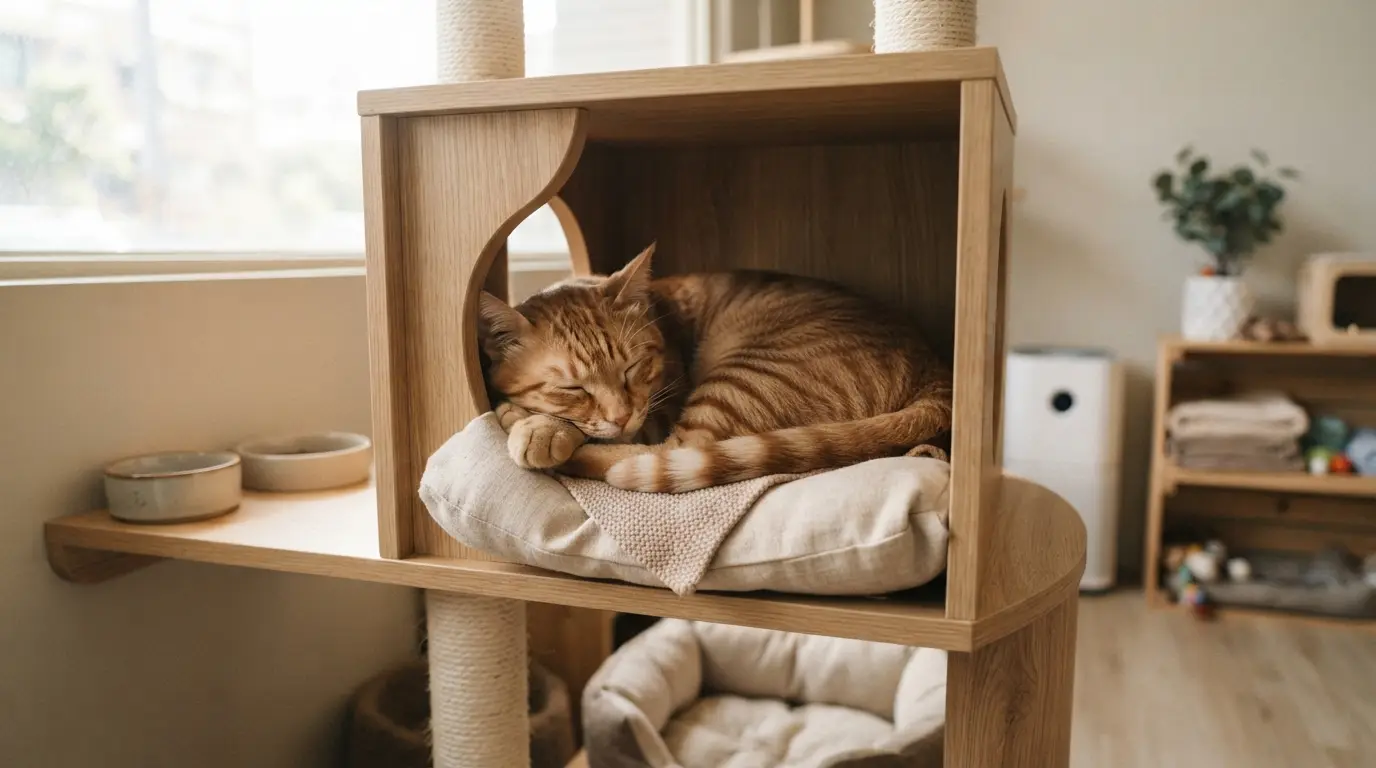
Many people only ask about the square footage. In reality, cats in unfamiliar environments need places to hide and climb. Our observations at the hotel show that cats in rooms with climbing platforms and a fully enclosed hiding space (like a cardboard box or a small house) will start exploring within 6-12 hours. In open spaces without hiding spots, this often takes until the second day.
When inspecting a room, check specifically:
- Is there a hiding space where the cat can completely conceal itself (not just a blanket)?
- Are the litter box and food bowls separated by at least 30 cm?
- Are the partitions opaque or semi-transparent? Can neighboring cats see each other directly (this causes constant tension)?
3. Air Conditioning, Temperature, and Ventilation
Our hotel maintains a year-round temperature of 24-26℃ and humidity of 50-60%, which is the most comfortable range for most cats. In summer, ask about backup power in case of outages; in winter, inquire about heated mats or room heating. Long-haired, overweight, or flat-faced cats are at higher risk in stuffy environments. For more information, see What Are the Long-Term Effects of Cat Heatstroke? Recovery Timeline, Home Care, and When to See a Vet.
Ventilation is also critical: upper respiratory infections in cats are often spread through droplets and contact. Ideally, each room should have independent air intake and overall exhaust, rather than a single circulation fan blowing air between rooms.
4. Vaccination Requirements and Infectious Disease Control
Establishments that strictly enforce vaccinations are actually protecting your cat. Reasonable standards include:
- FVRCP vaccination within its validity period (most require within 1 year, with proof of records or vaccination booklet photos).
- On-site inspection before check-in: checking eyes and nose for discharge, ears, skin, weight, and overall demeanor.
- Availability of separate isolation rooms and disinfection protocols (sodium hypochlorite is effective against feline parvovirus; alcohol is not).
If a facility says, "No need for vaccinations, just bring them over," we recommend skipping it.
5. Daily Updates and Surveillance Cameras
The biggest anxiety when traveling is "not knowing if they're okay." Practically, confirm three things:
- Update frequency and content: Does it include food intake, water consumption, frequency and consistency of bowel movements, and photos or videos of activity?
- Abnormal situation reporting: How many missed meals trigger a proactive contact?
- Surveillance cameras: Are they viewable online? Are there time restrictions for viewing?
Food and litter box records are not just formalities; they are the earliest warning signs. If a cat hasn't eaten for over 24 hours, raise the alarm. You can refer to Cat Not Eating, Drinking, or Sleeping All Day: Normal Lethargy or Warning Sign of Illness? for assessment methods, then discuss with the hotel.
6. Emergencies and Medical Support
Be sure to ask these questions before booking:
- Which veterinary clinic is the partner hospital, how many minutes away by car, and do they offer emergency services?
- Is there a "Veterinary Treatment Authorization Form" and an agreed-upon cost limit?
- Do they accept senior cats or cats with chronic illnesses (kidney disease, heart disease, diabetes)? Can they administer medication or subcutaneous fluids?
For owners of senior cats, it's also advisable to clearly communicate their daily feeding routine. For portion calculations, refer to How Much Should a Senior Cat Eat Daily? Portion Calculation, Wet Food Ratio, and Meal Frequency.
7 Days Before Check-in: The Most Effective Preparation
The most common reason for "cats not eating for 24 hours after arriving at the hotel" isn't the hotel's fault, but rather both the environment and the food have been changed simultaneously. Here's what you can do the week before:
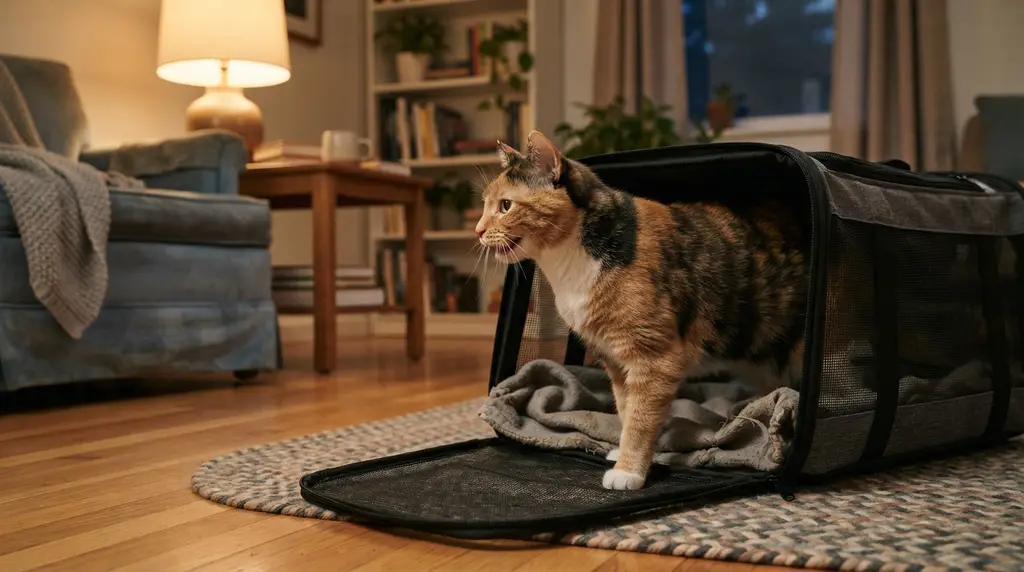
1. Carrier Desensitization: Remove the carrier door and place it in the living room. Put treats and their familiar blanket inside. Toss treats in a few times a day, letting them enter on their own.
2. Bring Your Own Cat Litter: Changing litter is a common cause of refusal to use the litter box or inappropriate urination. We recommend bringing 3-5 liters of the litter you normally use. For example, cats accustomed to Ultra-Fine Tofu Litter 3.0 may find clay litter difficult to adjust to.
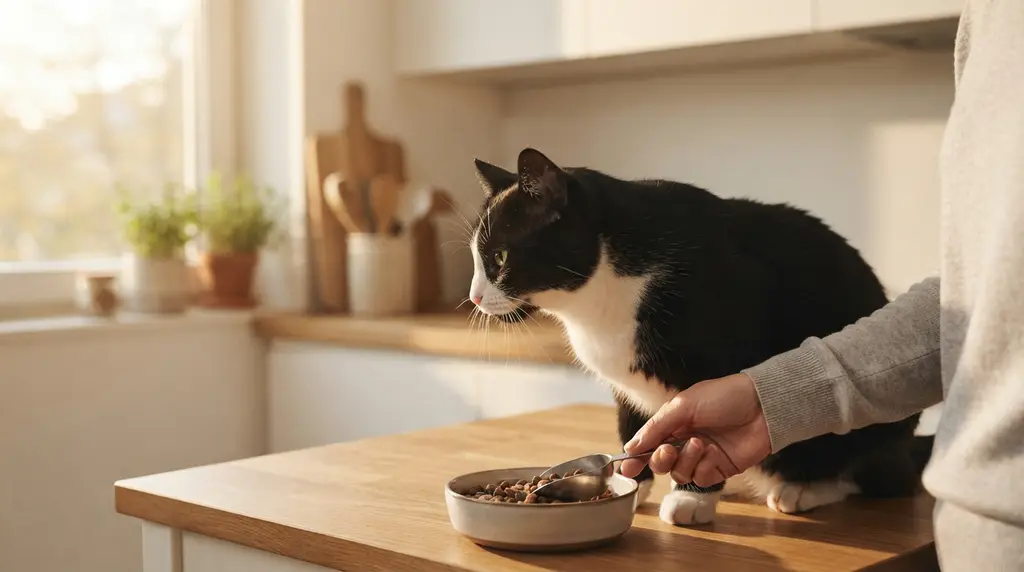
3. Bring Their Original Food: Don't even change the brand or flavor of wet food. Portion it out to the exact amount needed.
4. Bring an old piece of clothing or blanket that smells like home (washed items won't work; it needs to carry their scent).
5. For cats with sensitive stomachs: Loose stools are common when changing environments. You can start supplementing with Specialist Probiotics 3-5 days in advance and write down the usage instructions on the handover form.
6. Fill Out the Handover Form in Detail: Feeding times, number of meals, areas they dislike being petted, places they tend to hide, how to administer medication. We appreciate handover forms filled with details.
If your cat is particularly clingy and cries all night when you leave, consider how to adjust their routine upon your return. You can refer to What to Do About Cat Separation Anxiety? Home Adjustment Tips for Routine Changes After School or Holidays.
Situations Where We Recommend Against Boarding
- Recently undergone surgery, with wounds not yet stitched or still swollen (better to care for them at home first).
- Kittens who haven't completed their vaccinations (under 3 months old, only received one dose).
- Experiencing severe illness, with eye/nasal discharge or unexplained fever.
- Extremely timid cats who hide from everyone at home all day – for such cats, we recommend a one-night trial stay or opting for in-home pet sitting.
We've also covered considerations for short holidays: How to Arrange for Your Cat During the Mid-Autumn Festival Holiday? Home Care, Pet Sitters, and Boarding Options.
Why Banqiao is Often the First Stop for New Taipei Owners
Overall, if you live in New Taipei and want "cat-only, private rooms, daily updates, and convenient transportation" all at once, Banqiao has the highest success rate. Our establishment, Cat Garden in Banqiao, is entirely cat-only, with independent air conditioning and visual reporting for every room, and we can accommodate cats requiring medication for chronic illnesses. During peak seasons (Chinese New Year, winter/summer breaks, holidays), we recommend booking 1-2 months in advance. Cats boarding for the first time are also welcome to try a one-night stay. If needed, you can directly book a cat hotel in Banqiao and mention your concerns in the remarks, and we'll discuss the details with you beforehand.
Frequently Asked Questions
What is a Reasonable Daily Cost for Cat Boarding?
In New Taipei, a single cat private suite costs around NT$450-900 per day, while cage boarding is about NT$300-500. Prices below NT$300 usually indicate compromises in space, air conditioning, or staffing. It's best to visit the facility before deciding.
Do Two Cats Have to Stay in the Same Room?
For cats with a good relationship who groom and sleep together, sharing a room is recommended. They can comfort each other and adapt faster, and the cost is only an additional NT$150-300. However, if they fight or compete for food at home, the high-stress environment of boarding will only amplify conflicts, so separate rooms are necessary.
Do Cats Need Vaccinations for Boarding? Can Unvaccinated Cats Stay?
Most reputable cat hotels require FVRCP vaccinations to be valid (usually within 1 year) to prevent group infections. Kittens who haven't completed their vaccinations should postpone boarding or opt for in-home care.
What If My Cat Doesn't Eat at the Hotel?
A slight decrease in appetite for the first 12-24 hours is common. You can ask the hotel to switch to their original food, warm it to enhance aroma, or move the food bowl closer to their hiding spot. If they completely stop eating for over 24 hours, or show vomiting or lethargy, contact the partner veterinary clinic for a check-up.
Which District is Most Convenient for Boarding When Traveling Abroad: Banqiao, Sanchong, or Xinzhuang?
Banqiao. Banqiao Station has TRA, HSR, and two MRT lines. Transfers to airport buses and the Airport MRT are smooth. You can arrange cat drop-off and your flight on the same day, saving an extra night's boarding fee.
Article by Cat Garden Editorial Department. The above fees are a compilation of common market rates in New Taipei; actual prices vary by establishment and room type. Health-related advice in this article is for general care reference only. If your cat shows persistent lack of appetite, vomiting, rapid breathing, or significant lethargy, please seek veterinary attention immediately.
CatGarden offers curated supplies, cat boarding, and grooming
Book services or shop online.