Why Do Cats Push Things Off Ledges? 4 Psychological Reasons and Redirection Techniques to Prevent Tabletop Disasters
Cats push things off ledges as a test of their hunting instincts, out of curiosity about gravity's feedback, and through learned behavior that elicits a reaction from you. This article helps you understand the 4 main reasons, when to consult a vet, and the most effective environmental management and redirection strategies.
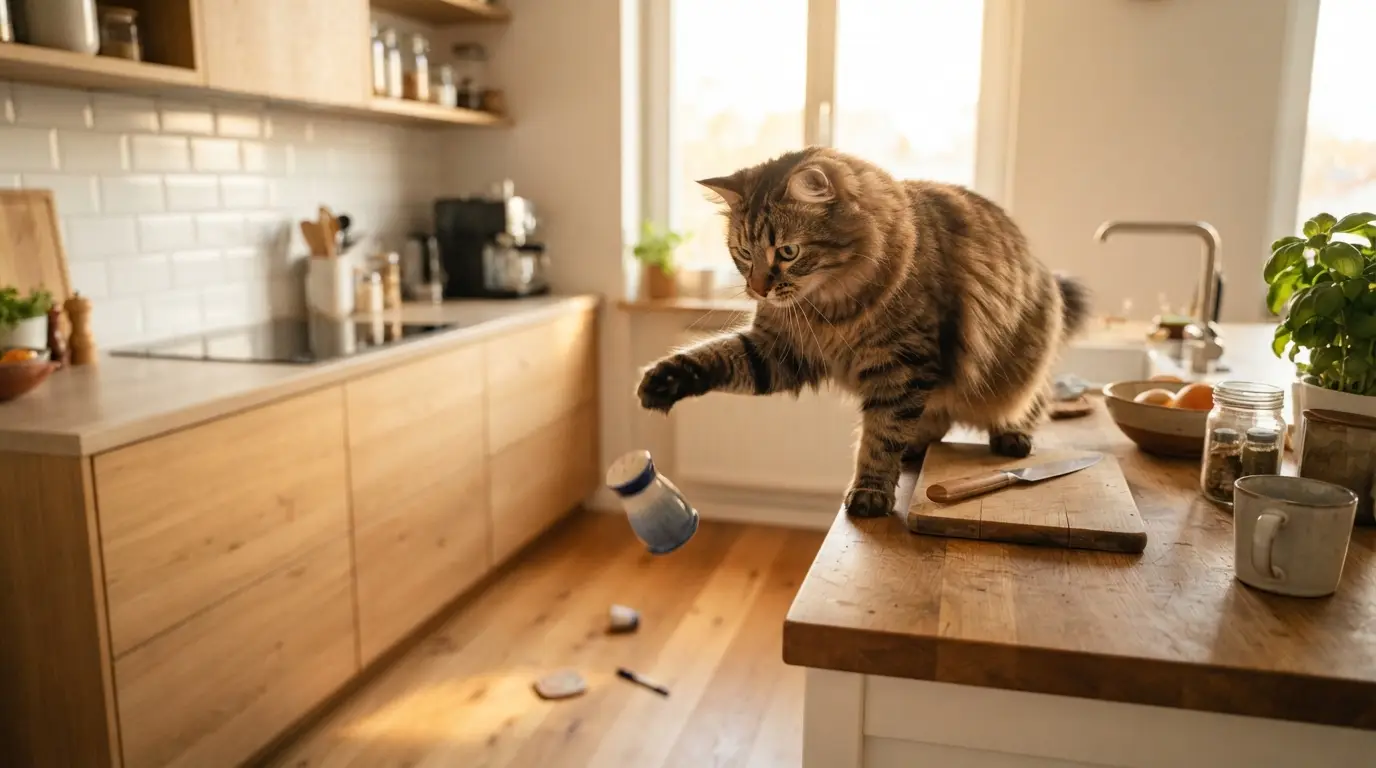
Cats pushing things off ledges are almost never acting out of spite or bad temper. It's usually a combination of four things: the batting test of their hunting instinct, using their paw pads to "feel" objects, curiosity about the "what happens when I push it" gravity feedback, and most crucially – they've learned that "pushing something = you react." Therefore, to truly change this behavior, the focus shouldn't be on scolding, but on "proactive environmental management + zero reaction in the moment + providing a legitimate alternative outlet afterward."
We care for over a dozen resident cats daily at our facility, and one of the most common sights captured on camera is a cat meticulously nudging a spoon from the edge of a water bowl, a disinfectant bottle cap, or even its own toys onto the floor, then staring down at them. This article breaks down this behavior based on our frontline observations.
Key Takeaways
- Cat paw pads are densely packed with sensory receptors; batting and nudging are how cats "investigate objects with their paws," functioning similarly to how humans use their fingertips. It's not destructive behavior.
- Cats have blurry close-up vision within 30 cm (1 foot). They rely on their whiskers and paw pads to gather information, making small objects "right in front of them" on tabletops particularly susceptible to being nudged.
- This behavior peaks during dawn and dusk (crepuscular activity peaks), coinciding with when owners are typically waking up or returning home, making them most likely to react immediately.
- Once the connection "pushing object → owner reacts (picks it up, talks, scolds)" is reinforced about 3 to 5 times, it becomes ingrained. This is a form of intermittent reinforcement, which is very difficult to extinguish.
- Our practical experience shows that 10-15 minute wand toy play sessions twice daily, combined with pulling items away from table edges and rotating toys, significantly reduces object-pushing frequency in most cats within 1-2 weeks.
4 Psychological Reasons Why Cats Push Things Off Ledges
Reason 1: Hunting Instinct – Batting to Confirm "Is it Alive?"
In the wild, before dispatching prey, cats will tentatively bat at it with their front paws to see if it moves or fights back. This action is ingrained in their muscle memory.
You'll notice that cats tend to prefer pushing objects that are small, light, roll easily, and make subtle noises – pens, hair ties, bottle caps, earrings, pills, ping pong balls. When batted, these items "move," perfectly simulating prey response, which rewards the cat's brain, prompting them to push again.
The top three items most frequently nudged off ledges at our facility are: ballpoint pens and small clips, cups of water, and keys or glasses left on the edge. The commonality is that they "make a sound or move when batted."
Reason 2: Tactile Testing – A Cat's "Hands" Are Their Paw Pads
Cats lack dexterous fingers. Their process for exploring the world is: smell → whiskers sweep → front paw bat. Their front paws are their primary tools for judging texture, hardness, temperature, and stability.
Furthermore, cat eyes are adept at detecting movement at a distance but struggle with close-up details. An object placed 20 cm (8 inches) from their nose appears as a blur. This is why many cats will first sniff, then gently touch with the back of their paw, accidentally knocking the item off the table. This isn't malice; it's them "seeing."
Reason 3: Gravity Feedback Experiments – Cats Are Learning Cause and Effect
Cats are genuinely interested in "results they cause." Push → fall → thump → object rolls away or water splashes – this is a whole sequence of audiovisual feedback, triggered by their own actions every time.
This also explains why glass cups are particularly common victims: they make the loudest noise, water spills, and owners react most intensely – a triple reward. Conversely, items like dish towels or socks, which make no noise when pushed, quickly lose a cat's interest after a few attempts.
Kittens and young adult cats (1-3 years old) are most active during this phase as they build their understanding of the world's physics. From this perspective, they aren't being destructive; they're conducting experiments.
Reason 4: Seeking Attention – The Most Common, and Easiest for Us to Reinforce
This is the most impactful of the four reasons. Cats are highly observant of human reaction patterns. If they discover that "bowl is empty → push pen off → human appears," this cause-and-effect link is established.
What's more problematic is that this reinforcement is often intermittent: if you react only a couple of times out of ten, it's actually more appealing to the cat than a consistent response (like a slot machine), making the behavior particularly stubborn.
If your cat's object-pushing behavior is concentrated during your sleep, phone calls, or focused computer work, it's almost certainly attention-seeking. This need follows the same logic as their choice to sleep near you – a form of "social distance language." For a deeper understanding of how cats express attachment through behavior, you can read What Does Your Cat's Sleeping Position Mean? Interpreting Posture, Location, and Affection.
Three Steps to Determine Your Cat's Motivation
No need to guess; a continuous three-day observation will make it clear. We recommend noting three things in your phone's memo app:
1. Timing: Concentrated in early morning/evening → likely instinct and energy-related; concentrated when you are busy or sleeping → attention-seeking.
2. Your Reaction: Did you go over, speak, or pick it up? If so, they are already training you.
3. Object Pushed: Only pushes things that roll or make noise → hunting/feedback-related; pushes anything, then stares at you → attention-seeking.
| Characteristic | Most Likely Reason | Priority Action |
|---|---|---|
| Only pushes small, rolling objects | Hunting Instinct / Gravity Experiment | Provide alternative toys, clear surfaces |
| Pushes then immediately looks at you, meows | Seeking Attention | Zero reaction + schedule interactive time |
| Regular evening bursts of pushing | Unspent Energy | Increase hunting-style play |
| Sudden increase recently, with other anomalies | Stress or physical discomfort | Rule out health issues first |
When to Suspect Physical or Stress-Related Issues
Most object-pushing is normal behavior, but if it has "suddenly increased or become more intense recently," it's worth pausing to investigate:
- Particularly severe at night, with vocalizations while pushing: For senior cats, consider cognitive dysfunction, hyperthyroidism, or pain. Refer to Senior Cat Crying All Night? Rule Out 3 Main Causes: Dementia (CDS), Hyperthyroidism & Pain, Plus Soothing Care.
- Accompanied by inappropriate urination, frequent litter box visits, or licking the lower abdomen: This is a typical combination for stress-induced urinary issues. We recommend reading What to Do About Feline Idiopathic Cystitis (FIC)? Common Causes, 5 Early Symptoms, and Stress Reduction Tips for Home Care.
- Accompanied by biting, chasing, or dilated pupils: This could be play aggression or redirected aggression. The approach is similar to What to Do If Your Cat Bites? Corrective Training for Kittens Who Bite Hands/Feet, Teething Biting, and Sudden Aggression.
- Bumping into things, misjudging distances, walking close to walls: Be mindful of vision changes.
If accompanied by decreased appetite, weight loss, lethargy, or if the behavioral change persists for more than 3-5 days, consult a veterinarian for an assessment. Don't dismiss it as "just being naughty."
Preventing Tabletop Disasters: 5 Environmental Management Tips (Most Effective, Fastest Results)
Honestly, behavior training is slow; environmental management is fast. The methods we use in our boarding rooms can be directly applied at home:
1. Move items 10 cm (4 inches) from the edge: Cats primarily push items that are "within easy reach from the edge." Moving all objects towards the center of the table immediately reduces the likelihood of them being pushed off by a large margin.
2. Add anti-slip measures: Use silicone coasters, non-slip placemats, or place a small piece of museum putty (tacky putty) under vases or decorative items. If it can't be moved = no feedback = not fun.
3. Zero-tolerance list for dangerous items: Pills, essential oil bottles, knives, glass cups, hair ties, earrings, paper clips, rubber bands, thin strings – store these in drawers. Cases of cats ingesting hair ties and rubber bands causing intestinal blockages are not uncommon; these can be life-threatening.
4. Use lidded cups: Switching to travel mugs or cups with lids at home is one of the simplest solutions we've found.
5. Provide a "legal tabletop": Place a shallow dish on a windowsill or cat tree filled with ping pong balls, wool balls, or crumpled paper – allow them to push things here. Cats need an outlet for this behavior, not just prohibitions.
Redirection: Channeling "Object Pushing" into Appropriate Outlets
Twice-Daily Hunting Play Sessions Are More Effective Than Anything Else
The key isn't how long you play, but making it resemble a hunt. A complete hunt has five stages: search → stalk → pounce → catch & bite → eat. When using a wand toy, do this:
- Make the toy move behind furniture or under rugs, rather than just dangling in the air (airborne prey is often birds, and most cats prefer ground-based prey).
- Give them 2-3 opportunities to successfully pounce; don't make it constantly elusive, as this can lead to frustration.
- Immediately feed a small meal after 10-15 minutes of play to "close the hunting loop" with eating. Doing this step significantly reduces evening zoomies and object-pushing.
- Twice a day: Once in the morning before you leave, and once before bed, perfectly targeting the two peak behavior times.
Puzzle Feeders and Toy Rotation
Place 1/3 of their daily dry food ration in a treat-dispensing ball or snuffle mat, making them "work" for their meal. Rotate toys: only have 3-4 out at a time, and swap them out weekly. This keeps them novel. If all toys are constantly available, cats tend to ignore them.
You can also provide olfactory stimulation 1-2 times a week. Sprinkle Premium Catnip on a scratching post or cardboard box. Many cats will enter a state of intense self-amusement for 5-10 minutes, which is like a free workout. However, about 30% of cats are naturally unresponsive to catnip; if this is the case, try silver vine instead.
For Attention-Seeking Cats: Proactive Giving is More Effective Than Reactive Responding
For attention-seeking cats, timing is crucial. Don't wait for them to push something before you engage; instead, proactively schedule fixed interaction times (e.g., 10 minutes at 8 AM and 9 PM). Simultaneously, when they push objects, practice: no looking, no talking, no picking up. Clean up silently after they have left the area for 30 seconds.
4 Things NOT to Do
- Don't spray water or yell loudly: Cats won't connect "I'm being punished because I pushed something" with the action. They will only learn that "you are scary," leading to increased stress and potentially triggering urinary issues.
- Don't pick up the object and give it back: In the cat's eyes, this is a perfect interactive game; you just played with them.
- Don't get up in the middle of the night to give food: Doing this once is enough to establish that "crying gets food."
- Don't confine the cat: Solitary confinement doesn't solve energy issues; it only accumulates frustration.
Special Considerations for Multi-Cat Households and Boarding
In multi-cat households, object-pushing often involves resource competition – whoever gets your attention first wins. In this situation, you need to "give attention separately": play individually for 5-10 minutes instead of playing all together, to prevent one cat from always being unable to get attention. For ideas on managing space and stress in multi-cat environments, refer to the concepts in Multi-Cat Boarding: Choosing Between Shared Rooms vs. Separate Suites, Fees, and Preventing Fights, which are also applicable at home.
We also observe an increase in this behavior during boarding because the stress and boredom of a new environment amplify each other. Our approach is: only place non-breakable items in the room, provide 1-2 individual play sessions daily, and offer a few pushable, rollable toys as an outlet. If you are going away and worried about your cat "destroying the house," you can directly book a stay at our cattery to ensure they are in an environment with regular human interaction.
Frequently Asked Questions
Is My Cat Pushing Things Off Ledges to Get Revenge on Me?
No. Cats' brains are not capable of complex, planned behaviors like "delayed revenge." Their motivation for pushing objects stems from instinctive exploration and immediate feedback. When you perceive it as revenge, it's usually because they choose to do it at a time you care about most – because that's when you react the most.
Is Scolding or Spraying Water Effective?
It may seem effective in the short term, but it's counterproductive long-term. Cats will only learn "not to push when you are present." They will continue to push when you leave, while also developing wariness and stress towards you, potentially leading to inappropriate urination or excessive grooming. Using environmental management and zero reaction yields more stable results.
What Age Cats Are Most Prone to Pushing Things? Will It Stop on Its Own?
The peak is during the young adult stage, from 6 months to 3 years old. Most cats naturally decrease this frequency after 3-5 years old. However, if they don't receive sufficient play and environmental enrichment, some cats may maintain this habit into middle age.
How Much Play Does a Cat Really Need Per Day?
For an average adult cat, a cumulative total of 20-30 minutes of high-intensity interactive play per day, divided into 2-3 sessions, is a realistic goal. Ending each session with a small meal is most effective. Younger cats or active breeds like Oriental Shorthairs may require more.
Why Are They Particularly Fond of Pushing Cups and Water Bowls?
Because water moves, reflects light, and makes noise, providing the highest level of feedback. Some cats also naturally prefer to drink water droplets from their paws after batting at the water. If your cat frequently pushes their water bowl, consider using a wide-mouthed, heavy ceramic bowl or a pet drinking fountain, and place an absorbent mat nearby. This can satisfy their behavior while minimizing messes.
Ultimately, a cat pushing things off ledges is a healthy, curious, and energetic cat doing what comes naturally. What we can do is not shut down this instinct, but rather clear our tabletops, put away dangerous items, and then dedicate 10 minutes daily to a serious hunting session. Most tabletop disasters disappear this way.
— The CatGarden Editorial Team
CatGarden offers curated supplies, cat boarding, and grooming
Book services or shop online.