What is a Cat's Primordial Pouch? Understanding the Loose Skin on Their Belly
The loose, dangling skin on a cat's belly is usually its "primordial pouch," a protective structure from wild evolution, not a sign of weight gain. This article helps you distinguish between the primordial pouch and obesity.
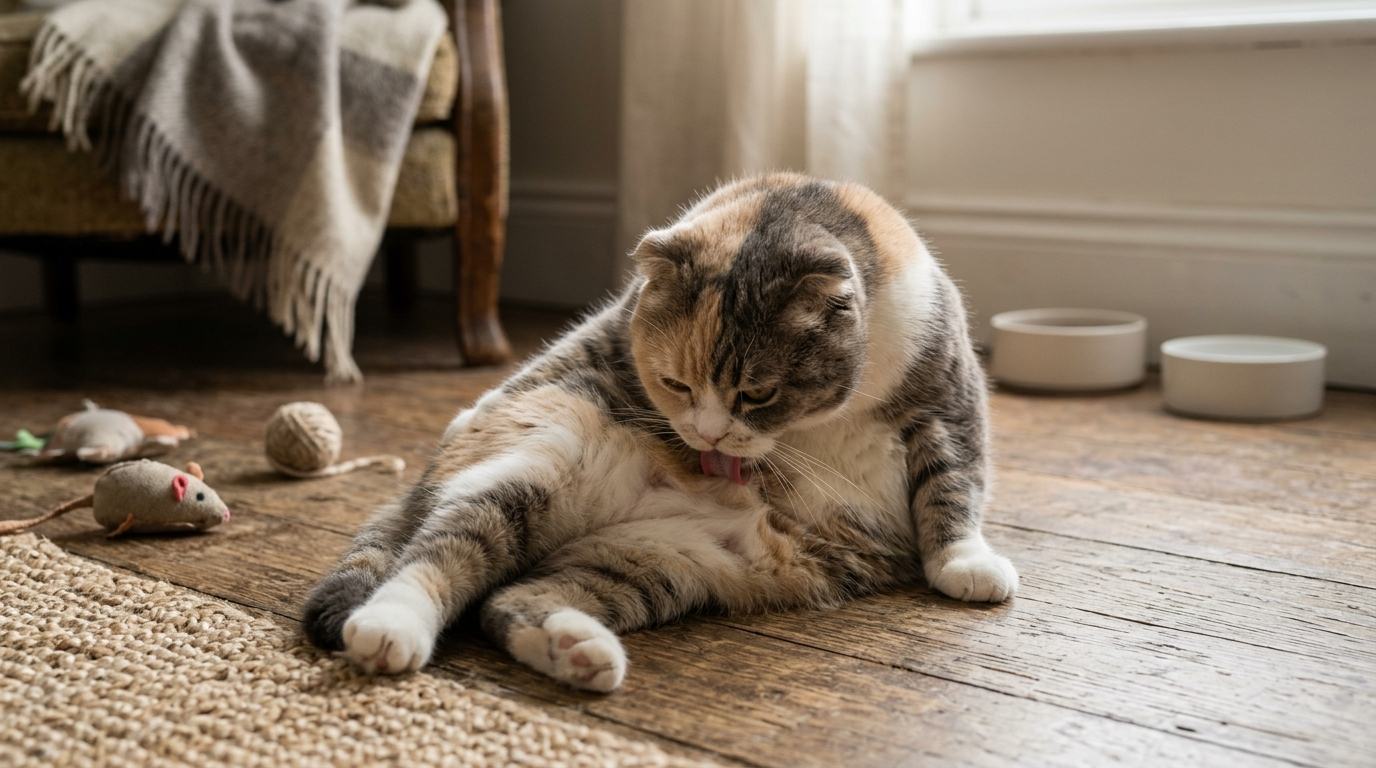
When you feel that loose skin on your cat's lower abdomen that sways as they walk, your first thought might be, "Are they getting fat?" — In reality, it's most likely the primordial pouch, a normal structure evolved from their wild ancestors, not obesity. The primordial pouch is a skin fold that almost all cats are born with, located on their lower abdomen near their hind legs. It feels soft and wobbly, which is perfectly normal.
At our grooming and boarding facility, we encounter owners asking this question almost daily. Today, we'll clarify "What is the primordial pouch, what is its purpose, and how to tell it apart from weight gain."
Key Takeaways
- The primordial pouch is a skin fold on a cat's lower abdomen near the hind legs. It's a normal structure retained from wild evolution, not a disease or obesity.
- The primordial pouch usually becomes noticeable around 6 months of age, near sexual maturity. Both male and female cats, whether spayed or not, can have it.
- To determine if a cat is obese, check if you can feel their ribs and observe their waistline contour, rather than focusing on the wobbly skin on their belly.
- The primordial pouch is fixed in the lower abdomen and feels like loose skin. Generalized, symmetrical fat accumulation is a sign of obesity.
- If your cat's belly rapidly enlarges, becomes hard, or is accompanied by changes in appetite or energy levels, it's a warning sign and requires prompt veterinary attention.
What is a Cat's Primordial Pouch?
The primordial pouch (Primordial Pouch) is a drooping fold of skin and subcutaneous tissue on a cat's lower belly, between their hind legs. When a cat stands or walks, this skin visibly sways back and forth, side to side, appearing like a "little belly." However, it's actually skin, not internal organs or excessive fat.
Nearly all cats have a primordial pouch, though its prominence varies by breed and individual. In lean breeds like Bengal cats or Egyptian Mau, the primordial pouch can appear particularly noticeable. For long-haired cats, the pouch is often hidden by their fur, and owners may only discover it by touch.
When Does the Primordial Pouch Appear?
The primordial pouch typically becomes more apparent when a cat is around 6 months old, nearing sexual maturity, and may become slightly more pendulous with age. This is a normal developmental process and is not directly caused by spaying or neutering. Many owners mistakenly believe that a "loose belly after spaying" is due to weight gain, when in fact, it's often just the primordial pouch becoming more prominent with age, or a change in metabolism after spaying/neutering that requires dietary adjustment.
What is the Purpose of That Loose Skin on Their Belly?
A cat's primordial pouch isn't superfluous; it has practical evolutionary significance from their wild past:
1. Protecting Internal Organs During Fights
When cats fight, they often use their hind legs to "rabbit kick" their opponent's abdomen. This loose skin provides extra cushioning, making it less likely for direct injury to the abdominal organs even if scratched or bitten.
2. Stretching the Body and Increasing Stride Length
Cats are burst predators. The primordial pouch allows for greater extension of the skin in the lower abdomen, enabling them to stretch their bodies further during sprints and leaps. Theoretically, this helps increase their stride length.
3. Space for Storing Energy
In the wild, a cat's meals are inconsistent. This skin also provides elastic space to accommodate food after a meal and store a small amount of fat, meaning they can go for a period without immediate impact if they go hungry.
Understanding these points, you'll realize the primordial pouch is a functional structure, not just excess fat gained from being well-fed. For a more comprehensive understanding of feline body language, you can refer to our series of articles on What Does Your Cat's Sleeping Position Mean? Decoding Sleep Postures, Locations, and Their Affection.
Primordial Pouch vs. Obesity: How to Differentiate?
This is the question owners are most concerned about. The primordial pouch and true obesity can be distinguished by location, texture, and symmetry.
Check the Location
- Primordial Pouch: Located only on the lower abdomen, between the hind legs; it's a dangling fold of skin.
- Obesity: Fat is accumulated throughout the body, thickening the chest, back, neck, and the base of the limbs. It is not confined solely to the lower abdomen.
Check the Texture and Movement
- Primordial Pouch: Feels like a thin layer of skin membrane when pinched. It's primarily skin and sways like a cloth when the cat walks.
- Obesity: Feels like a thick, full layer of fat. You won't feel clear subcutaneous space.
Use the "Rib Test" and Waistline Assessment (Most Practical)
To determine if your cat is overweight, don't just look at the skin on their belly. Focus on these two indicators:
1. Feel the Ribs: Gently run your hand along the sides of their rib cage. An ideal body condition means you should be able to feel the ribs through a thin layer of fat, similar to feeling the bones on the back of your hand. If you need to press hard to feel them, or can't feel them at all, they are likely overweight.
2. Observe the Waistline: Look down from above. There should be a noticeable tucked-in waist behind the ribs and before the hind legs. From the side, the abdominal line should curve upwards, not hang straight down.
If you can feel the ribs and there's a visible waistline when viewed from above, then the wobbly skin on the lower abdomen is the normal primordial pouch, and there's no need to worry.
Is the Primordial Pouch Actually a Sign of Weight Gain?
The answer is: The primordial pouch itself is not weight gain, but an overweight cat's primordial pouch will be more pronounced.
When a cat truly becomes overweight, the primordial pouch, which already has elastic space, will accumulate more fat, making it appear more droopy and larger. Therefore, "cat primordial pouch" and "obesity" can occur simultaneously, but their causes are different — the primordial pouch is a natural skin structure, while obesity is due to excessive energy intake.
In practice, we recommend: First, confirm their body condition using the rib and waistline assessment, then adjust their diet accordingly. If they are indeed overweight, focus on controlling daily calorie intake and increasing activity levels, rather than trying to "get rid of that skin" — the primordial pouch cannot be eliminated; it's always there. For guidance on determining the correct daily feeding amount, refer to How Much Should a Cat Eat Per Day? Guide to Dry Food, Wet Food, and Water Intake.
Senior cats have slower metabolisms and reduced activity, making them more prone to accumulating fat in the primordial pouch area. Diet and weight management require extra attention. You can refer to How Old is a Cat Considered Senior? Diet, Vet Care, and Home Care for Senior Cats.
When to Be Concerned
The primordial pouch is soft, wobbly, long-standing, and stable in shape. However, the following situations are not simply the primordial pouch and warrant prompt veterinary attention:
- The belly rapidly enlarges or becomes rounded in a short period, feeling hard or distended to the touch.
- You feel a distinct hard mass in the abdomen, or the cat shows pain or avoidance when touched.
- Abdominal enlargement is accompanied by decreased appetite, lethargy, rapid breathing, or abnormal weight loss or gain.
- Only one side is swollen, or it's accompanied by vomiting, constipation, or bloody stools.
These symptoms may be related to ascites, tumors, gastrointestinal issues, or organ problems, which cannot be explained by the primordial pouch. If you notice any changes in your cat's posture or energy levels, you can also refer to Is Your Cat in a "Loaf" Position? Comfortable or Sick? A Complete Interpretation of Cat Sitting and Sleeping Postures to assess their current physical state. If symptoms persist or your cat shows significant discomfort, seek veterinary examination promptly. Do not self-diagnose.
Store Manager's Daily Observation Tips
At CatBackyard, when boarding or grooming cats, we regularly check their ribs and waistline to record each cat's body condition changes. Here are some small habits for owners at home:
- Feel the ribs and waistline every 1-2 weeks. This is more intuitive than weighing them daily and helps detect weight gain trends earlier.
- Check the abdomen while brushing. Long-haired cats are particularly prone to having their condition overlooked. Brushing also helps reduce hairballs. You can refer to What to Do If Your Cat Constantly Vomits Hairballs? Solutions for Hairball Prevention, Brushing, and Diet.
- Encourage drinking water and increase activity as the fundamental steps for weight management. During hot weather, use methods mentioned in Cat Water Fountain Recommendations: How to Choose to encourage water intake.
If your cat's long fur obscures their abdomen and makes it difficult for you to assess their body condition, or if you'd like a professional to check during a grooming session, you're welcome to book a grooming appointment. We will also report on their body condition findings.
Frequently Asked Questions
Does the primordial pouch only appear after spaying/neutering?
No. The primordial pouch is a congenital structure that typically becomes more noticeable around 6 months of age, near sexual maturity. Both male and female cats, whether spayed or not, can have it. After spaying/neutering, metabolic changes can lead to easier weight gain, making the primordial pouch appear more prominent, but these are distinct issues.
How can I tell at a glance if it's a primordial pouch or weight gain?
Look at the ribs and waistline, not the skin on the belly. If you can feel the ribs and there's a tucked-in waistline when viewed from above, it's a normal primordial pouch. If you need to press hard to feel the ribs or the entire body has thickened, it's obesity.
Can the primordial pouch be eliminated through weight loss?
No. The primordial pouch is a skin fold structure; even very thin cats will have it. Weight loss can only reduce the fat accumulated in that area, making it appear less droopy, but the skin itself will not disappear.
Do all cats have a primordial pouch?
Most cats do, but the degree of prominence varies. Lean breeds like Bengals actually have a particularly noticeable pouch, while long-haired cats often have it hidden by their fur and can only feel it by touch.
Is a sudden enlargement or hardening of the belly also a primordial pouch?
No. The primordial pouch is long-standing, stable, soft, and wobbly. If the belly rapidly enlarges or hardens in a short period, if there are lumps, or if accompanied by decreased appetite and lethargy, it's a warning sign and requires prompt veterinary examination.
This article was written by the CatBackyard editorial team. The content is a general sharing of care experience and cannot replace veterinary diagnosis. If your cat exhibits abnormal symptoms, please seek veterinary attention promptly.
CatGarden offers curated supplies, cat boarding, and grooming
Book services or shop online.