How to Choose a Private Cat Boarding Room? A Guide to Single Cat Suites, Soundproofing, Ventilation, and Multi-Cat Family Rooms
When choosing a private cat boarding room, the key factors are "completely separated sightlines, independent ventilation, and the ability to place the litter box and food bowls at least 60 cm apart." This article compares the space specifications and care differences of fully independent suites, loft-style cat rooms, and multi-cat family suites, and provides a measurement checklist for you to take on-site.
When choosing private cat boarding, there are truly only three things to compare: whether the enclosure is "completely sealed on all sides, allowing cats to not see each other," whether ventilation is independent rather than shared via a single circulation fan, and whether the litter box and food/water bowls can be placed at least 60 cm apart within the room. For multi-cat families, a simple standard determines whether they should stay in the same room: only cats that groom each other and share litter boxes without conflict at home are suitable for family rooms. Cats with already tense relationships must be separated, as the stress of boarding can escalate minor friction into actual fights.
Key Takeaways
- The practical minimum for a single cat's private room is a floor area of approximately 0.8–1 square meter, a height of over 150 cm, 2–3 levels for jumping, and a completely enclosed hiding spot.
- Placing the litter box and food/water bowls at least 60 cm apart is the cheapest and most effective room design to reduce "not eating" or "not using the litter box" during boarding.
- You don't need instruments to assess ventilation: if you smell a distinct ammonia or urine odor within 30 seconds of entering the boarding area, it indicates insufficient air exchange. Pet spaces generally recommend 6–10 air changes per hour.
- The biggest source of noise in soundproofing is often not the neighboring cat, but the high-velocity dryer (which can reach over 90 decibels); the grooming area and boarding area must be separate spaces, not just divided by a fabric curtain.
- For multi-cat families sharing a suite, the recommended number of litter boxes is "number of cats +1," and feeding bowls should be placed separately in locations where they don't interfere with each other's sightlines.
First, Understand: What Constitutes a "True Private Room"?
The term "private" is very confusing in Taiwanese cat hotels. Some are single rooms with solid walls on all four sides, while others are actually cage spaces within a larger area separated by wire mesh, with just a door to close. What's the difference?
The key is sightlines. Cats' stress rarely comes from "too small a space," but more often from "I can see other cats, but I can't escape." Wire mesh enclosures that allow cats to see each other mean being stared at by unfamiliar cats all night, leading cats to choose not to eat, drink, or use the litter box – this is precisely the chain reaction we least want to see in our facility.
So, when viewing a room, squat down, bring your eyes to the cat's level, and see if you can see the neighboring cat. If you can, it's not a private room.
Specifications and Care Differences of Three Common Room Types
1. Fully Independent Suite (Single Cat Private Room)
Solid walls on three sides + a door for observation (acrylic or tempered glass), where neighbors cannot see each other.
- Suitable for: First-time boarders, timid and sensitive cats, senior cats, cats requiring medication, and cats with a history of Feline Idiopathic Cystitis (FIC).
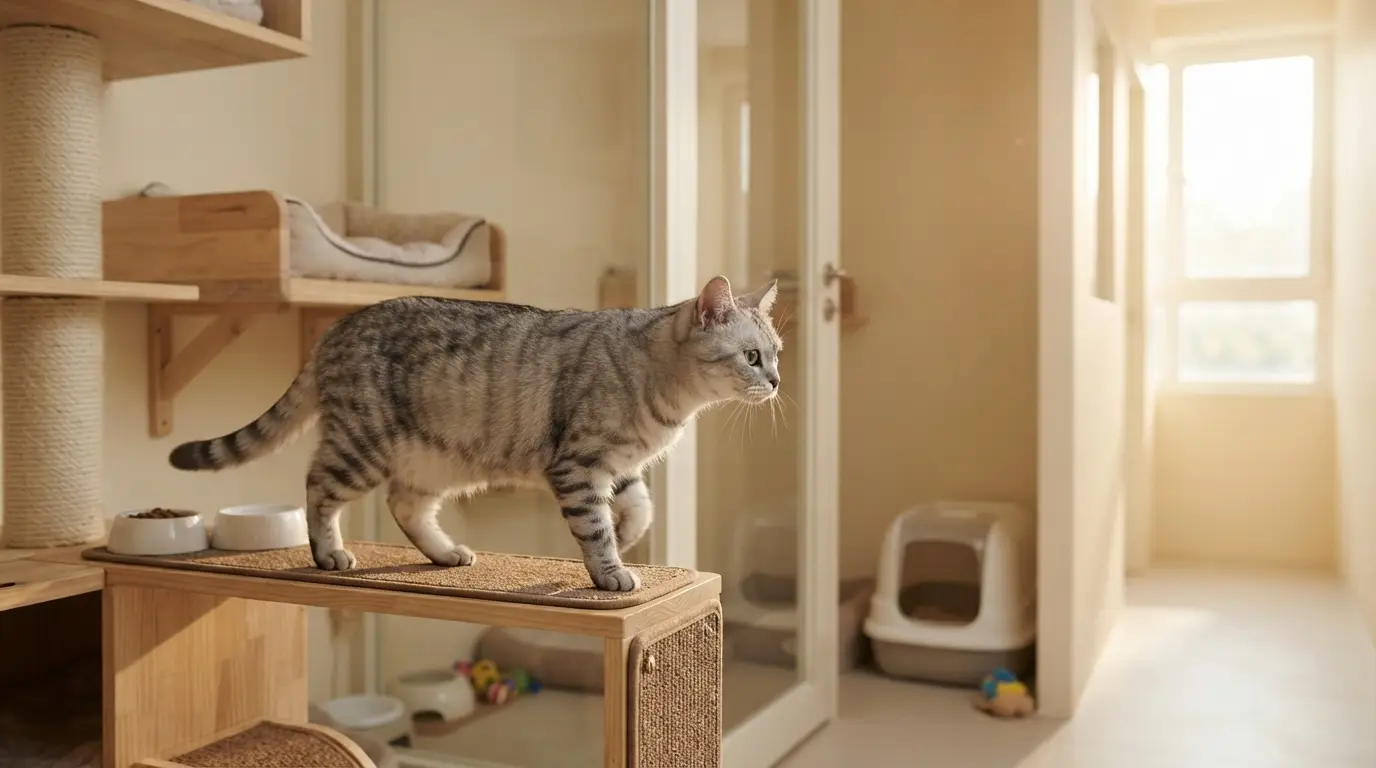
- Recommended Specifications: Floor area starting from 0.8–1 sqm, height over 150 cm, 2–3 levels, and one completely enclosed hiding box or tunnel.
- Care Focus: Because they cannot be seen, staff must have a regular inspection and record-keeping system (we record food intake, water consumption, urination, and defecation every 2–3 hours). Otherwise, the privacy of the independent room can become a situation where "no one notices abnormalities."
2. Loft-Style Cat Room (Mezzanine Type)
This type utilizes vertical space for activity, with single rooms typically being 180–200 cm high.
- Advantages: Cats naturally like to observe from high places. Nervous cats can hide on the upper level and also survey the doorway, providing a clear sense of security compared to flat rooms.
- Note: The recommended spacing between platforms is 30–40 cm; too far apart can be a burden for overweight or senior cats. For cats weighing over 6 kg, or those with arthritis or weak hind legs, inquire about ramps or gentle slopes as alternatives to jumping. This is also a core consideration in Evaluating Senior Cats for Boarding: Health Checks, Medication, and Accessible Rooms.
- Practical Observation: Cats in loft-style rooms often spend the entire first night on the highest level. This is a normal observation period, and there's no need to rush to bring them down.
3. Multi-Cat Family Suite
Two rooms connected, or a large family room of 2–4 sqm, allowing cats from the same family to stay together.
- Suitable for: Cats that have lived together long-term, have a good relationship, groom each other, and sleep close together.
- Not Suitable for: Cats that exhibit resource guarding at home (fighting over bowls, blocking litter boxes), newly introduced members within the last six months, or cats that are currently ill or recovering from surgery.
- Specification Focus: Number of litter boxes "number of cats +1," at least two hiding spots that do not face each other, and feeding bowls placed separately.
Quick Comparison Table
| Room Type | Suitable For | Recommended Space | Most Important Considerations |
|---|---|---|---|
| Fully Independent Suite | Sensitive cats, senior cats, cats needing medication | 0.8–1 sqm+, height 150cm+ | Thoroughness of inspection records |
| Loft-Style Cat Room | Active cats, cats that love to climb | Height 180–200cm, 2–3 levels | Platform spacing, ease of access for senior cats |
| Multi-Cat Family Suite | Cohabiting cats with a good relationship | 2 sqm+ | Number of litter boxes, ability for temporary separation |
Soundproofing: The Most Overlooked Yet Most Impactful Specification
Noise in boarding areas comes from three sources, which should be assessed separately when viewing:
1. Neighboring Cat Sounds: Estrus calls, meowing for attention, kittens calling for their mother. The sealing of gaps in solid walls and doors is crucial.
2. Staff Movement Sounds: Footsteps in hallways, sliding doors, cleaning carts. Rooms directly facing the main walkway are constantly disturbed by passing figures.
3. Mechanical Sounds: High-velocity dryers, washing machines, ventilation motors. High-velocity dryers often operate at over 90 decibels; cats' hearing is far more sensitive than humans', which is why the boarding area absolutely cannot share space with the grooming area.
On-Site Testing Method: Ask the facility to let you enter an empty room, close the door, and sit quietly for 30 seconds with your eyes closed. If you can clearly hear conversations in the hallway or cats moving in adjacent enclosures, the cats can hear it even better. For more detailed information on movement and CCTV checks, refer to the 6 Checklists for Visiting a Cat Boarding Hotel, which is recommended to bring along.
The material of the door also needs consideration: acrylic/glass doors offer good soundproofing and controllable sightlines but require separate air intake vents or independent ventilation; wire mesh doors offer good ventilation but almost no soundproofing and do not prevent mutual viewing. A good solution is a "solid door with an independent ventilation port above or below."
Ventilation and Temperature/Humidity: Not Just "Having a Fan" Means Good Ventilation
Ventilation means exchanging the indoor air, not just circulating the same air. A single circulation fan in a fully occupied boarding area merely distributes odors and droplets more evenly to every room.
When viewing, check these points:
- Odor Test: Is there an ammonia or stuffy smell within 30 seconds of entering the boarding area? No matter how frequent the cleaning, insufficient ventilation will still lead to a stuffy environment.
- Air Exchange Rate: Pet spaces generally recommend 6–10 air changes per hour. You can directly ask the facility if they have total heat exchangers or mechanical exhaust systems.
- Airflow Direction: Exhaust air should not blow from room A into room B. Many upper respiratory infections are transmitted this way.
- Temperature and Humidity: We maintain 22–26°C and 50–60% relative humidity at our facility. Long-haired and flat-faced cats (Persians, Exotic Shorthairs) are more comfortable with slightly lower temperatures in the summer.
- Air Treatment Equipment: HEPA air purifiers are acceptable, but ozone generators should not be operated in spaces with cats, as ozone can irritate the respiratory tract.
Bring This Checklist When Viewing Rooms (You Can Bring a Tape Measure)
- Litter box and food/water bowl distance ≥ 60 cm
- Litter box length ≥ 1.5 times the cat's body length (excluding tail)
- At least one completely enclosed hiding spot (cardboard box, tunnel, covered bed are all acceptable)
- A platform higher than the doorknob, allowing the cat to survey the doorway
- A second escape-proof door between the room door and the entrance to the boarding area
- Independent in-room CCTV with viewable footage
- How the cat is housed during cleaning: Is it taken out, or confined to an upper level? Are temporary holding cages used?
- Whether you can use your own cat litter and food (changing litter or food is a common reason for refusal to urinate or soft stools during boarding)
Regarding bringing your own cat litter, our recommendation is always "use the one from home." If you happen to be looking for one with stable odor control, high cat acceptance, and is easy to bring to a hotel, Odor Control Mineral Litter 3.0 is a standard item in our boarding rooms; it has a fine texture and is well-accepted by cats for stepping on.
Multi-Cat Families: Same Room or Separate? 5 Criteria
1. Do they groom each other and sleep close together at home? (Yes → good for cohabitation)
2. Does one cat guard the litter box or food bowls, preventing the other from approaching? (Yes → separate rooms)
3. How long have the new members lived together? For less than 6 months, separation is recommended.
4. Is one cat ill, recovering from surgery, or on a restricted diet? (Yes → definitely separate rooms for precise recording of individual food intake and excretion)
5. Is there a significant size difference? Cohabitation of kittens and adult cats depends on the quality of interaction. The Kitten Boarding: Age and Vaccination Standards must be met first.
In practice, we've encountered many cases where cats "are fine at home but start fighting the second day at the hotel." The reason isn't a change in affection, but environmental stress lowering their tolerance threshold to zero. Therefore, our family rooms are designed with the ability for temporary separation: if conflict arises, the room can be divided that day, without waiting for the owner to return.
How to Compare Costs Fairly
Fully independent suites are usually 30–60% more expensive than open cage spaces, and loft-style rooms are a step above that. Multi-cat cohabitation often offers a discount for the second cat, so a "family room for two cats" is often more cost-effective than "two independent rooms." However, don't just look at the unit price – factor in "independent ventilation," "inspection records," and "viewable CCTV." For regional pricing and selection logic, refer to New Taipei Cat Hotel Recommendations: How to Choose in Banqiao, Sanchong, Xinzhuang? Pricing and 6 Key Selection Points Explained.
Before and After Check-in: Align These Indicators with the Facility
- Food Intake in the First 24 Hours: Eating more than 50% of their usual amount is considered adapting well. Complete refusal to eat for over 24 hours requires notification of the owner.
- Urination: At least 1–2 normal urine clumps per day. No urination all day, or frequent trips to the litter box with only a few drops, is a red flag for lower urinary tract issues.
- Defecation: Over 48 hours without defecation requires attention.
- Hiding Behavior: Hiding in the den on the first day is normal. If they remain completely hidden by the third day, adjustments are needed (changing room location, adding pheromones, reducing staff traffic).
Any symptom lasting over 24–48 hours, or if the cat is unable to urinate, vomiting uncontrollably, or has rapid breathing, seek immediate veterinary care without waiting for the owner's return. When booking, remember to leave the contact information for your trusted veterinarian and an emergency contact person authorized to make decisions.
If you want your cat's vacation to be "quiet, with no sight of other cats, and with someone recording their status regularly," you're welcome to see the actual layout of our independent and family rooms in Banqiao, or book a cat hotel in Banqiao and arrange an on-site visit before check-in.
Frequently Asked Questions
Will my cat be too lonely staying alone, leading to more anxiety?
For the vast majority of cats, "quiet, predictable, and no unfamiliar cats" is more important than "having company." Cats that truly need companionship are those that are already highly attached to their owners. In such cases, the solution is to increase staff interaction time, not to house them with unfamiliar cats.
For two cats with a good relationship, is it mandatory to book a multi-cat family room?
Not necessarily, but it's usually more cost-effective and stable. The prerequisite is that they don't exhibit resource guarding at home. If one cat needs a controlled diet or is on medication, separate rooms are recommended for accurate recording of their individual food intake and excretion.
If the room is private and I can't see my cat, how do I know if they are okay?
Please confirm that the room has independent CCTV and that you can view it, and whether the facility provides daily records (food intake, water consumption, number of urine clumps, stool condition, activity level). Reports with only photos and no data are of limited informational value.
Is a loft-style room suitable for senior cats?
If their hind legs are strong and they still jump onto the sofa, a loft-style room can provide an excellent vantage point for observation. However, for cats with arthritis, those who are overweight, or those with declining vision, a low-level flat private room is recommended, with the addition of ramps or slopes.
Do I need to bring my own cat litter and food?
Highly recommended. Changing environments, litter, and food simultaneously during boarding is a common combination that leads to refusal to urinate or soft stools. Bringing your usual cat litter, your usual food, and a blanket with the scent of home will significantly speed up their adaptation.
This article was written by the CatGarden editorial team, compiling information from the front-line care experience at our Banqiao boarding and grooming facility. It is for owner reference only and cannot replace veterinary diagnosis and treatment advice.
CatGarden offers curated supplies, cat boarding, and grooming
Book services or shop online.