What is Your Cat Thinking When It Stares Blankly? 3 Possible Reasons for Staring at Nothing or Freezing Suddenly
When your cat stares at the air or suddenly freezes, it's usually scanning its environment with its ears and nose or is in a light sleep. What you should truly worry about is a vacant stare that doesn't respond. This article uses observations from a cat boarding facility to help you distinguish between three reasons for blank stares and when to seek veterinary care.
What is your cat thinking when it stares blankly? The answer is usually a bit anticlimactic: it's most likely not "thinking" but rather scanning its environment with its ears and nose, or it's in a power-saving mode of half-sleep. A simple test to determine if it's normal is to call its name, open a can of food, or clap your hands gently. If its ears turn and its eyes refocus within 1-2 seconds, it's a normal cat blank stare. However, if the cat is completely unresponsive, as if disconnected, or exhibits facial twitching, drooling, unequal pupil sizes, and staggering confusion afterward, it's not just zoning out but a seizure that requires veterinary attention.
We observe dozens of cats in our cat boarding and grooming facility in Banqiao, often freezing in unfamiliar surroundings. Over time, we've realized that the same phrase from owners, "My cat is always staring blankly," can actually refer to three completely different situations.
Key Takeaways
- Cats' hearing range extends to about 55-79 kHz, far exceeding the human upper limit of 20 kHz. When they "stare at the air," they are often listening to sounds you can't hear (pipes, air conditioner compressors, geckos or mice in the ceiling).
- Cats sleep 12-16 hours a day, with about three-quarters of that being light sleep. Therefore, a "blank stare" with half-closed eyes, slow breathing, and a relaxed body is usually just dozing off, not a vacant spell.
- The most practical way to distinguish between normal and abnormal is the "call-back test." Normal blank stares can be interrupted within 1-2 seconds; vacant spells like focal seizures typically last 30 seconds to 2 minutes and are unresponsive.
- Senior cats (10+ years old) exhibiting fixed stares, staring at corners, circling, or howling at night should be evaluated for high blood pressure, hyperthyroidism, chronic kidney disease, and cognitive dysfunction syndrome (CDS), rather than dismissing it as "personality changes with age."
- Sudden freezing for 3-10 seconds with a stiff body, followed by resuming play, is usually a "freeze" response during hunting behavior, which is a normal instinct.
First, Differentiate: Three Completely Different Types of "Blank Stares"
Before diving into the reasons, let's categorize your cat's behavior. Even though it looks like a blank stare, these three types are handled very differently at our facility:
| Type | Body Posture | Responsive to Calls? | Common Times |
|---|---|---|---|
| Light Sleep / Dozing | Lying down or on its side, eyes half-closed, slow and regular breathing | Responsive, but may be reluctant | Scattered throughout the day |
| Sensory Scanning | Sitting upright, ears slightly rotating, whiskers forward, occasional tail tip twitch | Responsive, but may continue listening first | Evening, late night, or when the environment changes |
| Vacant Spell / Abnormal | Frozen while standing or sitting, vacant gaze, possibly lip-licking, twitching, head tilted to one side | Unresponsive | Lasts tens of seconds, may recur |
Reason 1: It's "Listening" to Something You Can't Hear (Sensory Monitoring)
This is the most common explanation. Cats are ambush predators, and their primary information gathering relies on hearing and smell, with sight being secondary. A cat's ear pinnae can rotate nearly 180 degrees independently, and their hearing range extends to about 55-79 kHz, more than three times that of humans (around 20 kHz). Therefore, the "empty air" they are staring at could be:
- Water flowing in pipes within the wall, or the ignition of a water heater.
- The high-frequency hum of an air conditioner or refrigerator compressor.
- Geckos, mice, or birds in the ceiling cavity.
- Footsteps or door locks from upstairs neighbors.
- A motorcycle alarm outside that you haven't noticed.
How to confirm this type? Observe three details: are the ears slightly rotating, are the whiskers pulled forward, and are the pupils reacting normally to light? If any of these are active, it means the brain is functioning consciously, not disconnected.
The most common scenario we see at our facility is a cat sitting bolt upright in its boarding room, staring intently at a door crack or a ceiling corner for ten minutes without moving. Owners often call us in a panic after seeing the surveillance footage. In reality, a new cat might have just been introduced to the adjacent room, and the cat is using its hearing to build a map of "who is in this building." This type of scanning is most frequent during the first 1-2 days of boarding and significantly decreases by the third day as environmental information is gathered.
What we use for this
CatGarden’s own products, shipped from Taiwan Premium CatnipFrom CA$36.65 per jarFree shipping on multi-packs
Reason 2: It's Dozing Off, Just Not Closing Its Eyes (Power-Saving Mode)
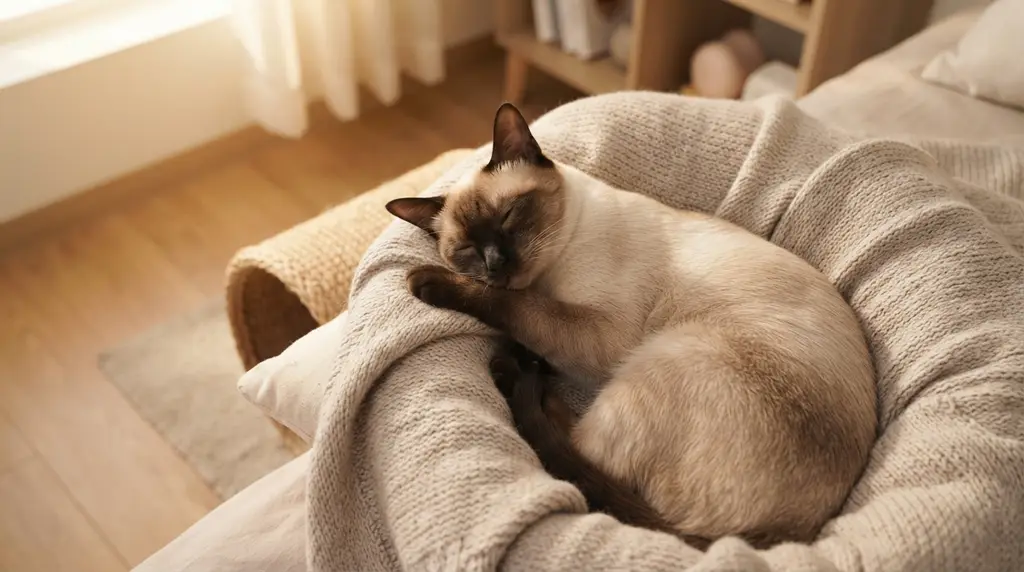
Cats sleep 12-16 hours a day, with kittens and senior cats sleeping even more. Approximately three-quarters of this sleep is light sleep, from which they can wake up at any moment. During light sleep, cats don't always close their eyes, especially in places where they feel somewhat alert but want to rest (e.g., in the middle of a hallway, on a windowsill, by your feet). This often results in a scene of "half-open eyes, unfocused pupils, and a limp body" – this is the quintessential cat blank stare.
The distinction is simple: look at whether the posture is bearing weight. True vacant spells usually involve freezing while standing or sitting; dozing cats will lie down, lie on their side, their chin will slowly droop, and sometimes they'll jolt awake with a head nod.
Incidentally, where they choose to stare blankly and which direction they face their belly can provide valuable clues. We've covered this in more detail in What Does Your Cat's Sleeping Position Mean? Decoding Sleep Postures, Locations, and Their Affection Level. Reading both articles together will give you a clearer understanding of your cat's daily routines.
However, be aware of the opposite scenario: if the blank stare transitions from "likes to sleep" to "sleeps all the time, is unresponsive, and too lazy to even eat or drink," it's not power-saving but a sign of illness. Refer to the observation chart in Cat Not Eating, Drinking, or Sleeping All Day: Warning Signs & When to See a Vet for guidance. If your cat hasn't eaten for over 24 hours, don't wait any longer.
Reason 3: "Freeze" After Emotional Overload and Decision Pause
Cats have three responses to stress: fight, flight, or freeze. Many owners mistakenly believe that freezing means "it's not scared anymore, it's just zoning out." In reality, it's one of the highest stress states. Common scenarios include:
- Freezing suddenly for 3-10 seconds mid-play: This is the ambush phase of the hunting sequence, a normal instinct, followed by a burst of activity.
- Freezing after being petted in an area they dislike: This is overstimulation, a warning sign that "I'm reaching my limit." Continuing to pet them may result in a bite.
- Two cats staring at each other without moving: This is a silent social standoff, not a blank stare. Whoever breaks eye contact or lowers their head first indicates who is yielding.
- Fixed staring after moving house, during renovations, staying overnight elsewhere, or when guests visit: This is an environmental assessment period, which usually subsides within 24-72 hours.
We most frequently encounter the second and fourth scenarios during grooming or boarding. Here's a real-life example: a cat, visiting for the first time, becomes completely still for 20 minutes after its nails are trimmed, not even looking at the canned food placed nearby. In such cases, we avoid forced interaction. Instead, we dim the lights, cover half the cage, and reduce noise. Usually, after 15-30 minutes, the cat will start grooming itself. The appearance of grooming indicates that the stress level is starting to decrease, which is our most practical indicator of a cat "coming back to its senses."
If your cat is naturally timid or prone to freezing and hiding, we recommend following the pace outlined in What to Do If Your Timid Cat Keeps Hiding? 5 Stages and Timeline for Socializing a Fearful Cat. Avoid forcing interaction with treats. You can also use Premium Catnip in their own territory to create positive associations, making "voluntarily leaving a corner" a rewarding experience (about one-third of cats are unresponsive to catnip, so don't worry if yours isn't interested).
When Should a Blank Stare Warrant a Vet Visit?
In the following situations, don't dismiss it as "it's just thinking":
1. Focal Seizures / Vacant Spells
Characteristics include unresponsiveness, lasting 30 seconds to 2 minutes, often accompanied by facial or ear twitching, involuntary lip-licking or chewing, unilateral muscle twitching, dilated pupils, drooling, and incontinence. After the seizure, the cat may experience a period of confusion, unsteady gait, or increased hunger ("post-ictal phase"). These seizures often recur at similar times.
2. Cognitive Dysfunction Syndrome (CDS) in Senior Cats
Be vigilant in cats aged 10 and above: staring at walls or furniture seams, getting lost in familiar environments, vocalizing loudly at night, urinating or defecating outside the litter box, and reduced interaction with family members. Behavioral changes in senior cats can also be signs of high blood pressure, hyperthyroidism, chronic kidney disease, or pain, requiring blood tests and blood pressure monitoring.
3. Pain and Internal Medical Issues
A cat in pain will not cry out; it will "quietly curl up and become still." Cats with bladder inflammation, oral ulcers, arthritis, or constipation are often mistaken for being "unusually quiet or zoning out today." If accompanied by decreased appetite, stiff posture, reluctance to jump onto high surfaces, or reduced grooming, veterinary attention is needed.
4. Vision or Hearing Loss
A sudden "stare at the air" could also be due to impaired vision. Retinal disease caused by high blood pressure in senior cats can lead to persistently dilated pupils, poor light response, bumping into objects, and hesitation before jumping down.
5. Feline Hyperesthesia Syndrome
A blank stare accompanied by rippling skin on the back, sudden excessive licking or attacking of its own tail, dilated pupils, and sudden bursts of energy requires specialist evaluation. Do not assume it's just "mischief."
> If your cat is unresponsive, seizures increase in frequency, last longer than 2 minutes, or are accompanied by twitching and loss of consciousness, seek veterinary care immediately. Do not observe at home if symptoms persist or worsen.
60-Second Home Assessment Flow (Just Follow These Steps)
1. Record a 30-second video first: It's crucial to record, as cats rarely perform on cue at the vet's office. The video should capture the full body and face.
2. Perform the call-back test: Call its name, clap your hands once. If there's a reaction within 1-2 seconds → normal blank stare. No reaction at all → proceed to the next step.
3. Observe the face: Are both pupils the same size? Is there lip-licking/chewing? Is there drool at the corners of the mouth? Is the head tilted to one side?
4. Observe the body: Is the breathing smooth (20-30 breaths per minute at rest)? Is there localized twitching? Are the muscles stiff?
5. Note the frequency: Use your phone to record the date, time, and duration of the episode. A week's worth of records is more useful than an hour of description.
How We Reduce "Boredom-Induced Blank Stares" at Our Facility
If health issues are ruled out, and your cat spends most of its day lying down and staring at the air, it's often due to a lack of environmental stimulation. Effective practical strategies include:
- Two 10-minute hunting-style interactive sessions daily: The wand toy should have a complete sequence of "spotting—chasing—pouncing—catching," followed by a meal. This easily leads into a sleep cycle.
- Window perch + vertical space: A high spot with a view of the outside provides more stimulation than ten toys.
- Food scattering: Divide one meal's portion into 3-4 locations, encouraging the cat to "hunt for its food."
- Consistent routine: Cats are sensitive to time. Fixed feeding and interaction times significantly reduce anxiety-related fixed staring.
- Watch for repetitive behaviors: If, in addition to blank stares, your cat starts exhibiting uncontrollable repetitive behaviors like excessive grooming or Cat Constantly Digging in Litter Box: Reasons for Excessive Scratching, consider stress and environmental factors.
Finally, a practical tip: If you're going away, it's normal for your cat to exhibit fixed staring, reduced eating, and infrequent urination/defecation for the first 1-2 days in an unfamiliar environment as they adapt. When booking boarding with us, we ask owners to bring their usual cat litter and an item of clothing with their home scent. These two items are more effective than any calming spray in shortening the "freeze period."
Frequently Asked Questions
Is my cat really seeing "ghosts" when it stares at the air?
There is no scientific evidence for this. Cats' hearing range extends to about 55-79 kHz, and they have far more olfactory receptors than humans. They are simply perceiving sounds and smells from sources you cannot detect, making it appear as if they are looking at nothing.
My cat suddenly freezes for a few seconds. Does it need to see a vet?
If it only lasts 3-10 seconds, the cat can be called back to attention, and its behavior returns to normal afterward, it's usually a hunting instinct freeze or a response to overstimulation and doesn't require veterinary care. If it happens repeatedly, the cat is unresponsive, or it's accompanied by twitching or drooling, record a video and seek veterinary attention promptly.
Is my senior cat staring at the wall due to dementia?
It could be cognitive dysfunction syndrome, but it's also common with high blood pressure, hyperthyroidism, chronic kidney disease, and pain. If this change occurs in a cat over 10 years old, a blood test and blood pressure measurement are recommended, rather than attributing it solely to aging.
Can I pet or hold my cat when it's staring blankly?
If it's dozing, let it sleep. If it's a fearful freeze (body stiff, ears back, tail tucked), the risk of being bitten is highest at this moment. It's recommended to first reduce environmental stimuli and interact only after it starts grooming or changes its posture.
How can I tell if my cat is bored or depressed?
Look for a decline in "other behaviors as well." A bored cat will immediately perk up at the sound of a wand toy or a can opener. A cat with emotional or physical issues will simultaneously show decreased appetite, reduced grooming, increased hiding, and changes in litter box habits. This combination warrants a veterinary check-up.
Article by CatGarden Editorial Team
CatGarden offers curated supplies, cat boarding, and grooming
Book services or shop online.