What is a Cat Cafe? How Does it Differ from a Cat Hotel or Foster Home? What to Know Before Taking Your Cat Out
A cat cafe is a dining space where "customers can interact with resident cats," not a place to board your cat or an adoption platform. In most cases, it's not suitable for bringing your own cat. This article clarifies the differences between cat cafes, cat hotels, and foster homes, and highlights the stress signals your cat might exhibit when taken out.
A cat cafe is a dining space where "customers can interact with resident cats while enjoying food and drinks." The cats are resident cats cared for by the establishment long-term; it is not a place where you can board your own cat. In most cases, cat cafes do not welcome or find it suitable for you to bring your own cat – these are three completely different services from cat hotels (boarding) and foster homes (for adoption).
If you are "planning to be away from home for an extended period and need a place for your cat," you should look for a cat hotel. If you are "looking to adopt a cat and want to meet adoptable cats," you should look for a foster home. In this article, drawing from our frontline experience in cat hotels and grooming, we will clearly explain the differences between these three, the stress signals cats exhibit in unfamiliar environments, and what to prepare when you truly need to take your cat out.
Key Takeaways
- Cat cafes are dining spaces with resident cats; cat hotels offer short-term boarding; foster homes are transitional shelters for cats awaiting adoption. Their purposes are entirely different.
- The vast majority of cat cafes do not allow "customers to bring their own cats" due to the risk of territorial conflict and disease transmission from unfamiliar cats.
- Cats are highly territorial animals. Stress responses to a change in environment typically appear within 10-30 minutes of arrival: hiding, low growling, dilated pupils, tucked tail.
- When taking a cat out, it's recommended to keep them in their carrier at all times. Maintain room temperature between 22-26°C, and try to keep one-way travel under 30 minutes.
- For multi-day absences, a cat hotel with separate isolation spaces and individual rooms that prevent eye contact is much safer than taking your cat everywhere.
What Exactly is a Cat Cafe?
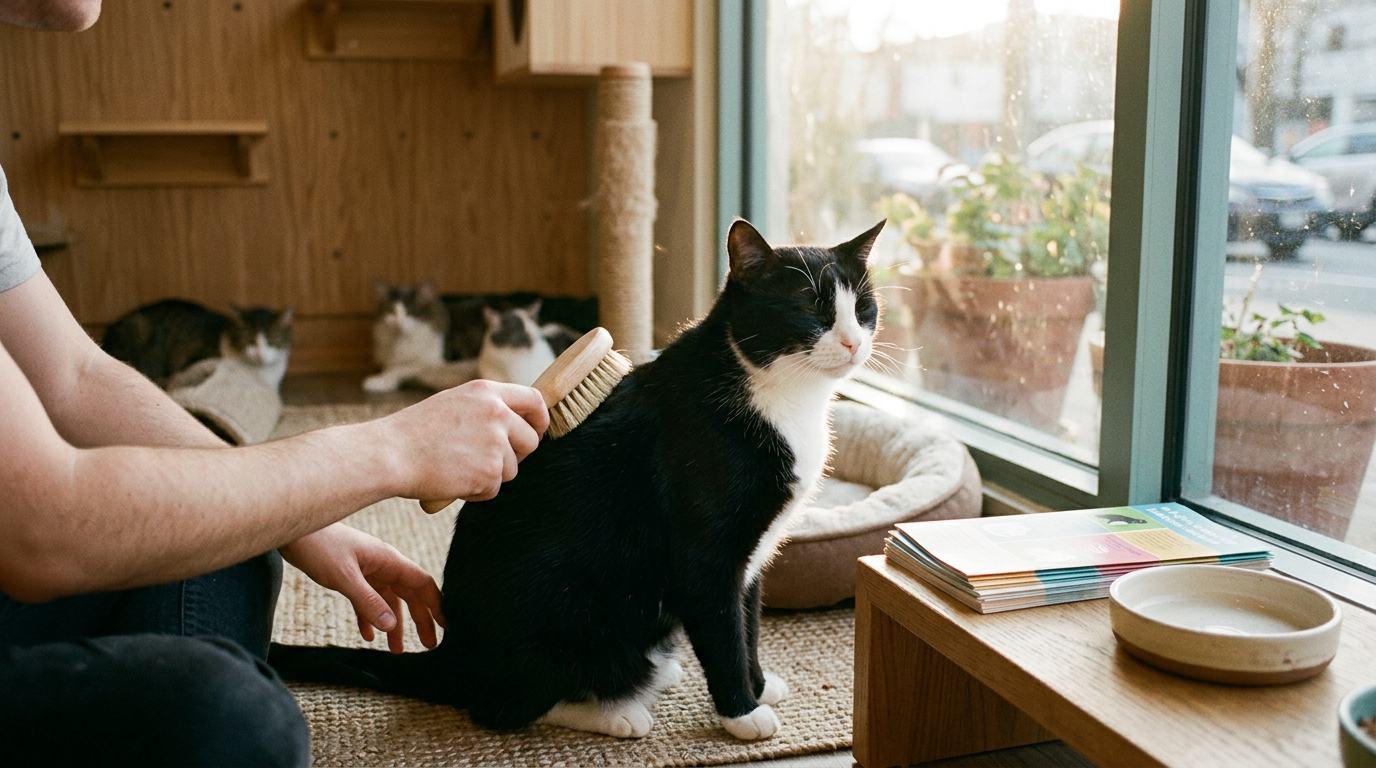
The core concept of a cat cafe is simple: the establishment keeps a group of friendly resident cats, and customers purchase a drink and spend time interacting with, photographing, and petting these cats. These cats are individuals who live in the cafe long-term and are accustomed to people coming and going. They are carefully selected (willing to be petted, not overly shy, don't bite aggressively) to be suitable as resident cats.
Therefore, a cat cafe offers an "experience of interacting with cats," with the resident cats as the stars, not your own cat.
What a Good Cat Cafe Does
Among the establishments we've observed, cat cafes that are run with care typically have these characteristics:
- Clear interaction rules: No rough handling, no waking sleeping cats, no feeding human food.
- Cats have high perches and private spaces to retreat to: Cats can withdraw when tired and are not cornered by customers.
- Hand washing/sanitizing required before entry: Reduces the chance of bringing external pathogens into the cafe.
- Scheduled rest periods: Cats are not petted 24/7 in shifts without any respite.
If the cats in a cafe always seem to be chased and have nowhere to hide, it's not because the cats are "very friendly," but because they have no choice.
What's the Difference Between a Cat Cafe, Cat Hotel, and Foster Home?
These three terms are often confused online. Let's clarify with a comparison.
Cat Cafe
- Purpose: Dining + leisure experience interacting with resident cats.
- Whose cats: The establishment's resident cats.
- Can you bring your own cat: Mostly no.
- Is it suitable for you: When you want to pet cats, assess if you're ready for cat ownership, or simply want to relax.
Cat Hotel (Cat Boarding/Accommodation)
- Purpose: Short-term care for your cat when you are away from home.
- Whose cats: Your cat, staying temporarily.
- Key features: Private rooms, no eye contact with other cats, established cleaning and feeding protocols.
- Is it suitable for you: When traveling for business, vacation, or undergoing home renovations, requiring you to be away for a few days. For information on costs and how to choose a facility, you can read our guide on How to Choose a Cat Boarding Facility in Banqiao? Summer Vacation Boarding Costs, Environment, and Preparation Guide.
Foster Home (Foster Care/Adoption)
- Purpose: To house stray or surrendered cats and find them suitable adoptive families.
- Whose cats: Temporarily cared for by the foster, with the goal of adoption.
- Is it suitable for you: When you want to adopt a cat and get to know their personality before deciding which one to bring home.
In a nutshell: A cat cafe is for seeing other people's cats, a cat hotel is for boarding your cat, and a foster home is for preparing to bring a cat home.
Should You Bring Your Own Cat to a Cat Cafe?
Let's get straight to the point: We do not recommend bringing your own cat to a cat cafe. There are three reasons, all related to a cat's natural instincts.
1. Territorial Conflict is Almost Inevitable
Cats are highly territorial animals. The resident cats consider the entire cafe their territory, and your cat entering is an "invasion." At best, it leads to standoffs and growling; at worst, it results in fights and injuries. Even if your cat is usually gentle at home, they might behave completely differently in an unfamiliar territory.
2. Risk of Infectious Diseases and Parasites
Cat cafes have high foot traffic and a high density of cats. Even with the best management by the establishment, bringing your own cat in carries the risk of exposure to ringworm, panleukopenia, upper respiratory infections, and ear mites. This is precisely why almost all cat cafes prohibit outside cats.
3. Your Cat Will Not Enjoy It
Many owners mistakenly believe that "taking their cat out to play" is a form of affection. However, for a cat, leaving their familiar home means a source of stress. Unlike dogs, they don't look forward to outings; most cats would rather stay in their cardboard boxes or corners.
How to Read Cat Stress Signals at a Cat Cafe
Whether you're observing the resident cats or have brought your own cat into an unfamiliar environment, these stress signals are worth remembering. When we check in cats at our facility, these are the common signs of anxiety we see within the first 10-30 minutes:
- Tucked tail or tail held low: A typical sign of nervousness or fear. For a detailed interpretation, see What Does a Cat's Downward or Tucked Tail Mean.
- Dilated pupils, ears flattened back: Entering a state of alert or preparing to flee.
- Low growling, hissing, or emitting low-frequency sounds other than purring.
- Desperately trying to hide in the furthest corner or squeeze into the smallest space.
- Frozen posture, curled up in a "loaf" position: Appears calm but is actually tense and unable to move.
- Excessive licking of front paws or grooming: A displacement behavior when anxious. Refer to Is it Normal for a Cat to Lick its Front Paws Constantly.
- Panting with tongue out: Cats rarely pant. This indicates significant stress or overheating and requires immediate cooling and removal from the situation.
If you observe multiple signals appearing simultaneously, it means the cat is overwhelmed and needs to be removed from the source of stimulation and returned to a quiet space.
If You Really Need to Take Your Cat Out, What Should You Prepare?
Vet visits, moving, checking into boarding – some outings are unavoidable. In these situations, "how you take them" is more important than "where you take them."
Before Leaving
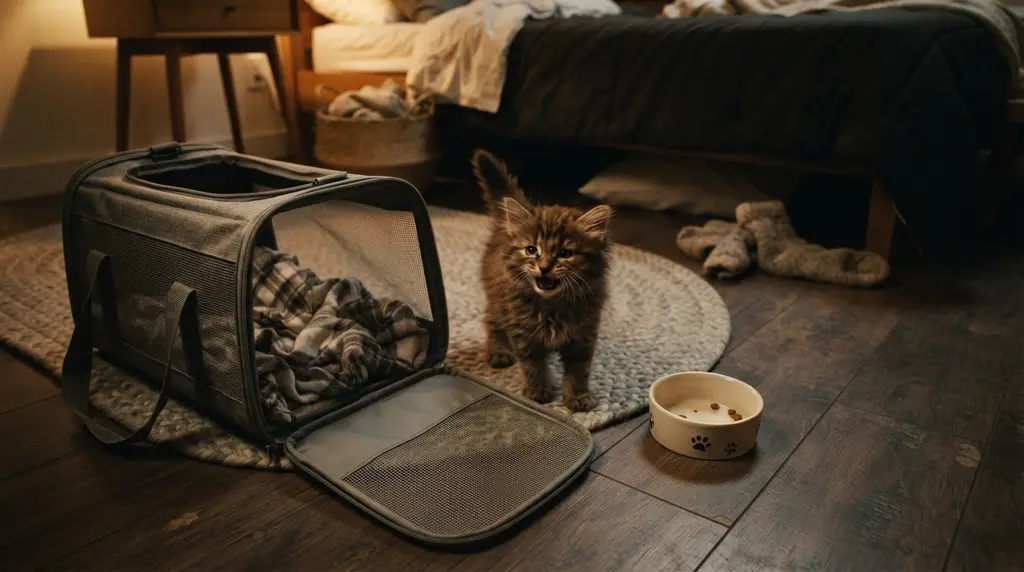
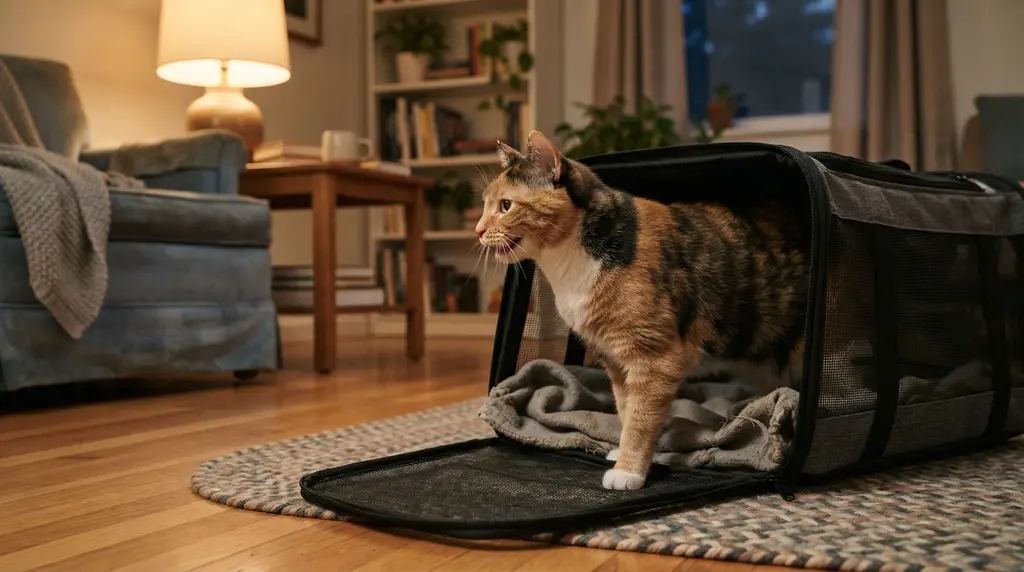
- Acclimate your cat to the carrier beforehand: Leave the carrier in the house as a resting spot. Spray some catnip or place a familiar blanket inside. Don't wait until you need to leave to force them in.
- Do not feed a large meal 2-3 hours before leaving: Reduces the chance of car sickness and vomiting.
- Ensure the carrier is well-ventilated and has a padded bottom: Line the bottom with an absorbent pad for easy cleanup if accidents occur during the journey.
During Travel
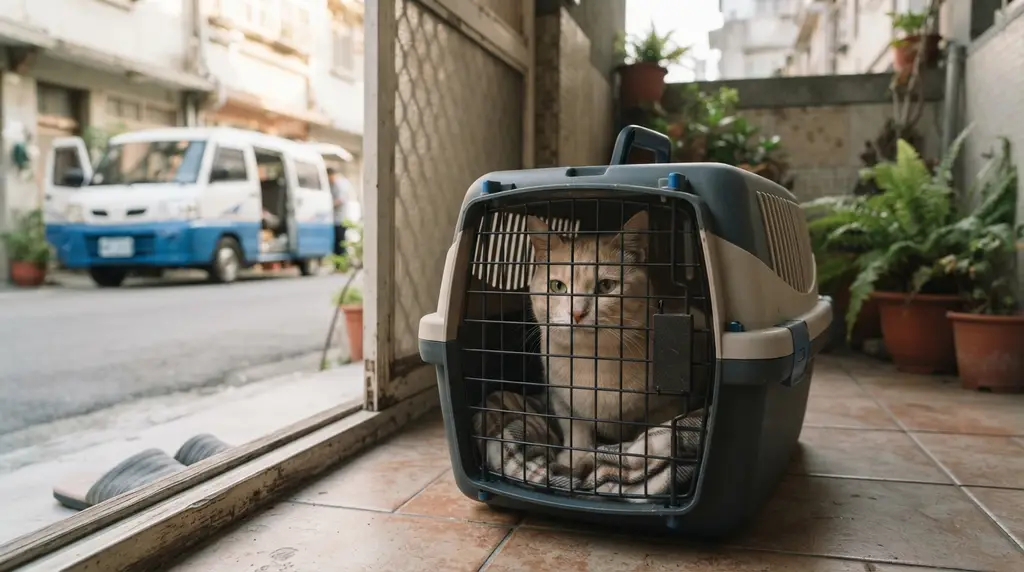
- Keep your cat in the carrier at all times. Do not open the carrier in an unfamiliar environment.
- Maintain room temperature between 22-26°C. Car interiors heat up extremely quickly in summer. Never leave your cat alone in the car, even for a short while.
- Try to keep one-way travel under 30 minutes. Partially cover the carrier with a towel to reduce visual stimulation; this can help calm the cat.
- Watch for signs of heatstroke such as panting, drooling, or fully dilated pupils. If necessary, follow the Cat Heatstroke First Aid Steps for immediate treatment.
After Returning Home
Upon returning home, let your cat settle in on their own. Don't rush to play with them. Provide fresh water and monitor their eating and elimination habits. After a long or stressful outing, some cats may experience digestive sensitivity. Consider offering easily digestible food and, if necessary, specialized probiotics to help stabilize their gut.
If you have just brought a new cat home and they are still adjusting, it's crucial to establish their environment in the first few days. We have compiled guidance on How to Care for a New Cat in Their First Week, which is highly recommended reading.
For Multi-Day Absences, a Cat Hotel is Safer Than Constant Travel
Many owners ask, "Can I leave my cat at a cat cafe for a few days while I'm abroad?" The answer is no – cat cafes do not offer boarding, and cats should not be kept in high-stress environments for extended periods.
The real solution is to find a well-managed cat hotel:
- Private rooms where cats cannot see each other, reducing territorial stress.
- Confirm vaccination records before check-in, a basic requirement to protect all guests.
- Bring familiar scents: Pack an item of clothing with your scent, along with their usual bowls and litter box; this can significantly help stabilize your cat.
If you are in the Taipei or New Taipei City area and need short-term accommodation, you can directly refer to our Boarding Services, where we will arrange private rooms and routines based on your cat's personality. If you also need to bathe or trim your cat's nails before your trip, you can book grooming services at the same time.
Frequently Asked Questions
Can I bring my own cat to a cat cafe?
In most cases, no. Unfamiliar cats can trigger territorial conflicts with resident cats and pose a risk of cross-contamination of diseases, which is why most cat cafes explicitly prohibit outside cats. If you want to interact with cats, visit and pet the resident cats; if you need to board your cat, look for a cat hotel.
Do cats at cat cafes experience stress?
Well-managed establishments provide cats with high perches, private resting areas, and scheduled breaks, allowing stress levels to be kept within a reasonable range. However, if resident cats are constantly pursued and have no place to retreat, it indicates a clear welfare issue, and such establishments should not be supported.
Is it mandatory to use a carrier when taking a cat out?
Yes. Keeping your cat in a carrier at all times is the safest and most secure option for them. Carrying a cat or using a harness in an unfamiliar environment poses a high risk, as a startled cat could easily escape.
Is it better to take my cat with me or find a cat hotel when traveling for an extended period?
Unless it's a necessary move like relocating, finding a cat hotel is generally more considerate for the cat. Cats dislike travel and unfamiliar environments. Keeping them in a hotel with a regular routine and a private room is much more stable than taking them everywhere.
What should I do if my cat pants or has its tongue out in an unfamiliar environment?
Cats rarely pant. When they do, it usually indicates excessive stress or overheating. First, remove the cat from the source of stimulation and move them to a cool, quiet place. Ensure good ventilation and cooling. If panting continues, is accompanied by drooling, or the cat collapses, seek veterinary attention immediately.
This article was written by the Cat Backyard editorial team. The care advice provided is general experience sharing. If your cat exhibits persistent or severe abnormal symptoms, please seek prompt veterinary care from a professional veterinarian for diagnosis.
CatGarden offers curated supplies, cat boarding, and grooming
Book services or shop online.