What to Do If Your Cat's Nail Bleeds After Trimming? How to Use Styptic Powder, 3 Home First-Aid Steps, and Prevention Guide
When a cat's nail bleeds after trimming, the most effective action is "apply pressure for 2-5 minutes + use styptic powder," with most wounds stopping within 5 minutes. This article teaches you 3 home first-aid steps, how to use styptic powder and its alternatives, how to identify the quick, and how to trim without cutting into the flesh.
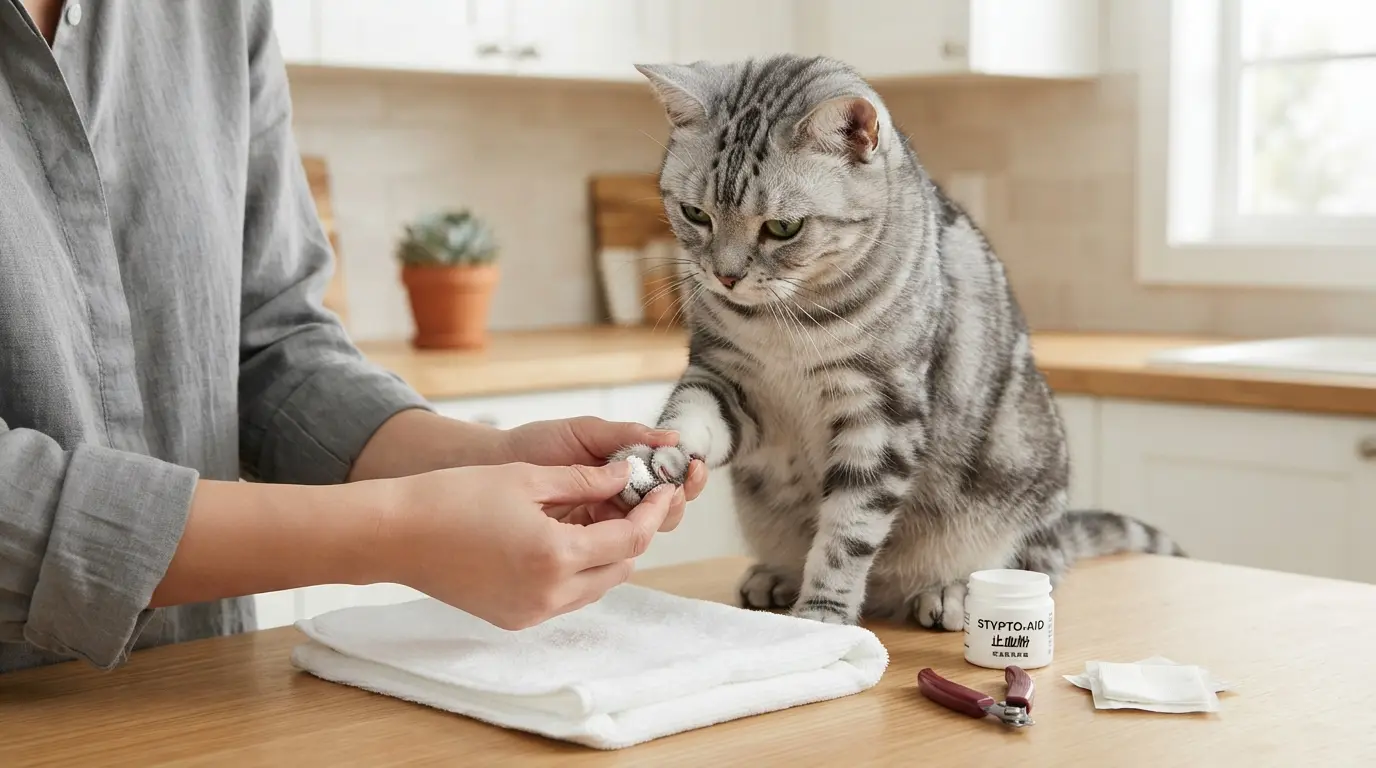
When a cat's nail bleeds after trimming, the most effective treatment is "apply direct pressure with a clean gauze pad for 2-5 minutes, then apply styptic powder for 30 seconds." The vast majority of quick bleeds will stop within 5 minutes, and there's no need to rush to the emergency vet. What you should truly worry about isn't that single drop of blood, but rather uncontrollable bleeding (lasting over 10-15 minutes), the entire nail breaking off, or signs of redness, swelling, and pus developing over the next two to three days – these are the situations that require a vet visit.
At our salon, we trim hundreds of cat nails every month and frequently have owners rush in saying, "I cut my cat's nail and it's bleeding, what do I do?" This article will share our frontline approach, explaining first aid, how to use styptic powder, how to read the quick, and prevention all in one place.
Key Takeaways
- The most effective first step when a cat's nail bleeds is to "apply continuous pressure for 2-5 minutes without repeatedly checking." Constantly lifting to check is the most common reason for failed hemostasis.
- The correct way to use styptic powder (containing aluminum sulfate or ferric chloride) is to "pour it into a clean small dish and press the nail tip into the powder for 30 seconds to 1 minute," not to sprinkle it onto the bleeding nail.
- When you don't have styptic powder at home, tapioca starch, cornstarch, and flour are the most practical alternatives; in an emergency, you can also lightly press with a dry bar of soap. Do not use alcohol, hydrogen peroxide, talc-based baby powder, or super glue.
- If bleeding continues for more than 10-15 minutes, the blood is spurting, the entire nail breaks off, or the cat is clearly limping and reluctant to put weight on its paw, seek veterinary attention immediately.
- For 24-48 hours after a nail trim bleed, it's recommended to temporarily switch to a low-dust cat litter and keep the litter box clean, which can significantly reduce the risk of wound infection.
First, Understand: You're Cutting the "Quick," Not Bone
A cat's nail is a semi-transparent, hooked structure. The pink triangular area near the base of the toe is called the "quick" (where blood vessels and nerves are concentrated). Cutting the quick will cause bleeding and pain; the cat will pull its paw away and might even bite you. However, it is not bone or tendon. The wound from cutting the quick is essentially just a small cross-section of a blood vessel.
This is why, in most cases, the bleeding stops with sufficient pressure: the blood vessels in the quick are very fine, and for a cat with normal blood clotting, it will stop within 5 minutes. Owners' panic often makes the situation seem worse than the wound itself – rushing around, constantly checking, chasing the cat – which actually prolongs the bleeding (a cat's blood pressure rises when stressed, making bleeding more pronounced).
> Salon Observation: For cats whose quick is cut, the pain usually subsides significantly within 1-3 minutes. If the cat continues to hold its paw up or cries out when touched after 10 minutes, consider if you also cut into the paw pad or interdigital skin.
Cat Nail Bleeding Treatment: 3 Home First-Aid Steps
Step 1: Secure the Cat, Then Treat the Wound (Within 30 Seconds)
As soon as blood appears, the first thing to do isn't to find styptic powder, but to prevent the cat from running away. If it runs, blood will be tracked all over the house, and you'll lose the opportunity to treat it.
- Gently wrap the cat's body and the other three paws with a large bath towel, exposing only the injured paw (this is called the "sushi roll" restraint).
- It's ideal to have one person holding the cat and another treating the wound; if you're alone, you can tuck the cat under your arm, with its back against your chest.
- Use a clean gauze pad, cotton ball, or tissue to apply direct pressure to the cut surface of the nail tip. Apply pressure as you would for a nosebleed; no need to forcefully squeeze the toe.
- Apply pressure continuously for 2-5 minutes, do not lift to check in between. Each time you lift, you're essentially starting over.
If the cat becomes agitated and prone to biting, especially if it's already in a biting mood, refer to the gripping and redirection principles in What to Do If Your Cat Bites People? Corrective Training for Kittens Biting Hands/Feet, Teething Biting, and Sudden Aggression to avoid injuring yourselves.
Step 2: Apply Styptic Powder (or Alternative)
After applying pressure for 2-5 minutes, release. If there's still oozing, proceed to the second round: pour styptic powder into a small dish or bottle cap to a depth of about 1 cm. Press the cat's nail tip entirely into the powder and hold for 30 seconds to 1 minute, allowing the powder to form a crust on the cut surface.
The key is "pressure," not "sprinkling." The powder only aids clotting; the actual hemostasis comes from the pressure. If you sprinkle it on and immediately release, the powder will be washed away by the blood, making it seem ineffective.
Step 3: Isolate and Observe for 20 Minutes + Manage the Environment
After stopping the bleeding, place the cat in a quiet room with easy-to-clean flooring (bathroom, balcony, or a carrier). Do not let it immediately jump around or step into the litter box.
- Observe for the first 20 minutes: Does the scab get dislodged after a few steps? Are there new blood spots on the floor?
- For the first 24-48 hours: Avoid bathing, soaking, or letting the cat excessively lick the paw (if licking is persistent, distract with a toy or treat).
- Keep the litter box clean and temporarily switch to a low-dust litter. At our salon, after treating nail bleeds, we switch to a fine-grained, low-dust Ultra-Fine Tofu Litter 3.0 for a day or two. It's less likely to get into the fresh cut than mineral litter.
How to Choose and Use Styptic Powder for Cat Nail Bleeding?
Common Ingredients and Differences
| Type | Common Ingredients | User Experience |
|---|---|---|
| Pet-Specific Styptic Powder | Aluminum Sulfate, Benzocaine | Stops bleeding quickly, less stinging; highly recommended to keep on hand |
| Styptic Stick/Pencil | Ferric Chloride, Potassium Aluminum Sulfate | Strong effect but noticeably stings; most cats will resist intensely |
| Styptic Gel | Chitosan-based | Non-dusty, easy to apply precisely, higher price |
For owners who regularly trim their cat's nails, I recommend buying a small jar of pet-specific styptic powder and keeping it next to the nail clippers. It costs less than $10 and is worth it after just one use. Store it in a dry place after opening; it typically lasts for several years.
4 Alternatives When You Don't Have Styptic Powder
1. Tapioca Starch/Cornstarch/Flour: Commonly found in kitchens, these work just as well as styptic powder. The method is identical: pour into a dish and press the nail tip into it for 1 minute.
2. Dry Bar of Soap: Press the nail tip onto the surface of the soap and twist slightly to create a physical seal. This is useful for late-night emergencies when you can't find powder.
3. Tea Bag (Dry or Slightly Dampened and Squeezed): The tannins in tea have astringent properties. Press onto the cut surface for 2-3 minutes.
4. Plain Vaseline + Gauze Pressure: This doesn't speed up clotting but can prevent the scab from being dislodged.
What NOT to Use
- Alcohol, Hydrogen Peroxide: Highly irritating, damages new tissue, and will cause the cat to panic and thrash.
- Baby Powder (Talc-Based): Not recommended for open wounds, and cats may inhale it.
- Super Glue/Cyanoacrylate: Some people online suggest this, but the risk of chemical burns and sealing in infection is too high. We absolutely do not recommend it.
- Human Topical Ointments: Some ingredients (like corticosteroids or salicylates) are unsafe for cats. Do not apply them yourself.
- Undiluted Povidone-Iodine: If disinfection is needed, use iodine diluted to a light tea color to gently wipe around the wound, but do not pour it directly.
How to See the Quick? Including Tips for Dark Nails
Light-Colored Nails: Leave a 2mm Safety Margin
Hold the cat's paw up to the light (a phone flashlight shone from behind the nail is clearest). You'll see a pink triangle inside the nail. The cutting point should be 2mm outward from the tip of the pink area, meaning you only trim the very tip of the hook. The rule is always: "Better to trim too little and do it again in two weeks."
Dark/Black Nails: Trim in Small, Incremental Cuts
You can't see the quick in black nails, which is why they are the most common group to accidentally cut. Our method is:
- Trim only 1mm at a time, then examine the cut surface. A completely white cut surface means it's safe; if a small grayish-white dot appears (sometimes slightly pink, like a sesame seed), you're close to the quick, so stop immediately.
- You can also use the "paw pad reference": From the side, the curved hook of the nail is usually in line with the front edge of the paw pad. Trimming only the tip below the hook is almost foolproof.
- Older cats' nails can become thicker, drier, and more curved, with the quick extending further forward. Trimming should be even more conservative.
Cats Prone to Accidental Cuts
- Cats that haven't had their nails trimmed in a long time, with nails that have grown into large hooks (the quick has also grown longer).
- Senior cats, long-haired or heavily-furred cats (interdigital fur obstructs vision).
- Cats that struggle violently and require forceful restraint – a moment's distraction can lead to cutting in the wrong place.
- Trying to trim all 18 nails in one session. At our salon, we trim 4-6 nails at a time, and stop if the cat becomes tense. It's perfectly fine to complete the task over two days.
When to See a Vet?
If any of the following occur, stop trying to handle it yourself:
- Bleeding continues for more than 10-15 minutes after applying pressure and styptic powder, or the blood is spurting rhythmically.
- The nail breaks off entirely, lifts up, or is pulled from the root (common if the nail gets caught on window screens or scratching posts). These wounds are painful and prone to infection.
- You cut not just the nail, but also caused a visible tear in the paw pad or interdigital skin.
- Within 24-72 hours, the wound shows redness, swelling, heat, pus, or has a foul odor, or the cat continuously licks the area, limps, and refuses to put weight on its paw.
- The cat has blood clotting disorders, is on related medication, or has liver disease – these cats may have difficulty stopping even minor bleeding, and you should consult a vet after the first bleed.
If symptoms persist or worsen, rely on veterinary diagnosis. Home treatment is only for "minor cut surface bleeding," not for infections or bone issues.
How to Prevent Cutting Too Deep? 7 Practical Details
1. Maintain a Regular Schedule: For indoor cats, it's recommended to trim every 2-4 weeks. Shorter nails mean the quick recedes, making it harder to cut. If you wait two to three months between trims, there's almost always a risk.
2. Use the Right Tools: Use cat-specific small scissor-style or guillotine clippers with sharp blades. Dull clippers will "crush" the nail, which can still lead to bleeding if the quick is involved; never use human nail clippers on thick cat nails.
3. Choose the Right Timing: The best times are when the cat is relaxed and sleepy after a meal, or tired after playing. Avoid times when they've just come home, just bathed, or are on alert.
4. Positioning: Have the cat face away from you, sitting on your lap or a table. Gently press the toe pad to extend the nail. Trim the blade "up and down vertically" relative to the nail, not horizontally (horizontal cuts can cause splitting).
5. Complete in Stages: Trim 4-6 nails at a time. If the tail starts twitching or ears go back, stop. Leaving a positive impression ("nail trimming isn't scary") is more important than finishing in one go.
6. Trim Front and Back Paws Separately: Back paw nails are thicker, harder, and cats are often more sensitive. You can trim them on a different day.
7. Keep a First-Aid Kit Ready: Styptic powder, gauze, and a clean towel in one box, kept with the nail clippers. In case of bleeding, having these items within 30 seconds makes a huge difference.
Nail trimming isn't an isolated task; it's integrated with bathing, ear cleaning, and brushing. For a complete home grooming schedule, see this comprehensive guide: How Often Should Cats Be Bathed? Timing for Nail Trims, Ear Cleaning, and Professional Grooming. Brushing frequency during shedding season also affects matting and nail observation difficulty. You can also refer to How to Care for Your Cat During Autumn Shedding? Brushing Frequency, Hairball Prevention, and Skin Allergy Care for Fall.
What If My Cat Won't Let Me Touch Its Paws After Bleeding Once?
This is the most common follow-up question we receive. Cats have strong memories and associate pain. A single painful experience can make them avoid having their paws touched for three months. Rebuilding trust involves "desensitization":
- Week 1: Only touch the paws, don't bring out the clippers. Immediately give a small lick of lickable treat after touching.
- Week 2: Let the cat smell the nail clippers, then touch the paws, still giving treats. Do not trim at all.
- Week 3: Trim just one nail and finish. Praise them enthusiastically. Gradually increase from there.
If the cat has reached the stage of "hiding at the sight of clippers" or "biting," forcing it will only create a vicious cycle. It's often faster and safer to have experienced groomers handle these cats. During our gentle restraint grooming sessions, we typically finish with one cat in 3-5 minutes, without force or sedation, while also checking for paw pad dryness, interdigital mats, and nail bed inflammation. If you're also looking to address bathing and paw grooming, you can check How Much Does a Cat Bath Cost? Pricing for Short/Long Hair, Extra Services, and Regional Fee Traps for price estimates, or Book a Grooming Appointment directly. Many owners opt for regular nail trims every two to three weeks, which provides more peace of mind than buying styptic powder.
Frequently Asked Questions
Will a cat's nail bleed after trimming heal on its own?
Mostly, yes. For cats with normal blood clotting, the quick's cut surface will stop bleeding after 2-5 minutes of pressure, forming a scab in 1-2 days and healing flat in about a week. However, if bleeding doesn't stop after 10-15 minutes, or if the entire nail breaks off, seek veterinary attention.
If I don't have styptic powder, can I use flour or tapioca starch?
Yes, these are the most practical alternatives. Pour tapioca starch, cornstarch, or flour into a small dish and press the nail tip into the powder, holding for 30 seconds to 1 minute. Do not use talc-based baby powder, and absolutely do not use super glue.
How long after cutting a nail and causing bleeding can I trim again?
It's recommended to wait at least 2 weeks, allowing the wound to heal completely and the cat to no longer be sensitive to paw handling. In the meantime, you can practice desensitization exercises like "just touching the paw and giving a treat." Rebuilding trust is more important than rushing the next trim.
My cat keeps licking its nail after it bled. Will it get infected?
Brief licking usually won't cause infection, but persistent licking can dislodge the scab and increase the chance of bacteria entering. For the first 48 hours, try to distract the cat and keep the litter box clean. If redness, pus, heat, or limping occurs, see a vet.
How can I trim the nails of a cat with dark nails without cutting into the quick?
Use the "trim in small, incremental cuts" method: trim only 1mm at a time and observe the cut surface. A pure white surface is safe; if a grayish-white or slightly pink small dot appears, you're close to the quick, so stop immediately. Trimming only the tip of the hook from the side is the most conservative and safest approach.
Cutting the quick is something almost every cat owner will experience. It doesn't mean you're an unqualified owner – what's important is having styptic powder on hand, knowing how long to apply pressure, and trimming a little shorter next time. If you're truly unsure, entrusting this small task to professional hands will make things much easier for both your cat and your fingers.
This article is written by the CatGarden editorial team and is based on home care experience. It cannot replace veterinary diagnosis. If your cat's bleeding is uncontrollable or the wound worsens, please seek veterinary care promptly.
CatGarden offers curated supplies, cat boarding, and grooming
Book services or shop online.